Albert I of Saxony
Albert I of Saxony was a Saxon king of the House of Wettin who reigned from 1873 to 1902 and belonged among the prominent personalities of the late 19th century within the German Empire. He is also important for numismatics in that during his rule the country's administration was modernised and there were significant changes in the organisation of Saxon c…
Albert I of Saxony was born in 1828 in Dresden as the eldest son of John of Saxony. From his youth he was trained for military and state service, which corresponded to the tradition of the Saxon court and to the position of the kingdom within the German space of the time. In the 19th century Saxony was not an isolated "small state" but an economically strong country, which had constantly to balance its own interests between the ambitions of the great powers, chiefly Prussia and Austria. Albert's career was therefore shaped at first mainly in the army, where he gradually gained experience of command as well as of the administration of the military apparatus.
His military activity had a marked effect on the public image of the sovereign. At the time of the Austro-Prussian conflict of 1866 Saxony found itself on the side of Austria, which brought the country into a serious political dilemma and, after defeat, the necessity of adapting to new conditions. As commander of the Saxon units, Albert became one of the faces of this epoch, even though it was Prussian policy that ultimately had the decisive say in the arrangement of Germany. In the following years Saxony was gradually incorporated into the Prussian framework of power and, after the foundation of the German Empire in 1871, was already a firm part of it.
Albert ascended the throne on the death of his father in 1873. In domestic policy his reign was marked by a rather moderate, representative style: the sovereign did not present himself as an aggressive reformer but supported the modernisation of state administration, social welfare and the stable functioning of the country within the imperial structures. At this time Saxony was being transformed into an ever more pronounced parliamentary monarchy, in which the role of the bureaucracy, of the diet and of party politics was growing. Albert's long reign thus falls into the period in which monarchical authority gradually "becomes accustomed" to modern politics and rests more and more on procedures and institutions.
A prominent theme of the second half of the 19th century was also the social impact of industrialisation. Saxony belonged among the industrially most advanced areas of Germany, and so questions of poor relief, working conditions and taxation took on concrete urgency here. Under Albert's rule adjustments to administrative structures and reforms designed to make the collection and distribution of public funds more efficient took place. From today's perspective it is important that precisely a stable state administration and a predictable fiscal policy created the environment in which a modern monetary circulation based on the imperial currency could function.
History
Alongside politics and the army, the court and charitable side belong to Albert's life as well. His wife was Carola of Saxony, who was involved in charitable work and healthcare. Such activities were not just a "private hobby" but formed part of the public role of the monarchy: they reinforced the image of the royal house as the protector of its inhabitants and at the same time supported institutions that the state was only just shaping into modern form. The marriage remained without offspring, and after Albert's death in 1902 his brother George of Saxony succeeded to the throne.
Albert's reign closed on the threshold of the 20th century, at a time when new conflicts were already taking shape in Europe and when monarchies were becoming more and more a part of mass politics. The Kingdom of Saxony preserved its own court tradition and identity until 1918, while at the same time being firmly set within the German imperial framework. It is precisely this dual perspective — regional distinctiveness and imperial integration — that is the key to understanding his age and to interpreting the monuments preserved from it, including coins.
Albert I of Saxony reigned at a time when a unified imperial currency of the mark system had taken hold across Germany. The Kingdom of Saxony at the same time retained its own state symbolism and tradition, which was reflected in the appearance of the coins. For the collector Albert's era is therefore interesting because it combines a uniform monetary environment with a regional "signature" of individual lands — in inscriptions, emblems and references to the sovereign.
From the numismatic point of view the organisation of coin production is also important. Under Albert's rule the Saxon state mint was moved from Dresden to Muldenhütten (1887), which reflects the trend of modernisation and the industrial background: coinage relied more and more on technical facilities, more precise machinery and efficient logistics. For the collector this means that coins from this period generally show a more uniform and higher-quality strike than older, more hand-made production; at the same time, however, the topic of variants, mintages and years of issue opens up, which with some types can be sensitive to demand.
Coinage under Albert I and the collector context
In practice the coins of Albert's day are collected in several ways. One path follows the sovereigns and their portraits or titulature, another focuses on denominations and years of issue, and another on the development of emblems and regional motifs. With coins from the end of the 19th century, grade of preservation also plays a role: strikes have often survived in decent condition, so the differences between an "ordinary circulating piece" and a finely preserved specimen can be marked in value. The naturalness of the surface is also important — unskilled cleaning is readily detectable on these coins and is undesirable for collectors.
Albert I is therefore regarded in numismatics not only as a historical figure but also as a "chronological anchor" for collections of Saxon and imperial strikes: his long reign offers a clear framework for studying the transition from traditional monarchical representation to the modern, industrially produced coin in the setting of a unified currency.
In our auction and shop
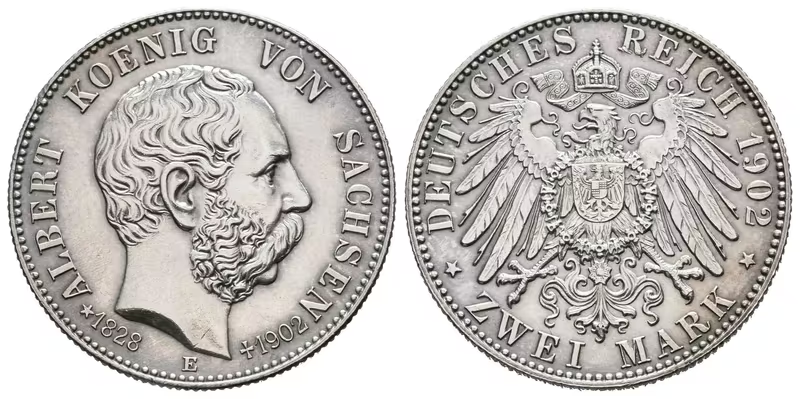
- Code: NBSAS-CZ1902V
Sasko, 2 Marka 1902 - Pamětní
Sasko (Sachsen), Albert I. ( 1873-1902 ) 2 Mark 1902 E - Na památku úmrtí, Muldenhütten, KM.1255, J.127, krásná zachovalost, tmavá patina, zbytky lesku, nep. rysky
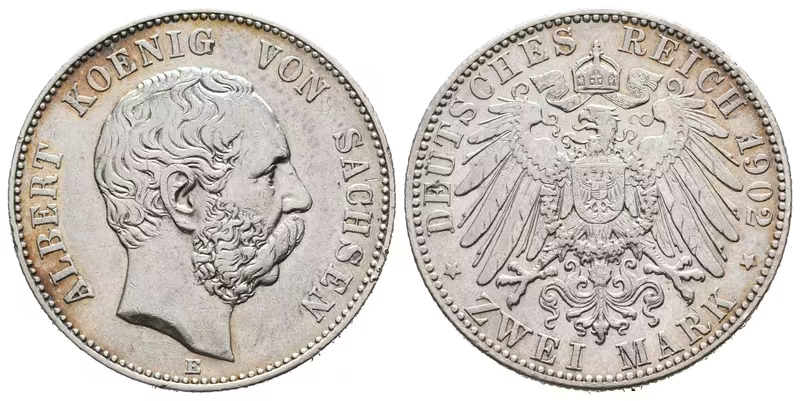
Skladem 1 ks - Code: NBSAS-CZ1902.1
Sasko, 2 Marka 1902
Sasko (Sachsen), Albert I. ( 1873-1902 ) 2 Mark 1902 E, Muldenhütten, KM.1245, J.124, pěkná zachovalost, patina, zbytky lesku, rysky a drobné hranky
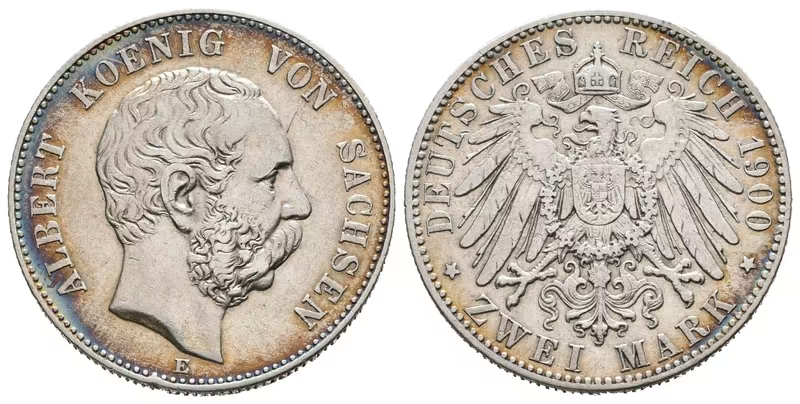
Skladem 1 ks - Code: NBSAS-CZ1900.1
Sasko, 2 Marka 1900
Sasko (Sachsen), Albert I. ( 1873-1902 ) 2 Mark 1900 E, Muldenhütten, KM.1245, J.124, pěkná zachovalost, patina, rysky a drobné hranky
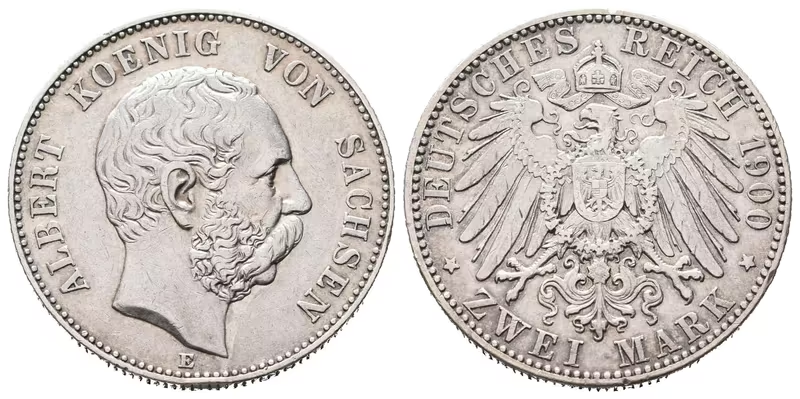
Skladem 1 ks - Code: NBSAS-CZ1900
Sasko, 2 Marka 1900 E
Sasko, Albert I., ( 1873-1902 ) 2 Marka 1900 E, J.124, patina, zbytky lesku, drobné rysky a hranky
Skladem 1 ks