Alexander I Karađorđević
Alexander I Karađorđević was King of the Serbs, Croats and Slovenes and later King of Yugoslavia, who reigned from 1921 to 1934. His era is associated with the attempt to hold a multinational state together, with the centralisation of power and also with coins and banknotes on which the transition from the "SHS" monarchy to the name Yugoslavia was gradual…
Alexander I Karađorđević (1888–1934) came from the Karađorđević dynasty, which had played a fundamental role in Serbian history already from the 19th century. In the period of the First World War he belonged among the most prominent representatives of Serbian statehood, and after its end he became one of the key personalities of the newly established state of Serbs, Croats and Slovenes. This state arose as an effort to unite the South Slavic nations into a common political framework, but already from the outset there existed within it a tension between the idea of a centralised monarchy and the demands of individual lands and national groups for greater autonomy.
After the death of King Peter I, Alexander ascended the throne as king in 1921. The basic problem of his rule was both political and practical: how to govern a state that differed in language, religion, historical experience and economic level of its individual parts. Political disputes gradually grew sharper and the parliamentary system struggled with frequent crises. Alexander therefore increasingly leaned towards the idea of a strong centre that could stabilise the state, even at the cost of restricting political competition.
The peak of this development came in 1929, when the king introduced an authoritarian regime and renamed the state Yugoslavia. He thereby symbolically emphasised a single "Yugoslav" identity above individual national programmes; in practical terms, however, it also meant an effort to govern the country from above and to weaken political forces that questioned centralisation. This period is referred to as the "6 January regime" and is associated with the restriction of parliamentary politics, the strengthening of state administration and of the security apparatus.
History
Alexander also sought international backing for Yugoslavia in inter-war Europe and tried to stabilise the country's position in a region where the interests of several states met. Even so, his rule was over the long term burdened by internal tension and the radicalisation of part of the opposition. In 1934 Alexander was assassinated during a state visit in Marseille, France, which became one of the best-known political assassinations of inter-war Europe. His death meant not only the end of personal rule but also a further weakening of the stability of the state, which continued to struggle with the national question and political polarisation.
Alexander I Karađorđević is recalled in numismatics chiefly as the sovereign under whom the monetary image of the state was unified and subsequently reshaped. In the first years after the foundation of the Kingdom of SHS it was a period of seeking balance: it was necessary to stabilise the monetary system, to unify circulation and to create coins and banknotes that would be comprehensible and accepted across the entire state. It is precisely coins and paper money that in such situations function as "visible statehood" — everyone holds them in hand and everyone reads on them who is the guarantor of value.
A prominent role is played by the change of the state's name to Yugoslavia in 1929, which was naturally reflected in inscriptions, emblems and symbolism on legal tender. For collectors this is important, because transitional years of issue and types often capture the period when a political change "tips over" into everyday circulation. With coins of the inter-war period it is moreover interesting to follow the material and the denominations: small circulation coin tends to be susceptible to wear, while higher values are sometimes preserved in better condition, or commemorative or representative pieces also exist.
Coins and banknotes under Alexander I
In collecting coins and banknotes associated with Alexander I, the grade of preservation and the legibility of details are decisive. With coins, a surface free from harsh cleaning is key; with banknotes, paper without marked folds and damage. Pieces in which the historical context is evident also have great value: for example a clearly identifiable type from the period of the Kingdom of SHS as opposed to issues that already bear the Yugoslav designation. Such a comparison can show well within a single collection how quickly a political decision is transformed into the money people use every day.
In our auction and shop
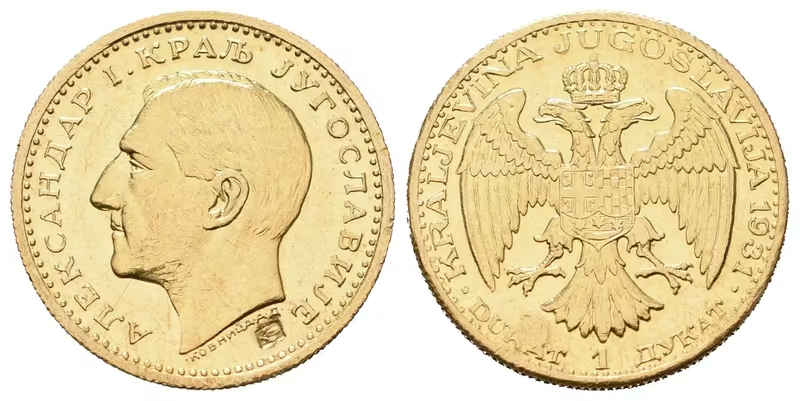
- Code: ZSJUG-90C1931
Jugoslávie, Dukát 1931 s kontramarkou
Jugoslávie, Alexandr I. (1921 - 1934) Dukát 1931 s kontramarkou "klas", KM.12.2, nádherná zachovalost Au 0,986, 20 mm (3,48 g)
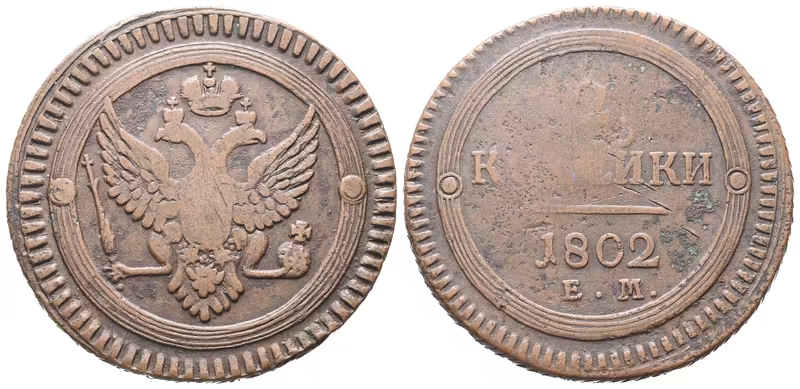
Skladem 1 ks - Code: SRUS86-E1802
Rusko, 2 Kopějka 1802 EM
Rusko, Alexander I., 1801 - 1825 2 Kopějka 1802 EM, Jekaterinburg, Bitkin2.307, Uzd.3006, patina, rysky
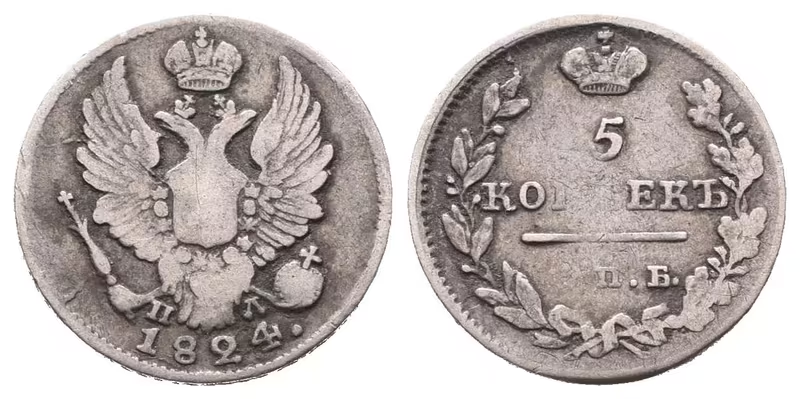
Skladem 1 ks - Code: SRUS86-F1824
Rusko, 5 Kopějka 1824 SPB
Rusko, Alexander I., 1801 - 1825 5 Kopějka 1824 SPB-PD, St. Peterburg, Bitkin2.280, Uzd.1487, patina, oběhový stav
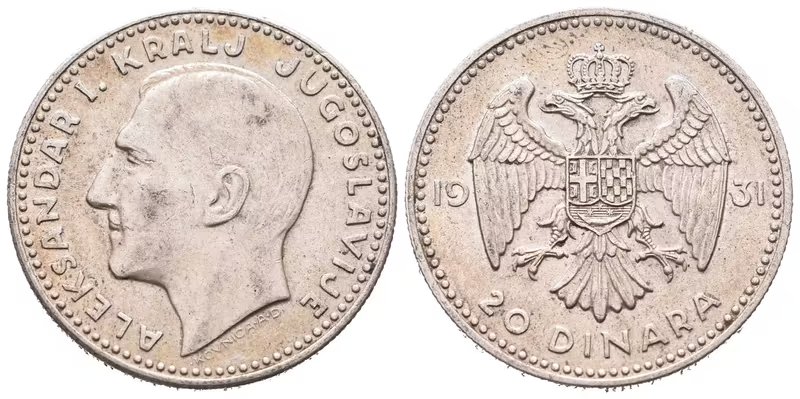
Skladem 1 ks - Code: SJUG98-B1931
Jugoslávie, 20 Dinar 1931
Království Jugoslávie, Alexander I. (1921 - 1934) 20 Dinara 1931, KM.11, zbytky lesku, patina, rysky
Skladem 1 ks