Anastasius I
Anastasius I was a Byzantine emperor (491–518) who stabilised the empire's finances and became famous above all for his great monetary reform. He introduced a clearer system of bronze denominations led by the follis, thanks to which both everyday monetary circulation and the collection of taxes improved.
Anastasius I (also called "Dicorus") ascended the throne in 491 after the death of Emperor Zeno at a time when the eastern part of the Roman Empire had avoided the complete collapse of the West but still faced a number of problems. Constantinople was the centre of power, but the empire had to maintain a costly army, defend long borders and at the same time deal with internal disputes, especially the religious tensions that returned in various forms after the Council of Chalcedon. Anastasius came to the head of state as an experienced official — and emphasis on administration, order and finance became one of the defining features of his reign.
From the very beginning he had to cope with internal political uncertainty. The succession was not self-evident and part of the elites and the army were not satisfied with him. An important role in legitimising his rule was played by the empress Ariadne, widow of Zeno, who married Anastasius and thereby gave him dynastic support. Even so, unrest arose against him and the court had to combine diplomacy, repressive steps and thoughtful personnel policy. At the same time it was necessary to maintain stable relations with powerful neighbours, above all with Sasanian Persia, and to defend the Balkans against incursions that represented in this period a long-term pressure on the Byzantine provinces.
A distinct chapter of Anastasius's reign were the religious disputes. The emperor tried to manoeuvre between individual currents and to seek a solution that would maintain the unity of the empire while at the same time satisfying key groups. He did not manage this without conflicts: questions of orthodoxy and ecclesiastical authority had direct political consequences and were capable of dividing cities and the army. In this atmosphere it was essential for the emperor to have sufficient resources and a functioning administration — because the state apparatus was what held a multi-national and multi-confessional empire together.
Anastasius, however, is most often remembered as a ruler who managed to put state finances in order. In late antiquity it was common for the population to struggle with non-transparent small currency and with fluctuating quality of certain denominations. At the same time the state needed a reliable system for collecting taxes and making payments, in the capital as well as in the provinces. When monetary circulation becomes complicated, the scope for speculation, price increases and abuse in conversions grows — and precisely this is felt most painfully by ordinary people who pay in small amounts on the market.
History
For this reason Anastasius undertook reforms which had a practical impact on everyday economy. It was not just about "great politics", but about ensuring that money in people's hands made sense and that the state could work more precisely with income and expenditure. In this connection his reign is often evaluated as a period when Byzantium drew breath towards financial stability that his successors could also benefit from. It is traditionally said that a considerable reserve remained in the treasury after Anastasius, which is exceptionally remarkable in the context of the costly defence and administrative expenditure of late antiquity.
Anastasius died in 518 and Justin I ascended the throne, opening the way to the later era of Justinian I. From a historical perspective Anastasius's reign is one of the key bridges between the late Roman world and "classical" Byzantium of the 6th century: under his leadership the empire did not rely only on the army but also on a firmer financial foundation and a more effective administration, which is clearly reflected in the coins, which have survived in enormous numbers.
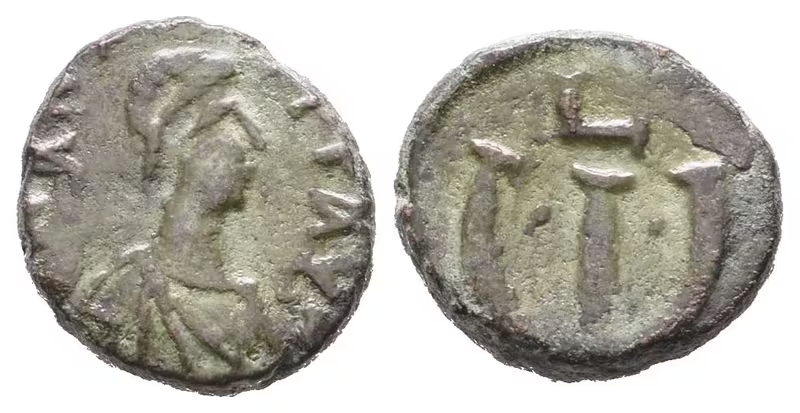
Anastasius I is fundamental for numismatics because of his reform of the bronze coinage, which created a clearer system of denominations expressed in units of nummi. The best-known result is the large bronze coin the follis (40 nummi), which is distinguished by a marked indication of value on the reverse — typically the large letter "M". Alongside it there were also smaller denominations, for example 20 nummi (often with the mark "K"), 10 nummi ("I") and 5 nummi ("E"). For everyday trade this meant a fundamental simplification: people could more easily count, compare prices and pay without complex conversions and without an excessive quantity of small coins.
The reform was reflected in the organisation of mints as well. On Byzantine bronzes of this period mint marks and sometimes other control elements often appear, which today help to determine the origin of strikes more precisely. This is exceptionally valuable for collectors: the same type may exist in a number of variants according to mint, lettering style and small marks. The basic guide is therefore the legibility of the reverse indication of value, the marks and the inscriptions, because these determine the correct identification.
Monetary reform and the coinage of Anastasius I
Alongside bronze, gold also remained important, particularly the solidus, which was key for the Byzantine state in international trade, diplomacy and military payments. For the ordinary person, however, the most tangible was the new bronze system: small coins were used daily and their comprehensibility affects how smoothly the market functions. This is also why Anastasius's bronzes are today one of the best "textbook" materials for understanding how monetary policy can change everyday economy.
For collector evaluation the state of the surface and legibility are important. Bronzes from late antiquity often carry patina and may have traces of corrosion; harsh cleaning is usually easy to recognise and is damaging to collector value. For folisses and related denominations it pays to follow whether the value (e.g. "M") is clearly legible and whether the mint marks are visible. Precisely thanks to the quantity of surviving pieces, the period of Anastasius I can be collected systematically: by denomination, mint and stylistic variant, while at the same time it provides a firm historical framework that links the history of the state with the development of coinage.
In our auction and shop
- Code: BF001-0029
Anastasius I., pentanummium, Konstantinopol, Sear 29
Anastasius I. (491-518) mincovna Konstantinopol, císař doprava / nominál, Sear 29
Skladem 1 ks - Code: XA-2005
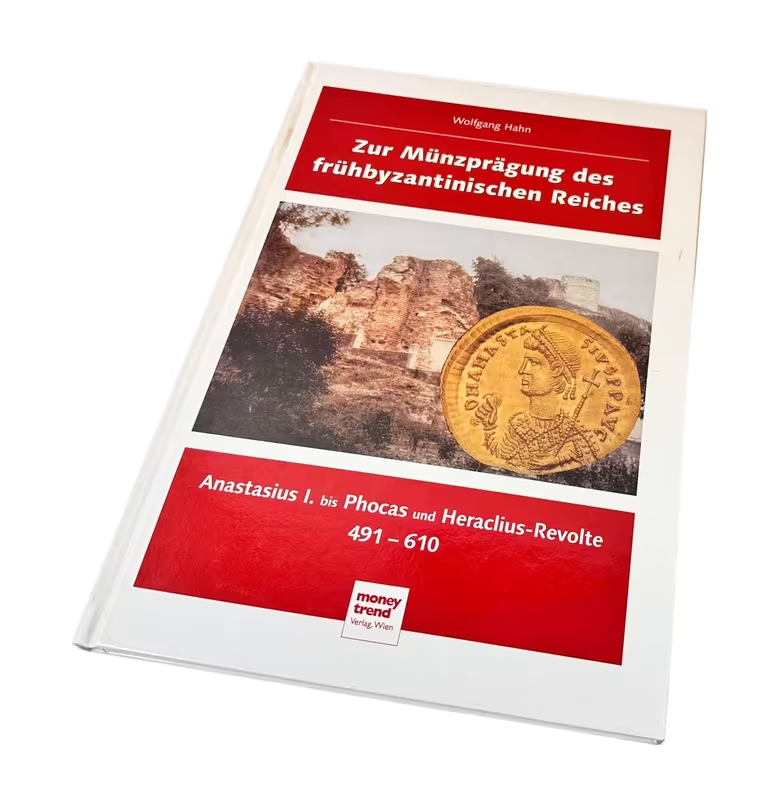
Zur Münzprägung des frühbyzantinischen Reiches
Zur Münzprägung des frühbyzantinischen Reiches, Anastasius I bis Phocas und Heraclius-Revolte 491 - 610 Wolfgang Hahn Anastasius I. bis Phocas und Heraclius - Revolte 491 - 610 Wien 2005, 222 stran, vázané