Apostle Peter
The Apostle Peter (Saint Peter) belongs among the most important figures of early Christianity and tradition regards him as the leader of the twelve apostles. He is associated with the rise of the Christian community in Rome and in Catholic tradition is perceived as the first bishop of Rome, that is the symbolic foundation of the papacy.
The Apostle Peter was according to New Testament tradition originally named Simon and came from a fishing background in Galilee. He belonged to Jesus's disciples from the beginning, and in the Gospel narratives he appears as a distinctive, sometimes impulsive personality — a man of great devotion but also with moments of uncertainty. It is precisely this "human" side that contributed to making Peter, in Christian memory, a symbol of faith that is born in struggle and trials, not as flawless certainty.
Jesus gave him the nickname Peter (Greek Petros, "rock"), which became a key symbol of his role in church tradition. In the Christian interpretation this means that Peter was to be the support of the emerging community and a witness who would help pass the message further. After Jesus's death and resurrection (in the conception of the Christian faith) Peter belonged among the most important representatives of the first Jerusalem community. It was here that the early church took shape, addressed its relationship to Jewish tradition and sought a way to function as a community within the society of the time.
In the first decades after the rise of Christianity, a fundamental question was how the faith would spread outside the Jewish environment. Peter is in tradition associated with the opening of Christianity to a wider circle of people, although in the early church there existed various currents and emphases. In the sources moments of cooperation as well as tension between individual leading figures appear, which corresponds to the fact that it was a living movement that was only just defining itself. Christianity gradually moved from one community into a network of urban communities across the whole Mediterranean.
History
The link between Peter and Rome is a strong tradition. The Christian account says that Peter acted in Rome and under the reign of Emperor Nero died a martyr's death. This very link became one of the pillars of Roman ecclesiastical authority: Rome was understood as the place where the chief apostles "testified to the faith" and where the centre of Western Christianity took shape. The historical details of Peter's last years are the subject of debate, but the importance of the tradition is undisputed: Peter became a symbol of continuity between the time of Jesus and the later institution of the church.
In subsequent centuries veneration of Peter spread across all of Christian Europe. He was perceived as the patron of the church, of fishermen and of many cities, and his name is borne by thousands of churches. In art and liturgy he is often associated with the theme of responsibility and service: the apostle who received the "keys" but at the same time recognised his own weakness is a rewarding image for the Christian spiritual tradition.
The Apostle Peter is in iconography most often recognised by the keys, which symbolise the authority and "entrusted administration" of the church. He often also holds a book or scroll, or is depicted with fishing motifs that recall his original calling. In art he is usually depicted as an older man with a short, curly beard, which is a fixed type by which he can be distinguished from other apostles.
Iconography, keys and motif on coins and medals
In numismatics and medal-making Peter appears especially on commemorative medals, ecclesiastical tokens and on strikes associated with pilgrimage sites and ecclesiastical institutions. The motif of the keys is ideal for this purpose, because it is comprehensible even in a small format and carries a clear message about authority and tradition. In the environment of the Vatican and Rome the keys of Saint Peter then became one of the most striking symbols that are regularly reflected in official visual culture.
For collectors it is useful to follow whether the keys and inscriptions are well legible, because these very details determine the correct identification of the motif. With medals the provenance and purpose of the issue are also important — whether it is an official commemorative piece, a pilgrimage object or a later commemoration. Petrine symbolism belongs among the most widespread Christian motifs of all, and therefore offers a wide space for thematic collections from sacred medals to commemorative strikes linked with the history of the church.
In our auction and shop
- Code: ZSSAN-2003
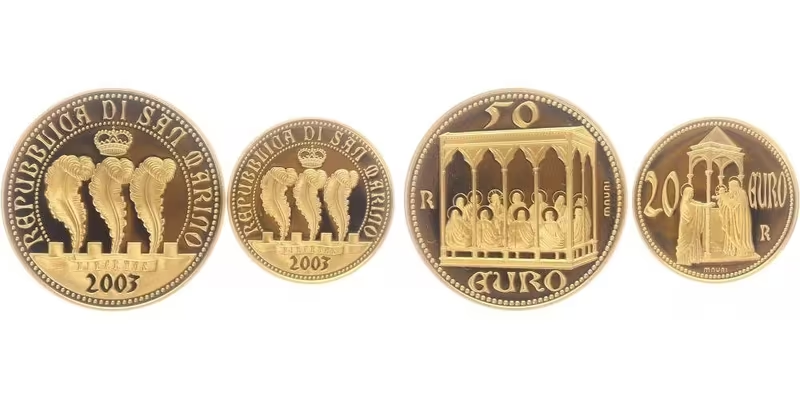
San Marino, 50 a 20 Euro 2003
50 a 20 Euro 2003 - 12 apoštolů, narození Ježíše Au 0,900, (16,129 g a 6,451 g), certifikát, společná etue, etue opotřebovaná, PROOF
- Code: SIRS-I2011
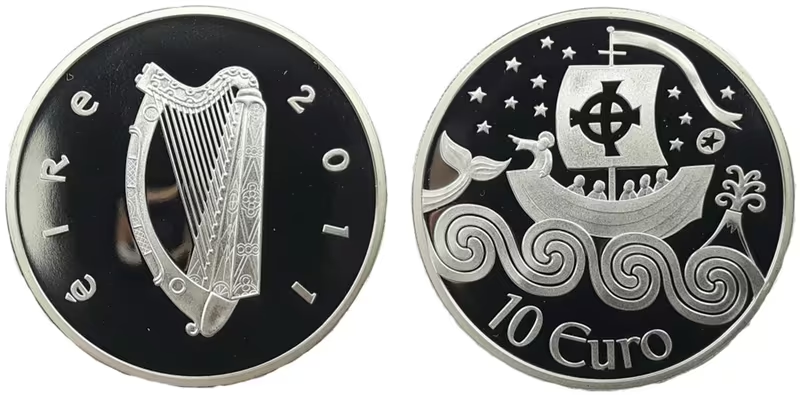
Irsko, 10 Euro 2011 - Svatý Brendan mořeplavec
Irsko Irsko, 10 Euro 2011 - Svatý Brendan mořeplavec Ag 0,925, 38,61 mm (28,28 g), raženo pouze 15 000 ks, Proof Svatý Brendan (484 Tralee – 577/583 Clonfert, Galway) je irský světec, jeden z dvanácti apoštolů Irska. Během svého života byl knězem,…
- Code: SISR-G2009
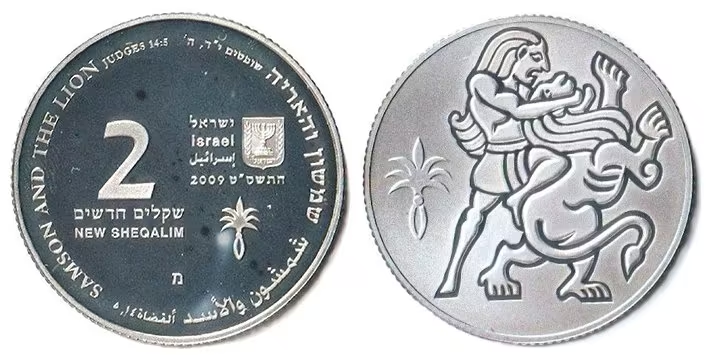
Israel, 2 New Sheqalim 2009 - Samson a lev
Israel (1948 - ) 2 New Sheqalim (Nové Šekely) 2009 (5769 židovského kalendáře) - Samson a lev Ag 0,925, 38,7 mm (28,80 g), Proof Samson ( Šimon ) je poslední ze starozákonních soudců, o němž se zmiňuje kniha Soudců. Jeho jméno je vykládáno jako…