Bonn
Bonn is a city on the Rhine in western Germany, known as the birthplace of Ludwig van Beethoven and also as the former capital of the Federal Republic of Germany from 1949 to 1990. It has a long history reaching back to Roman times and was also in the past an important administrative and commercial centre.
The history of Bonn is firmly tied to its position on the Rhine, that is, on one of the key European transport arteries. Already in Roman times there was a military and administrative base here, which exploited the strategic location in the empire's frontier zone. In the Middle Ages the city gradually developed into a regional centre with markets, crafts and institutions, while the importance of Bonn grew also thanks to ecclesiastical and secular power structures in the Rhineland.
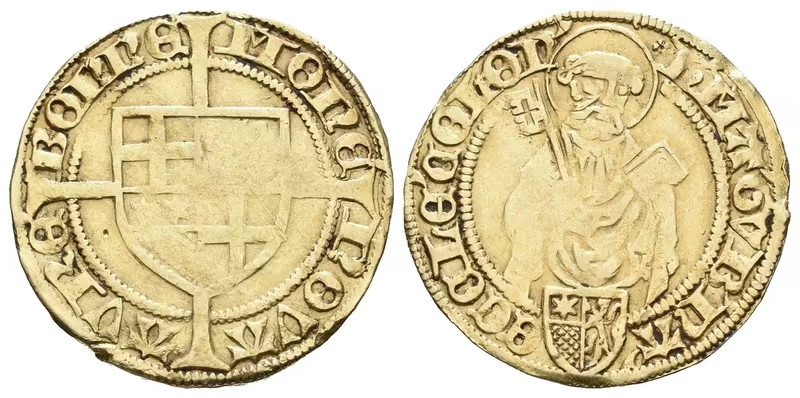
From the late Middle Ages, Bonn has been closely linked with the Archbishops of Cologne — Electors — whose position within the Holy Roman Empire was among the most influential. When relations with the burghers of Cologne sharpened, the centre of gravity of the electoral power shifted precisely to Bonn, which became a significant residential town. In this period the city also performed practical economic functions: it served as a market and customs place and, according to contemporary testimony, also as a minting location, which corresponds to the needs of administration and trade in the region.
History
The early modern and modern eras brought further layers of identity to Bonn. The best-known cultural mark is undoubtedly Ludwig van Beethoven, whose birthplace became a symbol of the city in European culture. After the Second World War, Bonn gained political importance when it was chosen as the capital of the newly emerging Federal Republic of Germany (West Germany). It served in this role for four decades, and after the reunification of Germany in 1990 the capital indeed moved to Berlin, but Bonn retained part of the federal institutions and international organisations.
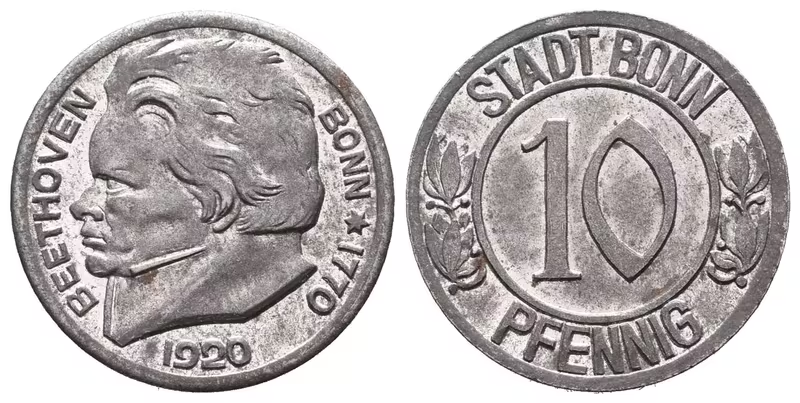
Bonn is interesting for collectors in that its name appears on numismatic objects from various periods. On the one hand there are coins struck at Bonn within the medieval and early modern structures of the Rhineland; on the other, one encounters civic medals, prizes and commemorative strikes that recall local institutions, associations or cultural themes (for example Beethoven anniversaries). Such objects can be attractive also for collectors who specialise in the German lands or in "municipal" medal art.
A city reflected on coin strikes
With civic and regional strikes it is good to follow who the issuer was (city, ecclesiastical prince, state, association), what the dating is and how the object is described. With older coins, identifying the mint and the ruling authority is key; with later medals, the material, the author and the purpose of issue matter. Bonn can thus function in a collection as a "node" that links the Roman and medieval roots of the Rhineland with the modern political history of Germany.
In our auction and shop
- Code: ZN-KOLN
Köln - arcibiskupství, Goldgulden b.l.
Köln - arcibiskupství, Hermann von Hessen 1480-1508 Goldgulden, Bonn (1480/81), Noss 467, Friedberg 802, Felke 1487 (3,30 g)
Skladem 1 ks - Code: ND-Z1920BON
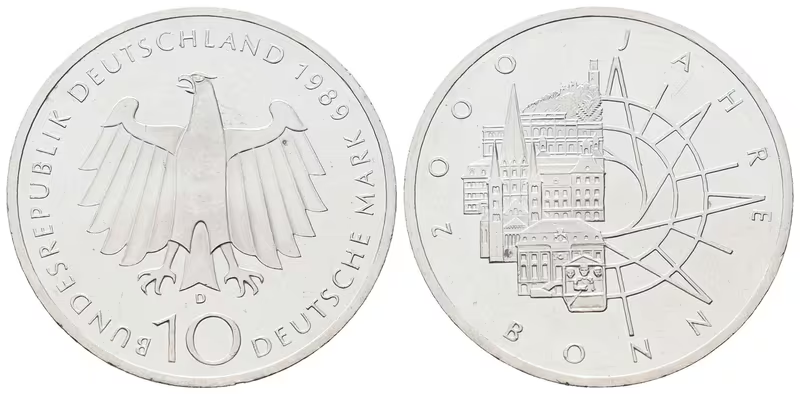
- Code: NG-B1989D
SRN, 10 Marka 1989 - Bonn
Spolková republika (1949 - ) 10 Marka 1989 D - 2000 let města Bonn , ražební lesk, drobné rysky