Brandenburg-Ansbach
Brandenburg-Ansbach was a territory in Franconia ruled by a junior branch of the Hohenzollerns, also known as the Margraviate of Ansbach. In the early modern period it belonged among the smaller but stable imperial states and left behind its own minting production as well.
The roots of Brandenburg-Ansbach are linked with the way in which possessions within the House of Hohenzollern were divided among the individual branches. While the main line was tied to Brandenburg and later to Prussia, the Franconian branches administered the territories around Ansbach and Bayreuth. These principalities were part of the Holy Roman Empire and functioned within a network of complex feudal relations, where local politics relied on the administration of towns, noble estates and ecclesiastical institutions.
In the early modern period, Brandenburg-Ansbach was a typical "middling" imperial state: it had sufficient resources for its own administration and representation, but at the same time had to balance carefully its relations with stronger neighbours. In times of wars and reforms, its position shifted according to how the situation in the empire and in surrounding lands developed. Even so, the territory retained continuity and order, which was reflected also in the economy, urban life and fiscal policy.
History
At the end of the 18th century a fundamental change occurred: the Ansbach state was ceded (or sold/relinquished) to the Prussian crown, by which it came into direct ties with the Prussian power bloc. The subsequent Napoleonic era then fundamentally rewrote the regional map of Germany, and the territory ultimately fell to Bavaria. Brandenburg-Ansbach thus represents a good example of how smaller imperial states at the close of the 18th century gradually "dissolved" into more modern and centralised state entities.
Numismatically, Brandenburg-Ansbach is interesting above all for its own strikes, which bear the margrave's titulature and usually also the heraldic emblems of the Hohenzollerns. Silver as well as smaller denominations corresponding to the standards used in the German lands appeared in circulation, with the specific composition of strikes changing according to the economic needs and monetary customs of the region.
Coins and marks linked with Ansbach
For collectors, it is attractive to be able to form a "chamber" collection of one small country: to follow the portraits of individual margraves, the change of arms and any changes of inscriptions and monetary units. When purchasing, it is important to verify the mint and type, because similar motifs can appear on the coins of other Franconian or neighbouring states. With older strikes, the condition (legibility of the legend and details) and expert identification of the variant are then essential.
In our auction and shop
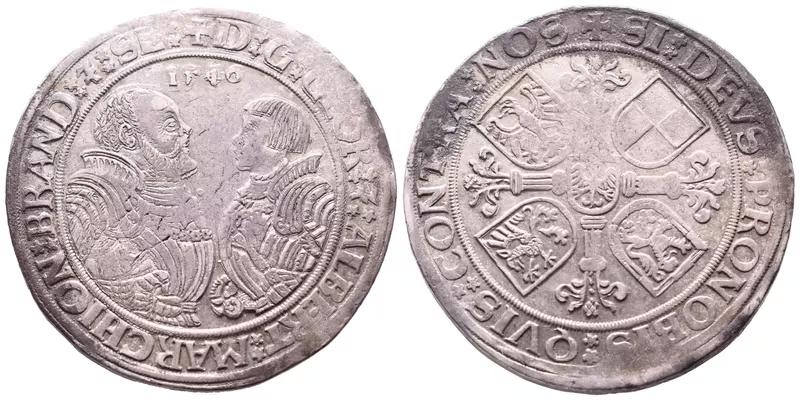
- Code: NABRAAN-A1540
Braniborsko - Ansbach, Tolar 1540
Brandenburg - Ansbach, Georg a Albrecht (1536 - 1543) Guldengroschen 1540. minc. Schwabach, Dav.8967 (28,95 g), pěkná zachovalost, tmavá patina, lehce ned., drobné vady střížku
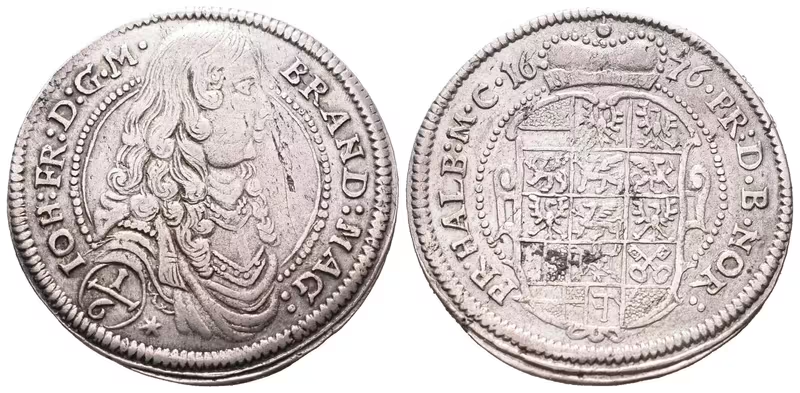
Skladem 1 ks - Code: NABRAAN-D1676
Braniborsko - Ansbach, 1/6 Tolaru 1676
Brandenburg - Ansbach, Johann Friedrich (1667 - 1686) 1/6 Taler 1676, minc. Schwabach, KM.82, Wilmersdörffer 911 , pěkná zachovalost, patina, drobné vady střížku, pěkně vyražený a prohnutý ražbou
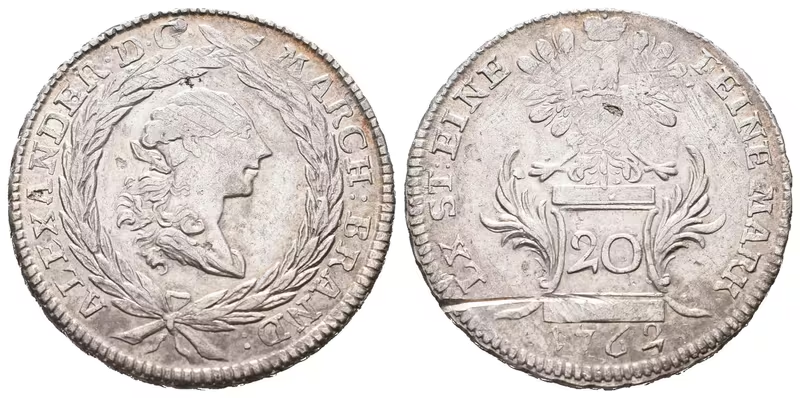
Skladem 1 ks - Code: NABRAAN-D1762
Braniborsko - Ansbach, 20 Krejcar 1762
Brandenburg - Ansbach, Christian Frederick Charles Alexander (1757 - 1791) 20 Kreuzer 1762, minc. Schwabach, KM.246, pěkná zachovalost, zbytky lesku, patina, vady střížku
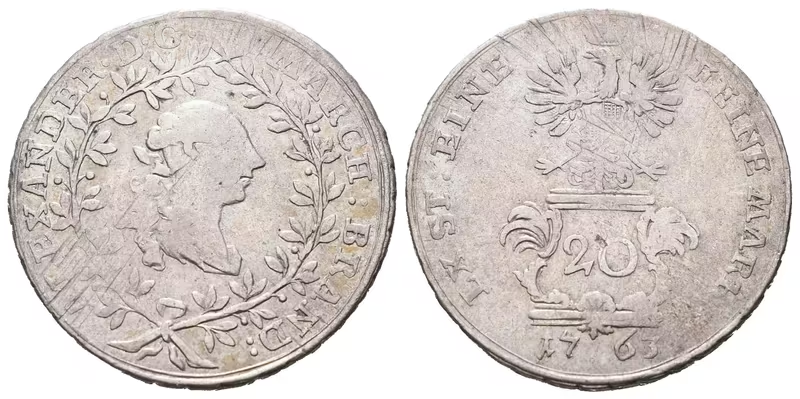
Skladem 1 ks - Code: NABRAAN-D1763
Braniborsko - Ansbach, 20 Krejcar 1763
Brandenburg - Ansbach, Christian Frederick Charles Alexander (1757 - 1791) 20 Kreuzer 1763, minc. Schwabach, KM.246, patina, just., var. kresby Rv.