Britain
Britain, in full the United Kingdom of Great Britain and Northern Ireland, is an island state in north-western Europe comprising England, Scotland, Wales and Northern Ireland. For numismatics, Britain represents the cradle of the pound sterling, which according to the Bank of England is the longest continuously used currency in the world.
A key figure in the early history of British currency is the Mercian King Offa (757–796), who around the year 790 introduced a new silver coin, the so-called Anglo-Saxon penny. Offa adopted the pattern of the Carolingian reform of Pepin the Short and Charlemagne and established that from one so-called Tower pound of silver (349.9 g) 240 pennies of a theoretical weight of approximately 1.46 g were to be struck. From this ratio are derived all three units of the future English monetary system: the penny (denarius), the shilling (solidus) as the accounting twelve pence and the pound (libra) as 240 pence. The penny was for centuries the only British coin actually struck; the shilling and the pound remained until the end of the Middle Ages merely accounting quantities. The etymology of the word sterling is not entirely certain — most often it is derived from the Old English "steorra" (star), after the small star on certain early strikes, or from the meaning "firm, strong" as a reference to the fineness of the coin.
The Anglo-Saxon penny and the origin of the pound
The sterling standard — a fineness of 92.5 % silver and 7.5 % copper — was formally introduced by King Henry II in 1158 with a reform of the penny known as the Tealby penny (after the find of almost six thousand pieces in Lincolnshire). This fineness was officially maintained in Great Britain for more than eight hundred years; only in the middle of the twentieth century was it replaced in circulation strikes by other alloys, but to this day it defines silverware — "sterling silver" is a worldwide legally protected hallmark for silver of this fineness. Edward III in 1351 reduced by reform the weight of the penny to 18 grains, and in 1344 introduced the large gold coin the noble of a weight of 8.97 g, which for one hundred years became the key English gold strike. Henry VII in 1489 had the first English sovereign struck — a massive gold coin of a weight of 15.55 g and a value of twenty shillings; the sovereign was rather a prestige representational strike than a common means of payment.
The sterling standard of Henry II
The modern British monetary system crystallised around the Great Recoinage of 1816, which formally anchored the gold standard. The Coinage Act of 1816 established a new unit of gold strike — the modern sovereign — which the Royal Mint began to strike in 1817 according to the design of the Italian engraver Benedetto Pistrucci with a depiction of Saint George slaying the dragon. The sovereign had a weight of exactly 7.98805 g at a fineness of 22 carats (91.67 %, that is 7.32238 g of pure gold) and a nominal value of one pound; this standard of gold of 22-carat fineness — so-called crown gold — has been preserved unchanged to this day, and modern bullion sovereigns struck by the British Royal Mint still maintain it. Alongside the sovereign the smaller half sovereign, the double sovereign and for occasional strikes the five-pound five sovereign also arose. Great Britain suspended the gold standard in 1914 because of the First World War, briefly restored it in 1925–1931 and definitively abandoned it after the monetary crisis under the government of Ramsay MacDonald in September 1931.
The gold sovereign and the Great Recoinage of 1816
Until the second half of the twentieth century, the British monetary system functioned in its original non-decimal format: one pound contained 20 shillings, one shilling twelve pence, so that one pound equalled 240 pence, supplemented by the small units farthing (a quarter of a penny) and halfpenny (half a penny). After a long political debate — the first serious proposal of decimal reform fell as early as 1849 — Parliament adopted the Decimal Currency Act 1969 and the so-called Decimal Day took place on 15 February 1971. The shilling as a unit disappeared, the pound remained and was newly divided into one hundred decimal pence (new pence, p). The old silver shillings and the old florin circulated transitionally as the five-pence and ten-pence equivalents until 1990 and 1993 respectively; the old half-crowns were demonetised already in 1969. The Bretton Woods system of fixed exchange rates against the dollar then ceased to function for the pound after the devaluation of 1967 and definitively after the Nixon Shock in 1971; the pound has floated freely since then.
The decimal reform of 1971
The numismatic legacy of Britain rests on several levels. The sterling standard of 92.5 % remains an internationally recognised hallmark of silver. The sovereign as a 22-carat bullion coin belongs, together with the American Eagle, the Canadian Maple Leaf and the South African Krugerrand, among the most traded bullion gold of the world. The British Royal Mint at Llantrisant (since 1968 relocated from the Tower) develops collector series such as Britannia (since 1987), Queen's Beasts and from 2023 the portrait series of King Charles III, which as the first English strike since 1968 changed the orientation of the ruler's profile. The accounting unit penny — from the Old English penig — then, via the French denier and the German pfennig, left traces in the small denominations of a number of European currencies, and the word dollar has an indirect etymological bridge through the German Thaler to the Jáchymov silver coins of the Czech Ore Mountains, which were the contemporary leading competitor of the English sterling strike in the European silver economy of the sixteenth century.
Numismatic legacy
In our auction and shop
- Code: RX-Z-001New
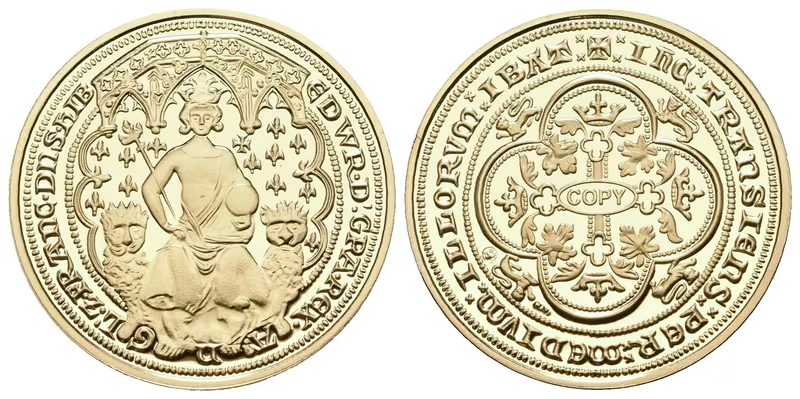
Velká Británie, Double Leopard Florin 6 shillings 1344 - Král Edward III. na trůnu / gotický kříž s liliovými motivy (Double Leopard Florin), replika
Království Anglie - Edward III. (1327-1377), moderní replika Double Leopard Florin 6 shillings 1344 - Král Edward III. na trůnu / gotický kříž s liliovými motivy (Double Leopard Florin) Ag (.925), 25 mm (10 g), v kapsli. Stav mince odpovídá fotografii.…
Skladem 1 ks - Code: RX-Z-026New
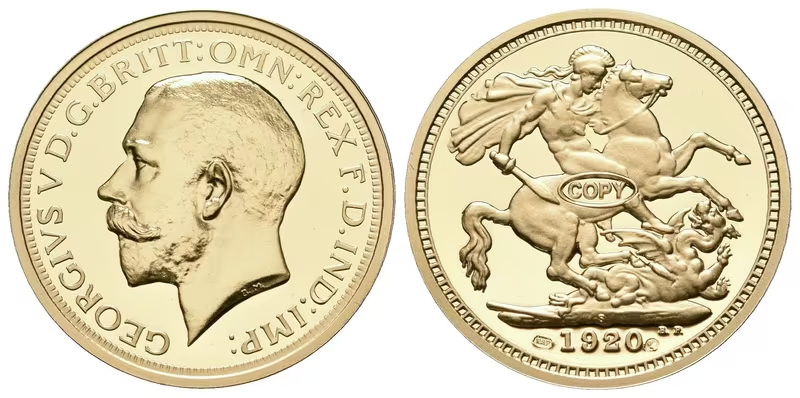
Velká Británie, Sovereign 1920 - Sv. Jiří a drak, replika
Spojené království - Jiří V. (1910-1936) Sovereign 1920 - Sv. Jiří a drak Ag (.925), 25 mm (10 g), v kapsli. Stav mince odpovídá fotografii. Jedná se o druhotný prodej. (Možná oxidace, atd.. ! - VIZ FOTOGRAFIE !)
Skladem 1 ks - Code: RX-Z-033New
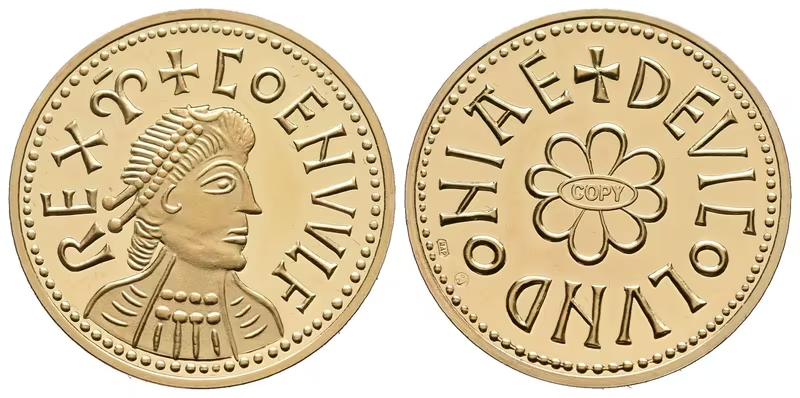
Velká Británie, medaile 796-821 - Coenwulf, král Mercie - flower penny (daisy type), londýnská mincovna, replika
Království Mercie - Coenwulf (796-821) / moderní vydavatel neznámý Medaile 796-821 - Coenwulf, král Mercie - flower penny (daisy type), londýnská mincovna Ag (.925), 25 mm (10 g), v kapsli. Stav mince odpovídá fotografii. Jedná se o druhotný prodej.…
Skladem 1 ks - Code: RX-VEL2015
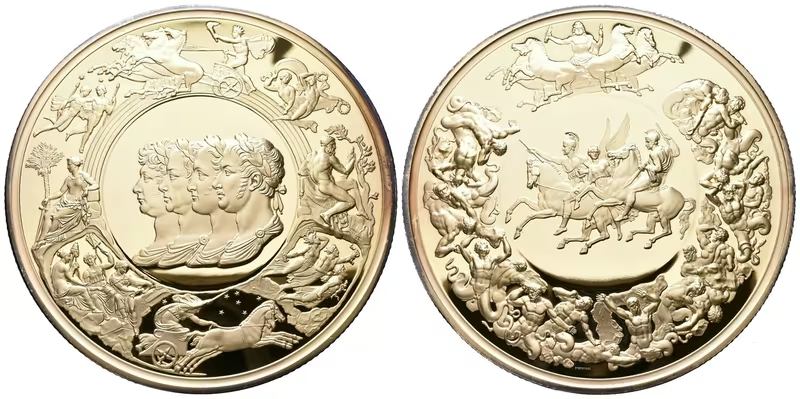
Velká británie - Bitva u Waterloo
Velká Británie AE Medaile 1815 - 2015 (B. Pistrucci) - Medaile na památku bitvy u Waterloo Bronz zlacený ryzím zlatem 88,9 mm (cca 400 g), číslováno na hraně, brožura s certifikátem a popisem bitvy, vojevůdci, historie vzniku medaile, etue, papírový…
Skladem 1 ks