Centesimo
The centesimo is the one-hundredth part of the Italian lira and at the same time the name of the small-denomination coins used in Italy from the unification of the country in 1861 until the introduction of the euro. The inscription "centesimo/centesimi" usually appears on the coins, together with the value in hundredths of the lira.
Centesimo belongs among the concepts linked to the modern state and to the effort to create a clear monetary system. After the unification of Italy in the 19th century, it was important to create a unified currency for a territory which had until then lived in various political entities and used various monetary customs. The lira became a symbol of state unity and its decimal division into centesimi corresponded to the contemporary trend of simplifying monetary systems.
Small coins denominated in centesimi served everyday payments and their appearance changed according to political stages. In modern states, numismatics is often a "textbook of history": state emblems, ruler portraits and republican symbols alternate on the coins. From the 19th to the 20th century, Italy underwent significant changes and the centesimi reflected them — both in artistic style and in the metals and alloys used.
History
In the 20th century, wars and economic upheavals were reflected in coinage. In such times, states often change the material of coins, simplify production and look for cheaper solutions, since more expensive metals are needed elsewhere or are too costly. Small denominations tend to be the most sensitive: they are struck in large mintages, wear out quickly and their real purchasing power can shrink considerably with inflation.
The end of the centesimo came with the transition to the euro. The introduction of the euro meant not only a change in the monetary unit but also a symbolic shift: national small denominations were replaced by the European system. From the collector's perspective, the Italian centesimo is therefore interesting as a closed chapter — it can be collected "from unification to the euro" and one can follow on it the development of motifs, technologies and economic pressures.
Coins, year-marks and collector tips
The centesimo is easily identified on coins by the denomination, but in collecting terms year-marks, mintmarks and types are decisive. Some periods produce a large quantity of common pieces, while elsewhere specific years or variants can be rarer. With small coins, the state of preservation is also important: details disappear quickly and a nice piece in sharper condition may fetch many times the price of a circulation average.
In practice it pays off to distinguish whether the coin is regular circulation currency or a special strike (for example with a different surface finish or a trial series). With Italian 20th-century coins, the corrosion of cheaper alloys is also a frequent issue, so it is appropriate to monitor the cleanliness of the surface and to avoid aggressively cleaned pieces.
In our auction and shop
- Code: MA031-1852V.1
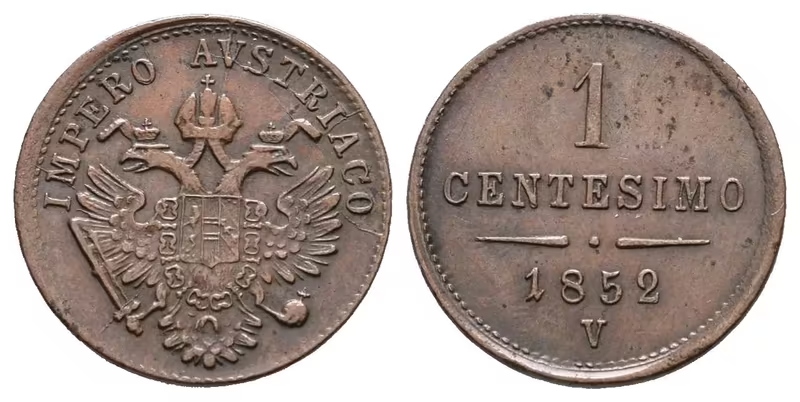
1 Centesimo 1852 V
František Josef I. (1848 - 1916) 1 Centesimo 1852 V - Benátky, Ves.31, velmi pěkná zachovalost, patina, drobné rysky
Skladem 1 ks - Code: SITA97-E1863.1
Itálie, 20 Centesimo 1863 M/BN
Itálie, Vittorio Emanuele II. (1861 - 1878) 20 Centesimi 1863 M, Miláno, KM.13, krásná zachovalost, patina
Skladem 1 ks - Code: SITA99-E1941
Itálie, 50 Centesimo 1941 R
Vittorio Emanuele III. (1900 - 1946) 50 Centesimi 1941 R, KM.76, krásná zachovalost, lesk
Skladem 1 ks - Code: MA029-1852LOT
3 Centesimi 1852 M, 1852 V
František Josef I. (1848 - 1916) 3 Centesimi 1852 M - Miláno, 1852 V - Benátky, Ves. 29_celkem 2 ks
Skladem 1 ks