Ernest Frederick of Saxe-Coburg-Saalfeld
Ernest Frederick of Saxe-Coburg-Saalfeld (8 March 1724 – 26 August 1800) was Duke of Saxe-Coburg-Saalfeld of the House of Wettin, who ruled from 1764 to 1800. He entered history above all as a sovereign who had to come to terms with the heavy indebtedness of his country and long-term oversight of its finances.
Ernest Frederick of Saxe-Coburg-Saalfeld was born in Saalfeld as the eldest son of Francis Josias of Saxe-Coburg-Saalfeld and Anna Sophia of Schwarzburg-Rudolstadt. He belonged to the Ernestine branch of the Wettins, whose minor Thuringian principalities formed an intricate mosaic of states within the Holy Roman Empire. For such lands stable administration and finances were crucial: they could not compete in size, and so they relied on a functioning court, offices and the ability to maintain the trust of subjects and creditors alike. Ernest Frederick assumed rule in 1764 after his father's death and inherited a country burdened with considerable debts that significantly limited his room for manoeuvre.
One of the important steps of his era was the definitive shift of the residential centre to Coburg, by which Coburg became the firmer administrative and representative centre of the duchy. In practice this meant not only court life but above all the concentration of officialdom, economic decisions and oversight of revenues. The debts, however, were so grave that the problem gradually became a matter going beyond the duchy itself. In 1773 the so-called Debit Commission was set up by decision of Emperor Joseph II — a forced administration of debts intended to stabilise the country's finances and gradually bring its liabilities under control. Such oversight was a perceptible limitation for the sovereign: even though formally he ruled, a significant part of financial decisions was governed by the rules of the commission and its long-term plan.
The duke's own policy therefore often focused on more practical areas that could benefit the country even without large outlays. The sources mention efforts to support agriculture and also the introduction of a numerical lottery in 1768, whose proceeds were to contribute to the financing of a breeding and orphan institution. Similar steps aptly capture the era of enlightened absolutism on a small scale: the sovereign tries to be "useful", seeks new sources of revenue and at the same time wishes to show that the court is not merely an expense but also an instrument of administration. Nevertheless, the core of the problem remained in the debts and in the fact that their settlement was a long undertaking.
History
Ernest Frederick ruled until his death in 1800. Towards the end of his life he also gained within the Ernestine family the position of senior of the house, which was of prestige rather than practical importance, but in dynastic culture it was an important symbol. His era is not associated with great military or territorial gains; on the contrary, it is a typical example of a reign in which finances, administration and the effort to maintain a functioning state despite limited resources predominated. It is precisely this that gives his rule its historical value: it shows the reality of the "small" German lands of the 18th century, where reputation, credit and good management often counted for more than ostentatious politics.
Ernest Frederick of Saxe-Coburg-Saalfeld is interesting for numismatics chiefly as an issuer of coins of a small German state that had to operate within the monetary rules of the imperial area of the time. In his day the Conventional currency was taking hold in the German lands, and circulation was very varied: alongside small denominations for everyday payments there were also larger silver coins of the thaler type and gold ducats intended rather for higher payments, trade and the preservation of value. The strikes of such principalities had a dual task — to provide the necessary coinage and at the same time to represent the state and the dynasty.
The coins of this period typically bear the sovereign's titulature, dynastic emblems and often a portrait of the ruler. For Saxe-Coburg-Saalfeld it holds that the coins served as a "calling card" of the duchy in regional circulation: each piece carried information about its origin and about who guaranteed the parameters of the strike. In an environment of fragmented currencies, recognisability was fundamental, since both people and merchants continually assessed whether to accept a coin, how to convert it and how trustworthy it was. With a small state, the coin had a further psychological significance — it confirmed that the country was functioning, was collecting revenues and was able to supply circulating coinage.
Ducal administration and the coins of Saxe-Coburg-Saalfeld
The duke's reign, marked by debts and oversight of finances, also reminds us that coinage was not solely a matter of "beautiful strikes" but also of finances. The cost of administration, payments and the servicing of liabilities created pressure on state revenues and in practice determined when and on what scale coins were minted. The coins of his era are therefore a good complement to the history of administration: they help us to understand how even a relatively small duchy sought to maintain stable circulation while preserving its dynastic representation in metal.
In our auction and shop
- Code: NBHES-CX1904.1
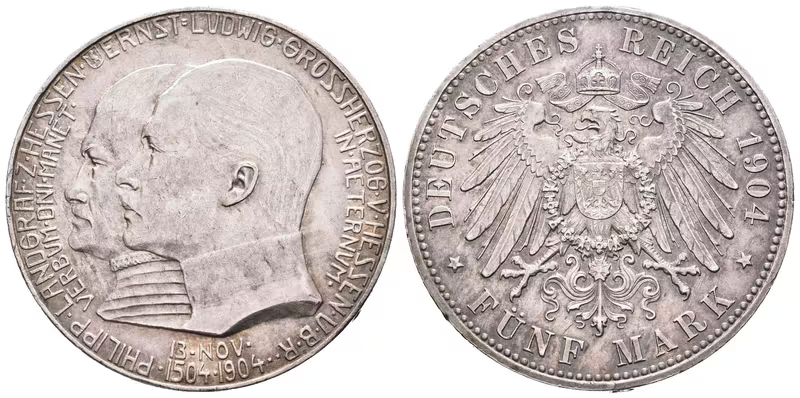
Hesensko, 5 Marka 1904 - Pamětní
Hesse-Darmstadt, Ernst Ludwig (1892 - 1918) 5 Mark 1904 A, Berlín - K 400. výročí narození Philippa I. Velkodušného, KM.373, J.75 (Vyraženo 40 000 ks), krásná zachovalost, lesk, patina, rysky a drobné hranky
Skladem 1 ks - Code: NBHES-CX1895
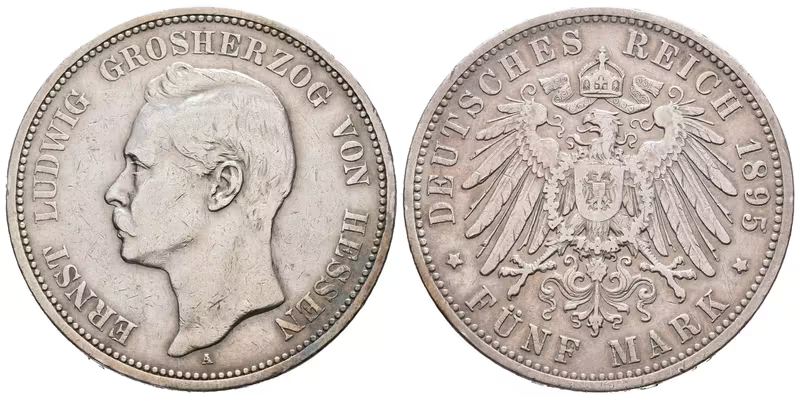
Hesensko, 5 Marka 1895
Hesse-Darmstadt, Ernst Ludwig (1892 - 1918) 5 Mark 1895 A, Berlín, J. 73, KM.369, patina, rysky a drobné hranky, oběh (vyraženo 39 000 ks)_R!
Skladem 1 ks - Code: NASOLM-1594
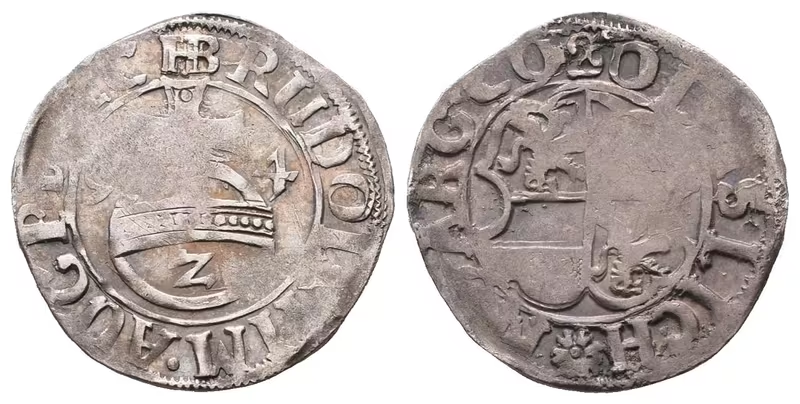
Solms - Lichtenberg, 1/2 Batzen 1594
Solms - Lichtenberg, Ernst, 1590 - 1619 1/2 Batzen 1594 (2 Krejcar), Jos.51, pěkná zachovalost
Skladem 1 ks - Code: NASOLM-1591
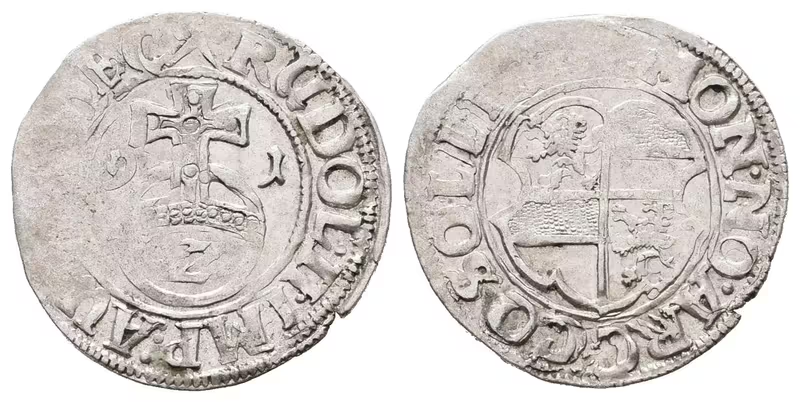
Solms - Lichtenberg, 1/2 Batzen 1591
Solms - Lichtenberg, Ernst, 1590 - 1619 1/2 Batzen 1591 (2 Krejcar), Jos.51, pěkná zachovalost, zbytky lesku, lehce ned.
Skladem 1 ks