Faustina II
Faustina II (the Younger) (130–175) was a Roman empress, the daughter of Antoninus Pius and Faustina the Elder, wife of Emperor Marcus Aurelius and mother of the future Emperor Commodus, who became famous for her beauty, controversial love affairs and influence on imperial politics. Faustina the Younger is significant in numismatics thanks to the extensiv…
Annia Galeria Faustina was born around 130 as the daughter of Emperor Antoninus Pius and Faustina the Elder. She grew up in the imperial palace surrounded by luxury and the highest quality of education available to women of her time. After her mother's death in 141 she became the most important female figure of the imperial court and was being prepared for a dynastic marriage that would ensure the continuation of the Antonine line.
The marriage to Marcus Aurelius in 145 was a dynastic alliance planned already by Emperor Hadrian during the adoption of Antoninus Pius. Marcus Aurelius was Antoninus's adoptive son and designated successor, and so the marriage ensured the continuation of dynastic legitimacy. Although the union was originally political, by all signs it became personally happy and produced many children.
As empress (161–175) Faustina represented the Antonine dynasty at the peak of its power under the rule of the philosopher-emperor. She accompanied Marcus Aurelius during his long military campaigns on the Danube against the Germanic tribes and acquired the reputation of a courageous and devoted wife. The soldiers nicknamed her "mother of the camps" (mater castrorum) for her care of the wounded and her support of the army.
Motherhood dominated Faustina's role as empress. She gave birth to at least thirteen children, only several of whom survived to adulthood, including the future Emperor Commodus and her daughter Lucilla. High infant mortality was common even in imperial families, but Faustina's repeated births and child losses affected her health and possibly her psyche.
Scandals and rumours accompanied Faustina throughout her adult life. Contemporaries accused her of numerous lovers including gladiators and senators, while some historians claimed that Commodus was not Marcus's son. These rumours may have been politically motivated, since a strong empress always provoked controversy in patriarchal Roman society.
History
Faustina's economic influence was considerable thanks to the enormous personal wealth she inherited from her mother and her inheritance from Antoninus Pius. She owned estates throughout the empire and financed public buildings, temples and charitable projects. Her brickyards and ceramic workshops supplied material for building projects in Rome, and the women's baths bearing her name served Roman women for centuries.
Faustina's death in 175 at the foot of the Taurus Mountains in Asia Minor during Marcus's eastern campaign shocked the entire empire. The official cause of death is not known, but speculation included illness, suicide owing to a political scandal or even murder at Marcus's order. Marcus Aurelius showed profound grief and asked the Senate for her deification.
The cult of the deified Faustina spread quickly, and Marcus founded on the site of her death the city of Faustinopolis in her memory. The Senate approved her deification unanimously and Faustina became Diva Faustina Maior (the Elder divine Faustina, in order to distinguish her from her deified mother). Her cult lasted until the end of antiquity as part of the imperial religion.
The legacy of Faustina the Younger is complex — she was at once an admired empress and a controversial figure whose son Commodus almost destroyed the Antonine inheritance. Her life illustrates the paradoxes of female power in the Roman Empire, where empresses had considerable influence but were exposed to constant criticism and slanderous campaigns.
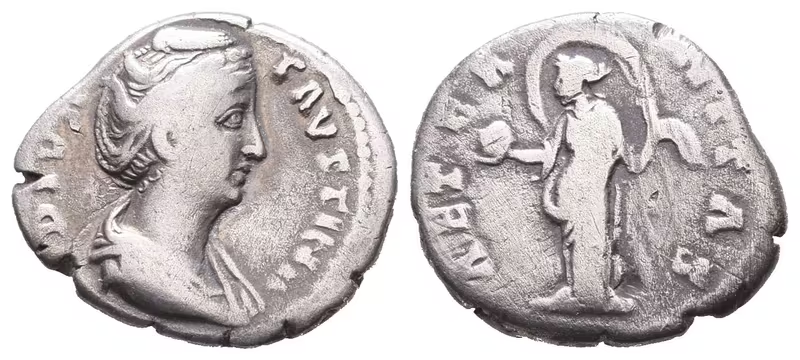
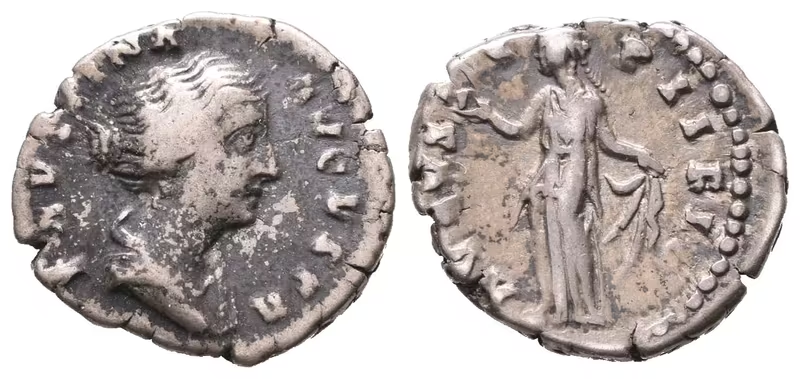
The coins of Faustina the Younger constitute one of the most extensive imperial coin issues dedicated to a woman in Roman history. The portraits document her development from a young bride around 145 to a mature empress in the 170s. Characteristic are the elaborate hairstyles typical of the Antonine era — complex buns, plaited braids and rich ornaments reflecting the fashion of the High Empire.
Faustina the Younger in Numismatics
Lifetime issues (145–175) depict Faustina in various roles — as the wife of Marcus Aurelius, as the mother of imperial children and as mater castrorum supporting the army. Frequent are the motifs of CONCORDIA (harmony) with clasped hands, FECVNDITAS (fecundity) with children and FELICITAS (happiness) with a caduceus. These inscriptions propagate Antonine values of family harmony and imperial prosperity.
Posthumous coins (175–180) celebrate the deified Faustina with the motifs of CONSECRATIO (deification) depicting an eagle or funeral pyre. AETERNITAS (eternity) with globe and stars, SIDERIBVS RECEPTA (received among the stars) and DIVA FAVSTINA PIA (the divine Faustina Pia) document her transformation from earthly empress into heavenly protectress.
The quality of Faustina's coins reaches the peak of Roman coin art with the use of the finest engravers and materials. The gold aurei and silver denarii are marked by precise portraits capturing fine facial details and elaborate hairstyles. Regional coins from the eastern provinces often depict local variants of her cult with Greek inscriptions and oriental symbols.
In our auction and shop
- Code: BE036-0351.1
Faustina starší, denár, RIC 351
Faustina starší (138 - 140) mincovna Řím, raženo 141 (pamětní ražba), stojící Providentia se závojem a glóbem, AETERNITAS, RIC 351
Skladem 1 ks - Code: BE038-0497
Faustina mladší, denár, RIC 497
Faustina Mladší (161 - 175) mincovna Řím, raženo za Antonina Pia 156 - 161, stojící Spes s květinou držící cíp oděvu, RIC 497
Skladem 1 ks - Code: BE037-0817New
S. Severus, Moesia, Marcianopolis, AE
Septimius Severus (193 - 211) Moesia Inferior, Marcianopolis, magistrát Julius Faustinianus, AE 25, Rv: Tyché stojící vlevo, drží kormidlo a roh hojnosti. Varbanov 817, AMNG 571(?), pěkná zachovalost, patina, lehce exc.
Skladem 1 ks - Code: BE049-0774
S. Severus, Moesia, Marcianopolis, AE
Septimius Severus (193 - 211) Moesia Inferior, Marcianopolis, magistrát Julius Faustinianus, AE 25 Tetrassarion, Rv: Cybele sedící vlevo na trůně, drží pateru a opírá loket o tympanum, po stranách lvi, opis. Varbanov 774, pěkná patina, drobné vady střížku
Skladem 1 ks