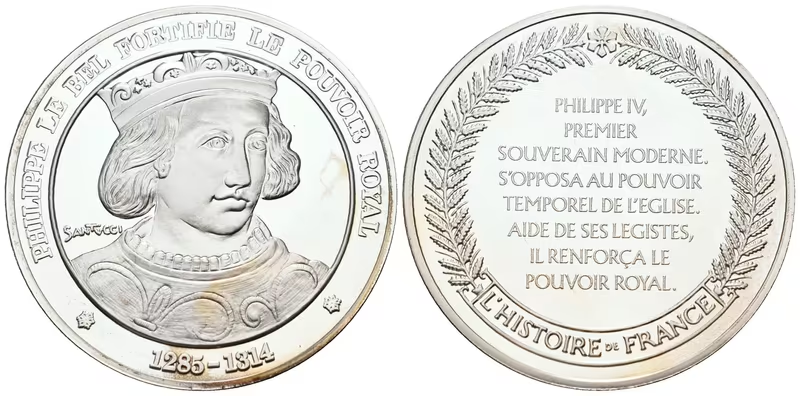
Philip IV of France
Philip IV of France, known as the Fair, was a French king ruling from 1285 to 1314, who became famous for extensive monetary manipulations and the striking of low-quality coins to finance his wars. His frequent devaluations and changes to the precious-metal content of coins earned him the nickname "the false mintmaster" and caused the first monetary crise…
Philip IV of France was born in 1268 at Fontainebleau as the second son of King Philip III the Bold and Isabella of Aragon. After the death of his elder brother Louis in 1276 he became heir to the throne. He received his education at the royal court, where he was instructed in Latin, the art of war, and the administration of the realm. In 1284 he married Joan I of Navarre, thereby gaining a claim to the kingdom of Navarre and the wealthy county of Champagne, which was the centre of European trade and banking. After the death of his father on 5 October 1285, he ascended the French throne at the age of seventeen as Philip IV.
The first years of Philip's reign were marked by an unsuccessful war with Aragon over Sicily, which he had inherited from his father. The war exhausted the royal treasury and Philip was forced to look for new sources of revenue. In 1289 he concluded peace with Aragon and turned his attention to the internal consolidation of the realm. He systematically extended royal power at the expense of the feudal nobility, building a centralised administration with professional officials drawn mainly from the ranks of educated townsmen and the lesser nobility. He founded the Parlement of Paris as the supreme judicial body and the Cour des Comptes for the control of royal finances. His councillors, especially the jurists Pierre Flote and Guillaume de Nogaret, formulated the theory of absolute royal power derived directly from God.
The longest-running conflict of Philip's reign was the war with England over Gascony, which broke out in 1294. Edward I of England, as Duke of Aquitaine, was formally Philip's vassal but in fact controlled extensive territory in south-western France. Philip attempted to confiscate the English fiefs, which led to open war. Hostilities continued with interruptions until 1303 and demanded enormous financial resources. Philip had to introduce new taxes, borrow from Italian bankers, confiscate the property of Jewish merchants, and above all manipulate the royal coinage. The war ended inconclusively with the Peace of Paris, which confirmed the status quo.
History
A fundamental conflict of Philip's reign was the dispute with the papacy over the right to tax the clergy. Pope Boniface VIII issued the bull Clericis laicos in 1296 forbidding secular rulers to levy taxes on Church property without papal consent. Philip responded by banning the export of gold and silver from France, thereby cutting off the papacy from its French income. The conflict culminated in 1303, when Philip had his chancellor Nogaret arrest the pope at Anagni. Boniface VIII died shortly thereafter and his successor Clement V moved under French pressure to Avignon, beginning what is known as the Babylonian Captivity of the popes, which lasted until 1378.
The most controversial act of Philip's reign was the destruction of the Templar Order. During the Crusades the Templars had become the largest banking institution in Europe; they administered the royal treasury and Philip owed them vast sums. On Friday, 13 October 1307, Philip had all the Templars in France arrested, including the Grand Master Jacques de Molay. A staged trial followed with charges of heresy, sodomy, and idolatry. Under torture the Templars confessed to the fabricated charges. Pope Clement V, under French pressure, abolished the order in 1312 by the bull Vox in excelso. Grand Master de Molay was burned at the stake in 1314 and the property of the Templars was confiscated to the benefit of the royal treasury, although it was officially to pass to the Knights Hospitaller.
Philip IV died on 29 November 1314 at Fontainebleau at the age of 46, several months after the burning of Jacques de Molay, who according to legend had cursed the royal house. Philip's death followed a stroke during a hunt. His three sons Louis X, Philip V, and Charles IV ruled France successively, but all died without male heirs, extinguishing the direct line of the Capetians. Philip's daughter Isabella married the English king Edward II, and their son Edward III later laid claim to the French throne, which led to the Hundred Years' War. Philip IV left France a centralised state with a modern administration, but economically exhausted and socially divided by his controversial methods of rule.
Monetary policy and coinage of Philip IV
Philip IV gained renown as one of the greatest manipulators of currency in mediaeval history. His constant financial needs, prompted by wars with England and Flanders, led him to systematic debasement of the royal coinage. Between 1290 and 1314 he carried out at least ten major monetary reforms, in which he alternately decreased and increased the precious-metal content of the coins. Devaluations were carried out secretly - the new coins looked the same as the old, but contained less silver or gold. When the debasement became apparent through rising prices, Philip blamed usurers and Jewish merchants. In 1306 he carried out the most drastic devaluation, when he reduced the silver content of the coins by two-thirds, which provoked a popular uprising in Paris, and the king had to seek refuge with the Templars.
Philip's monetary manipulations involved sophisticated techniques. He introduced a system of secret minting instructions, in which the actual metal content was known only to the highest mint officials. He created a dual monetary system - stable gold coins for international trade and manipulated silver coins for internal circulation. He banned the use of foreign coins and forced his subjects to exchange old coins for new at a compulsory rate. He monopolised money-changing and punished by death the illegal export of precious metals. His gros tournois, originally a high-quality silver coin introduced by Louis IX, lost half its value during Philip's reign. Paradoxically, Philip also struck very high-quality gold coins - the masse d'or and the agnel d'or - which served for international payments and the maintenance of royal prestige. These contrasting monetary policies demonstrate Philip's cynical use of coinage as an instrument of fiscal policy without regard to its economic consequences.
In our auction and shop
- Code: RX-FRAN007
Francie - AR Medaile b.l. - Philippe le Bel
Philippe le Bel - 1285-1314 Ag 0,800, 44 mm (cca. 37 g) Na minci se nachází Francouzský punc ryzosti. V originální kapsli. Medaile je ze série 'Historie Francie v medailích' - Na některých mincích jsou viditelné stopy patiny aj. - Viz. obrázek.…