The Navarrese
The Navarrese designates the inhabitants and members of historic Navarre, a Pyrenean territory on the border of today's Spain and France. In history the term is associated chiefly with the Kingdom of Navarre, its nobility and ruling houses, which influenced the politics of Western Europe.
"The Navarrese" (that is, "the people of Navarre") refers in historical context most often to the kingdom which emerged in the early Middle Ages in the area of the western Pyrenees. The core of this statehood was originally Pamplona and the surrounding territory inhabited among others by Basque-speaking population whose language and culture have survived in the region to this day. The kingdom gradually expanded and changed its borders and political ties depending on how the interests of the Frankish world to the north and the growing Christian and Muslim powers on the Iberian peninsula came into contact in the area.
Navarre was a typical "border" state: it had to balance relations with more powerful neighbours, especially Castile, Aragon and France. At the same time, thanks to its position, it controlled important passes and trade routes across the Pyrenees, which increased its strategic importance. In the High and Late Middle Ages Navarrese politics often relied on dynastic links and marriages. Several ruling houses succeeded one another on the Navarrese throne, which reflected the complex European diplomacy of the time. It is precisely for this reason that "the Navarrese" in the sources refers not only to the inhabitants of the country but also to a broader circle of elites - the nobility, court and royal administration, which could have ties far beyond the borders of the kingdom.
A fundamental turning point came at the beginning of the 16th century, when the "upper" (southern) part of Navarre was gradually subjugated and incorporated into the Spanish state space. The originally independent kingdom thereby became a territory with limited statehood of its own, although Navarre retained in various forms some traditional legal customs and regional institutions. On the northern side of the Pyrenees, meanwhile, "lower" Navarrese territory was preserved, which remained tied to its own ruling line and later became more closely linked with France.
History
In European history Navarre achieved exceptional visibility particularly when the Navarrese sovereign became at the same time the king of France. The best known example is Henry IV (originally Henry of Navarre), who upon his accession to the French throne combined the prestige of the "king of Navarre" with rule in France. This personal union strengthened the importance of Navarre in diplomatic symbolism, even though the real political weight of the smaller Pyrenean kingdom was in the modern period already more limited than in the Middle Ages. The title of king of Navarre then in a certain form long survived in European titulature, since it built upon older rights and inheritance claims.
The term "the Navarrese" thus across a long span of time encompasses both the inhabitants of a specific region with a distinctive cultural identity and a historical political community around the Navarrese crown. Depending on the context, it may designate the rural and urban population, the local nobility and officialdom, but also the "Navarrese" dynastic tradition, which entered into relations with the principal powers of Western Europe.
Navarrese identity rests on a combination of geography, history and cultural diversity. The Pyrenees created a natural border and at the same time a bridge between north and south: Navarre was for a long time a space where Iberian, Frankish and local Basque influences mingled. This was reflected in law, administration and everyday culture. The term "the Navarrese" can therefore be used not only politically, but also ethnographically or regionally - for example in describing traditions, language and local customs.
Navarre, identity and numismatic connections
From the numismatic perspective Navarre manifested itself as a distinctive issuer of money in periods when it had its own sovereign authority and mint administration. As elsewhere in medieval Europe, coins fulfilled, alongside the practical function, also the role of representation: they bore the name and titles of the sovereign, the emblems of the country and sometimes also Christian symbolism, which strengthened the legitimacy of rule. In the modern period the Navarrese title and Navarrese heraldry could survive in broader dynastic entities, which was sometimes also reflected in the official symbolism encountered on mintages or medals associated with sovereigns who used the Navarrese title.
In practice, therefore, "the Navarrese" functions as a useful orientation term: it recalls that behind a single name there lies a long history of transformations of statehood, borders and identity. With historical objects - including coins - it can suggest whether they are a trace of an independent kingdom or of a later dynastic tradition which carried over into larger state formations.
In our auction and shop
- Code: SFRA87-D1586
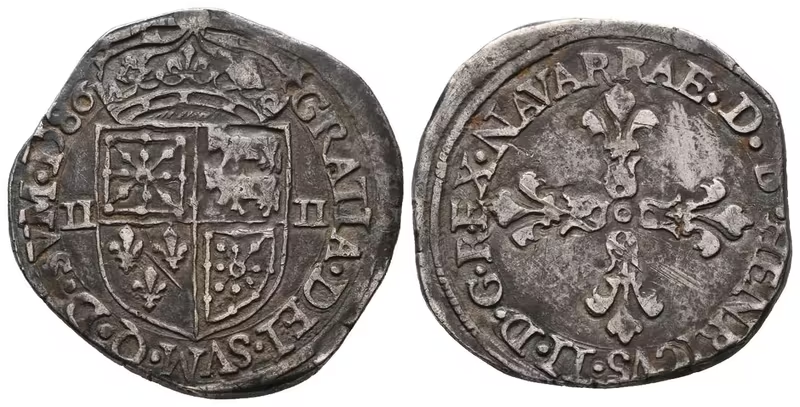
Francie, 1/4 Ecu d’Bearn 1586
Francie - Vikomtství Béarn, Jindřich II. Navarrský (1572 - 1589) 1/4 Ecu d´Bearn 1586, minc. Pau, PA.3501, pěkná zachovalost a patina_R!
Skladem 1 ks