Flutky
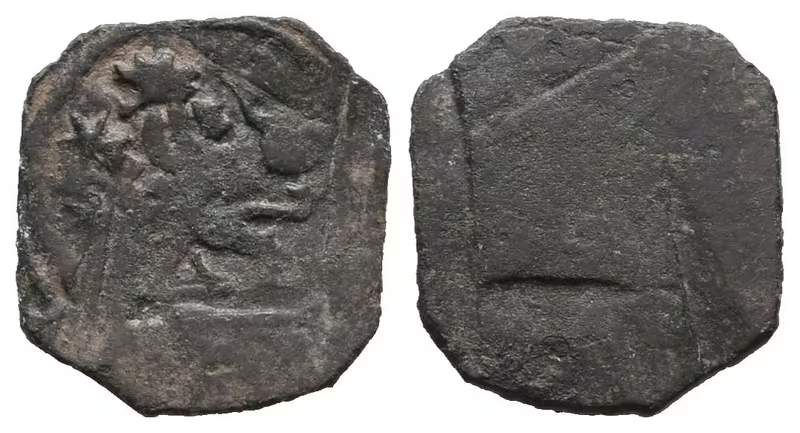
Flutky are small Hussite coins from the 15th century, struck predominantly from copper and often only on one side. They arose at a time of silver shortage, and their appearance imitated older lion coins, especially the types associated with the time of Wenceslas IV, in order to be more readily accepted in circulation.
Flutky are linked to the monetary distress during the Hussite Wars, when conditions for regular striking of high-quality coins in the Czech lands deteriorated significantly. War expenditures, the disruption of part of the economy, and disrupted metal supply led to a noticeable shortage of small coinage in circulation. Precisely the small denomination was indispensable for everyday exchange - at the market, in payment for services, and for ordinary urban and military expenses. In such a situation, solutions emerged that in calmer times would have met with resistance: coins were struck from cheaper metal, with simpler execution, and with symbolism intended to give the impression of a "normal" coin.
Flutky are traditionally associated with the Hussite milieu of Prague and Tabor (and in a broader sense also other Hussite centres). In their basic form they were small strikings of copper or copper alloys, sometimes surface-treated to appear "more silvery". The frequent one-sidedness is not a sign of artistic ambition but of simplification of production: striking with just one die was faster and cheaper. The result was coins that could be produced in greater quantity even in conditions of provisional mint organisation.
An important feature is the imitation of older and popular types. In their conception, flutky relate themselves to the traditional coin imagery of Czech small strikings - most often to the lion, that is, to a symbol that people knew well and that was long used in Czech coinage. In contemporary practice this had a clear purpose: the more "familiar" the coin looked, the more readily people accepted it, even though they sensed that its metal content did not correspond to older silver coins. Sources moreover suggest that production took place on a large scale and that ordinary copper material from household vessels and equipment was also used. This well captures the improvisation of the time: the currency had to function at any cost, even if its material was weak.
History
The origin of the name itself is not reliably explained. In the literature various conjectures appear, but none is generally accepted as definitive. More certain is that the word "flutky" is used in contemporary reports precisely for these emergency copper strikings, which were to replace the missing small silver coins. From today's viewpoint flutky are often described as contemporary "imitations" or "emergency coins": they did not arise primarily to deceive anyone in private fraud, but to ensure the circulation of small coinage in extraordinary conditions. At the same time, however, their low value and easy production logically increased the risk of misuse - similar types of strikings were generally susceptible to imitation and to further deterioration of quality.
For numismatics flutky are valuable evidence of how a monetary system behaves in crisis. They show that a coin is not merely a metal with a certain content of precious material but also an instrument of trust and habit: people often accept a means of payment because it looks familiar, comes "from authority", and one can use it onward in payment. Flutky thus belong to the types in which the tension between the official conception of the coin and the real possibilities of a time that had to address daily needs even amid political and military breakdown is visible.
Flutky tend to be small and light, often with rougher workmanship. As a motif primarily the Czech lion is used, or simple marks or stylised elements referring to older small strikings. Frequently the execution shows only one side clearly struck, while the other remains without image or with indeterminate traces of the strike. With some pieces you may also encounter a surface treatment intended to give the coin a "nobler" impression, although the base metal remained copper.
Appearance, types, and use
From the standpoint of function it was primarily currency for small payments, that is, a coin of everyday need in an environment where standard small silver currency was lacking. This explains both their more massive occurrence and their great variability: in emergency conditions perfect uniformity was not a priority, but rather rapid usability in circulation. For attributing individual pieces, therefore, the style of the lion, possible accompanying marks, and the overall "fabric" of the strike are important, because differences may indicate where and within what range flutky were produced.
In numismatic terminology flutky are classed among the extraordinary strikings of the Hussite period and are also described as coins imitating older small coins. They are thus not merely a curiosity but a concrete imprint of their time: they document that the currency had to function even in a situation when the usual sources of metal, authority, and quality control were collapsing.
In our auction and shop
- Code: GG-C
Husité, (Cu) Flútek
Doba husitská, 1419 - 1436 Flútek (Cu), pravděpodobně Praha nebo Tábor Velmi zajímavá ražba z raného období husitských válek. Vzhledem k vyhrocené vojenské situaci dochází roku 1421 z důvodu nedostatku mince k ražbě nehodnotných penízů z obecného kovu. O…