Frederick Augustus III of Saxony
Frederick Augustus III of Saxony was the last Saxon King (1904-1918) from the House of Wettin, who ruled within the German Empire. His era was marked by the modernisation of the country, the tensions before the First World War, and the fall of the monarchy in 1918, after which he became a private person.
Frederick Augustus III of Saxony (1865-1932) came from the long ruling tradition of the Wettins, which had shaped both politics and culture in Saxony for centuries. At the turn of the 19th and 20th centuries, however, the Kingdom of Saxony no longer functioned as a fully sovereign state in the modern sense - from 1871 it was a federal land of the German Empire. The king represented here an important symbol of territorial continuity, while the key areas of foreign policy and a large part of military decision-making were tied to the imperial framework.
He ascended the throne in 1904 and assumed a country which belonged to the most industrially developed parts of the empire. Saxony had a strong tradition of technical education, engineering, and manufacturing, but at the same time it faced the typical tensions of modern times: the rapid growth of cities, social questions, and the strengthening political influence of mass parties. In such an environment the role of the ruler gradually shifted from "governing" to representation and to maintaining the stability of territorial institutions.
Frederick Augustus III's family situation also entered into his public image. At the end of the 19th century his marriage fell into a serious crisis, which was extensively aired by the public and the press. In the monarchies of this time the family circumstances of the ruler often had a direct impact on the prestige of the court, and for this very reason similar affairs were not perceived as a merely private matter. Even so, in the following years Frederick Augustus III shaped his image especially as a ruler who sought to preserve a moderate and "civilian" style of conduct, suited to the changing circumstances.
History
The decisive turning point of his reign was the First World War. As a part of the German Empire Saxony participated in the war effort, and domestic life increasingly subordinated itself to the needs of the front and provisioning. The wartime economy, casualties, shortages, and the fatigue of society gradually weakened trust in the monarchy and in the existing political order. In the autumn of 1918, when Germany was collapsing militarily and internally politically, a wave of revolutionary events affected the individual lands.
In November 1918 Frederick Augustus III abdicated and the Kingdom of Saxony was transformed into a republic as part of the new German order. With this the long Saxon royal line at the head of the country came to an end. The former ruler then lived as a private person and lived out his days in a time when Germany was already going through a quite different era - from the Weimar Republic to the deep crises of the interwar years. His life path thus represents a typical example of the "last rulers" of the German lands: they reigned in a modernised state, but the fall of the monarchy came quickly as a result of war and social rupture.
Frederick Augustus III is of interest to numismatics especially as a territorial ruler within the unified imperial currency of the mark. In the German Empire there was indeed a common monetary system, but the individual lands could on selected denominations use their own dynastic portraits and territorial coats of arms. Saxon coins from his time therefore bear his profile and titulature, while the denomination marking corresponds to the standard of the whole empire.
Coins of Frederick Augustus III and the numismatic context
Alongside small coins of base metals, silver denominations in marks and, for higher values, gold coins also appeared in circulation. For collectors the combination of year, denomination, preservation, and mintmark is important, because the latter precisely determines where the coin was struck. With Saxon imperial strikings you will often encounter the mintmark of the Berlin mint (A), which distinguishes the origin within the German network of mints. Artistically the portrait coins of Frederick Augustus III belong to the typical style of the turn of the century: a realistic bust, a clean legend, and state symbolism on the reverse.
The numismatic value of these coins is given not only by the metal content but also by the historical significance: these are strikings from the last years of the existence of the Saxon monarchy. With many pieces, therefore, the combination of the "last king" with specific years before 1918, when in Germany the era of territorial rulers and their portraits on coinage came to a close, is what is attractive.
In our auction and shop
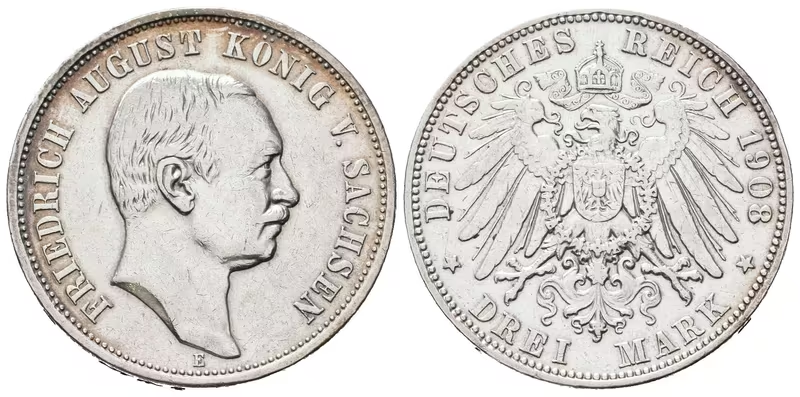
- Code: NBSAS-CY1908.1
Sasko, 3 Marka 1908
Sasko, Friedrich August III. (1904-1918) 3 Mark 1908 E, J.135, KM.1267, pěkná zachovalost, patina, rysky
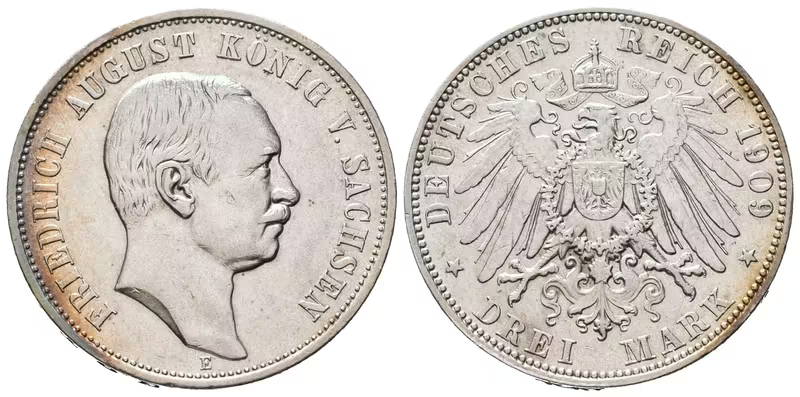
Skladem 1 ks - Code: NBSAS-CY1909.2
Sasko, 3 Marka 1909
Sasko, Friedrich August III. (1904-1918) 3 Mark 1909 E, J.135, KM.1267, velmi pěkná zachovalost, patina, zbytky lesku na Av., lesk na Rv., rysky
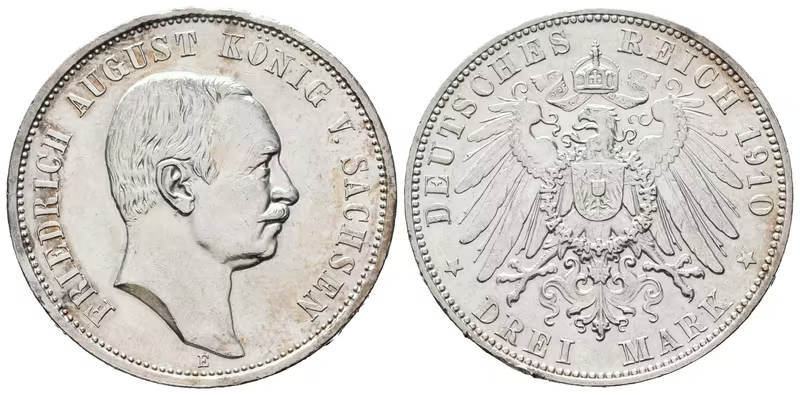
Skladem 1 ks - Code: NBSAS-CY1910.1
Sasko, 3 Marka 1910
Sasko, Friedrich August III. (1904-1918) 3 Mark 1910 E, J.135, KM.1267, krásná zachovalost, ražební lesk, patina, rysky
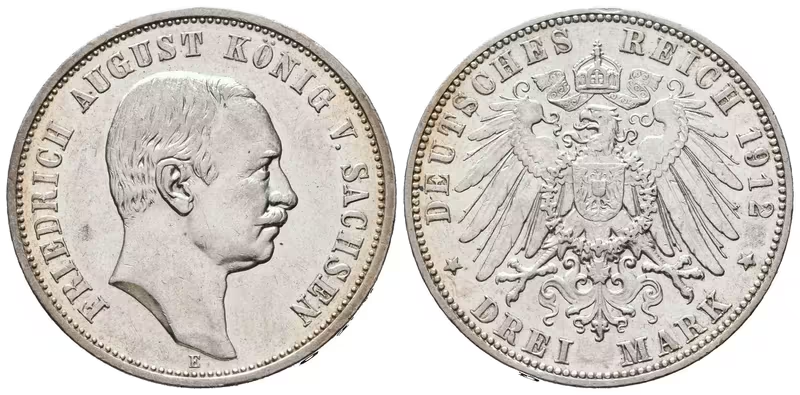
Skladem 1 ks - Code: NBSAS-CY1912
Sasko, 3 Marka 1912
Sasko, Friedrich August III. (1904-1918) 3 Mark 1912 E, J.135, KM.1267, velmi pěkná zachovalost, lesk, rysky
Skladem 1 ks