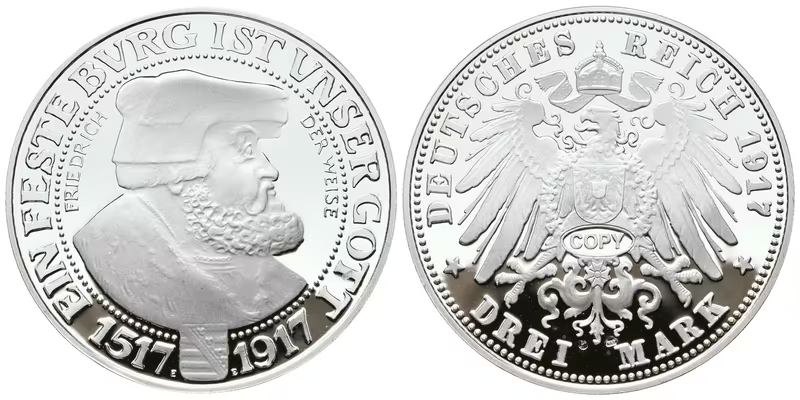
Frederick III of Saxony
Frederick III of Saxony (1463-1525) was a Saxon Elector ruling from 1486 to 1525, who became famous as "the Wise" thanks to his diplomatic skill, protector of Martin Luther before papal and imperial power, and patron of Renaissance art and humanism, thereby becoming a key figure of the German Reformation and the cultural flourishing of Saxony. Frederick I…
Frederick was born on 17 January 1463 in Torgau as the son of Elector Ernest of Saxony and Elisabeth of Bavaria. He grew up during the humanist flowering of the late 15th century and obtained a high-quality education preparing him for the role of elector in one of the most powerful German states. He inherited not only power but also responsibility for the reform of the Church and society.
His accession to the throne in 1486 brought the young elector rule over a divided Saxony, which he had to unite and modernise. Frederick continued the policy of his ancestors supporting ecclesiastical reforms and education, but had also to navigate complex imperial politics between the emperor and powerful princes.
The collection of relics at Wittenberg became Frederick's obsession and brought him a European reputation as a patron of ecclesiastical art. The collection contained more than 19,000 relics with the alleged power to forgive sins for hundreds of thousands of years. This piety later ironically contrasted with his support for Luther's reform ideas.
The founding of the University of Wittenberg in 1502 represented the peak of Frederick's cultural patronage. The new university attracted leading humanists and theologians from all over Europe and became a centre of learning competing with the traditional universities in Prague and Vienna. Later it became the cradle of the Reformation.
Martin Luther came to Wittenberg in 1508 as a professor of theology at Frederick's university. When Luther in 1517 published his 95 theses criticising indulgences, Frederick protected him from papal and imperial pressure, although he never publicly subscribed to the reform ideas.
History
The Imperial Diet at Worms in 1521 tested Frederick's loyalty to communion and the emperor. When Charles V issued the Edict of Worms condemning Luther as a heretic, Frederick staged an abduction of the reformer and hid him at Wartburg Castle, where Luther translated the New Testament into German.
The German Peasants' War (1524-1525) brought a violent uprising inspired in part by Luther's criticism of ecclesiastical authority. Frederick took the side of the nobility against the rebels but sought moderate solutions. Luther condemned the uprising, which saved the Reformation from discredit.
Church reforms under Frederick's rule progressed cautiously and pragmatically without radical changes causing unrest. Frederick never officially converted to Protestantism, but tolerated Lutheran preaching and gradually reformed the Saxon Church according to evangelical principles.
Diplomacy characterised Frederick's governing style with the avoidance of open conflicts with the emperor while preserving Saxon autonomy. He earned the respect of his contemporaries as a wise and just ruler capable of compromise in a religiously fractured period.
Frederick's death on 5 May 1525 at Lochau ended a 39-year reign which transformed Saxony from a traditional feudal state into the centre of the German Reformation. His brother John the Steadfast officially converted to Protestantism and completed the reformation of the Saxon Church according to Luther's teachings.
Frederick III of Saxony in numismatics
The coins of Frederick III of Saxony document the transition from late Gothic to Renaissance artistic style and reflect both his religious piety and humanist education. The portraits of the elector, from young man to mature age, show the evolution from mediaeval to Renaissance artistic conventions with an emphasis on individuality.
Characteristic motifs are the Saxon coat of arms with the electoral swords, crosses, and other Christian symbols reflecting Frederick's piety before the Reformation. The coins often bear Latin inscriptions emphasising the electoral dignity and position in the imperial hierarchy as one of the seven electors of the emperor.
Guldens and thalers of high quality document Saxon prosperity founded on Ore Mountain silver and efficient administration. Frederick invested mining profits in cultural projects, buildings, and education, which is reflected in the quality and artistic value of his coins.
Commemorative issues for the founding of the University of Wittenberg and other cultural projects celebrate Frederick's role as a patron of learning. Later Protestant traditions revere these coins as monuments to the "protector of the Reformation", although Frederick himself never officially converted.
In our auction and shop
- Code: RX-Z-020
Německo, 3 Mark 1917 - 400. výročí reformace, Friedrich III. Moudrý, replika
Německé císařství / Sasko (replika) 3 Mark 1917 - 400. výročí reformace, Friedrich III. Moudrý, KM# 1272 Ag (.900), 40 mm (20 g), v kapsli. Stav mince odpovídá fotografii.
Skladem 1 ks - Code: NAHOGO-1626
Holstein - Gottorp, 1/8 Tolaru 1626
Schleswig-Holstein-Gottorp , Friedrich III., 1616 - 1659 1/8 Thaler 1626, KM.75, Lange 336 var., pěkná zachovalost, patina, zvlněný_R!
Skladem 1 ks - Code: NBPRU-BX1888
Prusko, 5 Marka 1888
Prusko (Preussen), Friedrich III. (1888) 5 Mark 1888 A, Berlín, KM.512, J.99, krásná zachovalost, lesk, jemná patina, rysky a nep. hranky
Skladem 1 ks - Code: NAPRU91-G1690
Prusko, 1/12 Tolar 1690 LCS
Braniborsko-Prusko, Friedrich III. (1688 - 1701) 1/12 Thaler 1690 (2 Groše) LCS, Berlín, v. Schrötter 530, var. s letopočtem na Rv., oxidace
Skladem 1 ks