Hanover
Hanover was an electorate and later kingdom in northern Germany, which existed from 1692 to 1866. Under the rule of the House of Welf, Hanover was in personal union with Great Britain from 1714 to 1837.
Hanover arose in 1692, when Emperor Leopold I elevated Duke Ernest Augustus of Brunswick-Lüneburg to elector. The Duchy of Brunswick-Lüneburg was a fragmented territory of the Welf dynasty which Ernest Augustus gradually unified. The capital became Hanover, where he built the Baroque residence of Herrenhausen. In 1714 Elector George Louis acceded to the British throne as George I under the Act of Settlement, by which the personal union with Britain began.
During the 18th century the Hanoverian electors ruled chiefly from London and Hanover was administered by viceroys. The Seven Years' War brought heavy losses to Hanover, when it was occupied by the French between 1757 and 1758. Elector George III, who was at the same time the British king, lost interest in his German possessions and concentrated on Britain and its colonies. In 1803 Hanover acquired the bishopric of Osnabrück and expanded its territory. The Napoleonic Wars meant a catastrophe for Hanover.
History
From 1803 to 1813 Hanover was gradually occupied by France and Prussia. In 1807 Napoleon incorporated it into the Kingdom of Westphalia. After Napoleon's defeat Hanover was restored at the Congress of Vienna in 1814 and raised to a kingdom. It gained East Frisia, Hildesheim and other territories. King Ernest Augustus I abolished the liberal constitution in 1837, which provoked the protest of the Göttingen Seven. The personal union with Britain ended because under Salic law Queen Victoria could not inherit the Hanoverian throne.
The last Hanoverian king, George V, took the side of Austria in the Austro-Prussian War of 1866. After the defeat of Austria, Prussia annexed the Kingdom of Hanover and made it a Prussian province. The House of Welf went into exile but maintained a claim to the Hanoverian throne until 1918. The Hanoverian territory is today part of the federal state of Lower Saxony. The cultural heritage of the Hanoverian period is evident in the architecture and institutions of the region.
The coinage of Hanover
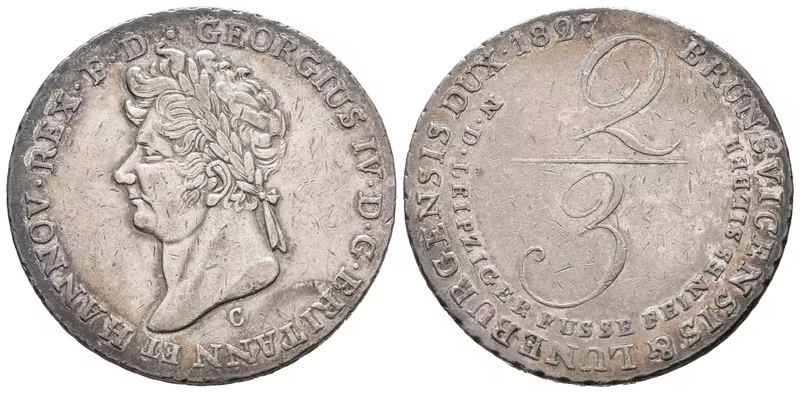
Hanoverian coinage benefited from the rich silver mines in the Harz, especially at Clausthal and Zellerfeld. The Hanoverian thalers struck to the Leipzig minting standard ranked among the highest-quality German coins. Characteristic was the depiction of a wild man holding an uprooted tree, the symbol of Harz mining. During the personal union the coins bore the British royal arms combined with the Hanoverian horse. Gold pistoles and ducats supplemented the silver monetary system.
Mints functioned at Hanover, Clausthal and Brunswick. The quality of the issues was high thanks to modern technologies, including steam presses introduced in the 19th century. After being raised to a kingdom in 1814, Hanover struck thalers with the royal crown and the inscription König von Hannover. The Vereinsthaler, introduced in 1857, unified Hanoverian coinage with that of the other German states. Hanoverian coins document the economic prosperity founded on mining and trade.
In our auction and shop
- Code: NABRACAH-C1827
Brunšvicko-Hannoversko, 2/3 Tolaru 1827 C
Braunschweig-Calenberg-Hannover, Georg IV. (1820 - 1830) 2/3 Taler 1827 C , Clausthal, KM.140, AKS.39, tmavá patina, škr. a drobné hranky