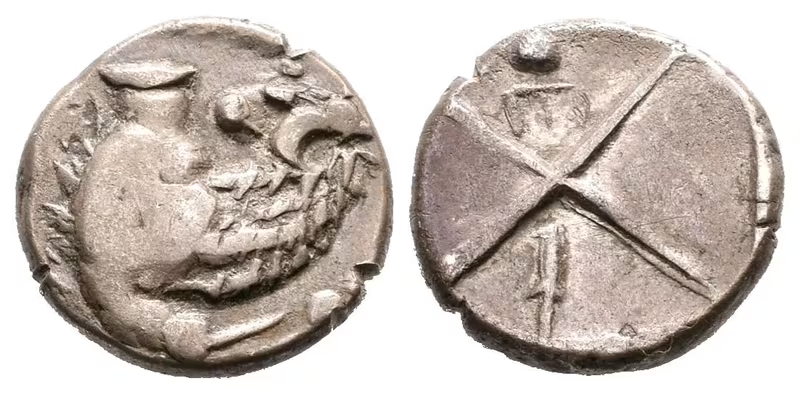
Hemidrachm
The hemidrachm is an ancient Greek silver (sometimes also bronze) coin of the value of half a drachm. It belonged to the smaller denominations used in the city-states and later in the Hellenistic world, and made everyday payments possible where the drachm was too large for daily exchange.
The hemidrachm grew out of the Greek weight-and-coinage system, in which the drachm was one of the most widespread units of silver currency. The very name is transparent: the prefix hemi- means "half", so a hemidrachm is literally a "half-drachm". In the Greek world there was no single uniform "currency" managed by a central state; on the contrary, the individual communities and states used their own standards and their own coins, which differed in weight and iconography. Even so the drachm and its fractions became so common a language of trade that a large part of the Mediterranean understood it—at least within regional spheres.
The value and weight of the hemidrachm depended on which weight standard the state in question used. The best known is the Attic circle associated with Athens, where the basic units were derived from the well-known "owls". In other areas, for example, the Aeginetan, Corinthian or Rhodian standards prevailed. This means that hemidrachm in a catalogue does not automatically mean one specific weight, but "half of the local drachm". For the numismatist it is therefore always important to give not only the denomination but also the minting circle and the type of issue, since it is precisely these data that determine whether it is a smaller "lighter" issue or a piece which by its weight approaches the coins of other areas.
Hemidrachms were struck in the classical period of Greek history, but they also found significant use in the Hellenistic period, when after the conquests of Alexander of Macedon great monetary flows spread across the Aegean, Asia Minor, the Levant and Egypt. In the Hellenistic kingdoms larger silver denominations (tetradrachms) became established, but everyday life and the local market needed smaller coins. The hemidrachm thus often performed the role of a "practical middle" coin: it was not as small as the smallest obols, but it was accessible for everyday exchange, wages and smaller payments.
History
In the Roman period Greek coinage gradually adapted to the new political framework. A number of cities retained the right to strike local coins, but the proportions of denominations and the circulation changed according to how Roman money established itself in the region and what taxes and payments were required. The hemidrachm as a term, however, survived also in numismatic description: even if some later issues no longer corresponded exactly in weight to the classical "half-drachm", the designation was used for the type of coin which traditionally filled this value position. From the long-term standpoint the hemidrachm thus represents a good example of how Greek monetary concepts were maintained across transformations of states and how denominations adapted to local needs of trade and administration.
The hemidrachm is most often associated with silver, since silver coins formed the backbone of the Greek monetary system. In practice this meant that it was relatively "good-quality smaller" change: valuable enough to be worth striking from silver, yet at the same time small enough to be readily usable in everyday transactions. In some areas and later periods one may also encounter bronze issues, which in cataloguing terminology sometimes take over the traditional nomenclature, although it is no longer a silver coin in the original sense.
The iconography of the hemidrachm tends to be typical of the mint or city-state which issued it. The obverse often shows the head of a deity or personification (for example, Athena, Apollo, Artemis), and the reverse the city's coat of arms, an animal motif or a cultic symbol. Precisely with the smaller denominations legibility is important: the motifs tend to be simpler, with the emphasis on a recognisable sign of the community. With some issues you will encounter monograms, abbreviations of the city's name or the name of the magistrate, which helps in more precisely dating and classifying the individual types.
Denomination, appearance and use in circulation
In circulation the hemidrachm served for payments which were impractical for larger drachms or tetradrachms. It could be used for purchases at the market, for smaller payments for services, or as a part of wages. From the numismatic standpoint it is important to observe whether the coin is struck on a "good" flan and how legible the image is: with small coins, wear and weak strikes show more rapidly. The hemidrachm is therefore a denomination on which one can clearly see the difference between the quality of striking, the state of the dies and actual wear from circulation.
In our auction and shop
- Code: BB-BMC0008Recommended
Řecko, Thrákie, hemidrachma, Chersonesos, BMC 8
Řecko, Thrákie, hemidrachma, Chersonesos, BMC 8 přední polovina lva / pole se čtyřmi díly, BMC 8
Skladem 1 ks