Jacques de Molay
Jacques de Molay (around 1243/1244-1314) was the last Grand Master of the Knights Templar, who headed the order at the time of its greatest crisis. He entered history above all as a symbol of the fall of the Templars after arrests, trials and confiscations at the beginning of the 14th century.
Jacques de Molay came from the region of Franche-Comté and entered the Templar Order in the second half of the 13th century. About his early life we know less, which is common with medieval knights, but he gradually rose in the hierarchy of the order to the point where he was elected Grand Master in 1292. He took over the leadership in an exceptionally difficult situation: the Crusader holdings in the Holy Land were crumbling and in 1291 Acre fell, the last great stronghold of the Latin East. The Templars thereby lost the key base for which the order had originally been founded, and had to seek a new meaning for their existence and a new political anchoring.
Molay sought to maintain the military role of the order and supported the idea of a new crusade. After the loss of the mainland, the Templars relied mainly on Mediterranean bases and on European commanderies that secured finance, horses, equipment and logistics. It was precisely this network, however, that began to provoke envy and suspicion: the Templars were wealthy, disciplined, were subject directly to the Pope and had extensive estates throughout Europe. At the same time the political balance was changing - kings were strengthening their power and seeking greater control over ecclesiastical and order institutions.
The most dramatic clash came in France. King Philip IV the Fair had a complicated relationship with the Templars and sought to subordinate or eliminate them. In October 1307 a coordinated wave of arrests of Templars including the Grand Master was launched in France. The accusations were serious and from today's viewpoint often appear as a mix of propaganda, pressure and politically motivated constructions - they spoke of alleged heresy, denial of the faith or immoralities at admission ceremonies. In practice the trials rested on confessions extracted by interrogation, and ecclesiastical power only gradually had to become involved, because the Templars were subject to papal jurisdiction.
History
Molay found himself in a trap between royal pressure and the ambiguous reaction of the papacy. Pope Clement V tried to manage the situation, but the political reality was harsh: France had the decisive say in the trial and public opinion was manipulated so that mistrust of the order grew. Eventually it was decided to abolish the Templar Order (1312) and its property was to be formally transferred to the Hospitallers, although in practice it was dealt with in different ways in individual countries. For Molay this meant the end of the institution he had led, and for many Templars the loss of standing and life.
In 1314 Jacques de Molay, after further intensification of the trial, was condemned and executed by burning in Paris. His death became a strong symbol: for some it was a "just punishment", for others a political execution and abuse of power. In later tradition Molay was transformed into a legendary figure of the fall of the Templars, often associated with the image of unwavering loyalty to the order and with a dramatic conclusion of the medieval story of wealth, faith and politics.
Jacques de Molay is today perceived above all as the last representative of the order at the moment of its fall. His name has become a shorthand for the demise of the Templars, which to this day attracts the interest of historians, collectors and the wider public. In popular culture legends of a "curse" and dramatic last words are attached to him, but historically more important is that his fate shows the clash of two worlds: an international order subject to the Pope versus rising royal power that wished to dominate wealthy and independent institutions.
The Templar legacy and Molay's place in memory
From the numismatic point of view Molay's time is interesting rather indirectly. The Templars as an order did not issue "their own" circulating coins in the usual sense, but they operated in an environment where money was key for the financing of wars, expeditions and the administration of vast estates. It is precisely the financial dimension that is one of the reasons why the order became a target: the property, credits and organisational ability were attractive for state power. Molay is thus a figure who links the history of the Crusader orders with the history of medieval economy and political centralisation.
In our auction and shop
- Code: RX-FRAN016
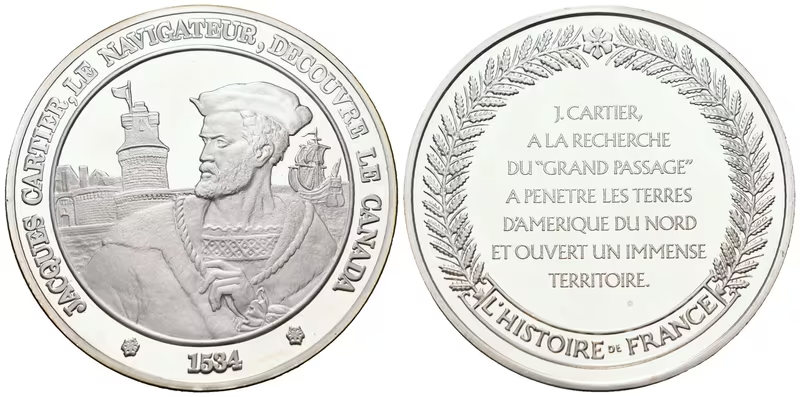
Francie - AR Medaile b.l. - Jacques Cartier
Jacques Cartier - 1491-1557 Ag 0,800, 44 mm (cca. 37 g) Na minci se nachází Francouzský punc ryzosti. V originální kapsli. Medaile je ze série 'Historie Francie v medailích' - Na některých mincích jsou viditelné stopy patiny aj. - Viz. obrázek.…