John George III of Mansfeld
John George III of Mansfeld (12 July 1640 – 1 January 1710) was an Imperial Count of the House of Mansfeld, ruling in part of the County of Mansfeld with his seat in Eisleben. He belonged to the last representatives of the Mansfeld-Eisleben line, and his era is linked with the mining wealth of the region as well as with his own coining activity.
John George III of Mansfeld grew up in the environment of the Central German nobility, for whom the Mansfeld region was a source of both prestige and income. The area around Eisleben for centuries belonged among the important mining regions, especially thanks to the extraction and processing of ores, which sustained towns, crafts and trade. The Counts of Mansfeld were therefore not merely a "landed" aristocracy, but also a power closely bound up with the economy: they supervised mining enterprise, collected dues and sought to maintain control over resources which in the early modern period were strategic.
The political situation of the county was not, however, simple. The Mansfeld holdings had historically been split among several family branches, and the division of estates often meant not only a complex administrative arrangement but also financial tension. In the second half of the 17th century, moreover, Central Europe was still bearing the consequences of the Thirty Years' War: a number of regions long laboured to recover, restore production and stabilise public finances. For small and medium-sized lordships it was crucial to maintain a functioning administration, secure revenues and not undermine the confidence of creditors, since noble courts and offices were expensive and the yields of the economy fluctuated.
Within this framework John George III drew upon the traditional Mansfeld base and sought to maintain the family's standing in a region where great weight was carried not only by the nobility but also by the town economy and mining enterprise. Eisleben was a lively centre of the region: metals and their processing meant money in the most direct sense of the word, since metal became currency, a taxable product and the foundation for trading contacts. Comital policy therefore naturally intervened in how production was organised in the area, how dues were collected and how order was maintained at a time when social and economic relations tended to be strained.
History
From the standpoint of family history it is important that John George III is usually mentioned as the last count of the Mansfeld-Eisleben line. His death at the beginning of the 18th century thus became a turning point, since after it the dynastic and proprietary arrangement that the Mansfelds represented in the area changed. For the region it meant a further step towards the former "family" lordships being increasingly integrated into the wider territorial and state structures, in which decisions were taken by larger power units and a more centralised administration.
John George III of Mansfeld is interesting for numismatics in that his name appears on coins issued within the Mansfeld circle. It is typical of the early modern period that the coin fulfilled a dual role: it was a practical means of exchange and at the same time a public testimony of legitimacy. On strikes, therefore, the sovereign's name and title are deployed, often supplemented by distinct heraldry, so that it should be clear who stood behind the coin and what "reputation" it had in circulation.
Mansfeld-Eisleben coin production is associated above all with silver denominations of the thaler family, including fractions of the thaler, which suited everyday commercial dealings. With such coins, good legibility of legends and arms is typical, since in the German region many strikes from various issuers circulated alongside each other and identification of origin was essential for merchants and burghers alike. Alongside standard currency, commemorative strikes also appear in the Mansfeld environment, which recalled religious or political events and were rather of a representative character — this too is an example of how the nobility used the coin as a "medium" for messages and prestige.
Coins of Mansfeld-Eisleben and comital representation
For collectors, Mansfeld coins from the era of John George III are attractive in their combination of regional history and quality artistic work. Unlike the great kingdoms, these are strikes of a smaller territory in which every detail can be interesting: variants of legends, minor deviations in the execution of the arms or specific years of issue. In sum, John George III represents a sovereign whose coins are tangible evidence of how closely the histories of metal, economy and power were intertwined in a mining region.
In our auction and shop
- Code: XB1290-3
Moravské denáry - Pavel Šťastný, III. díl
Moravské denáry 10. - 12. století ze sbírky Pavla Šťastného - III. díl Nabízíme vám exkluzivně čtyřsvazkovou edici proslulé sbírky českých denárů a brakteátů Pavla Šťastného. Sbírka představuje nejúplnější komplet českých raně středověkých mincí 10. -…
Skladem (>5 ks) - Code: XB1290-LOTNew
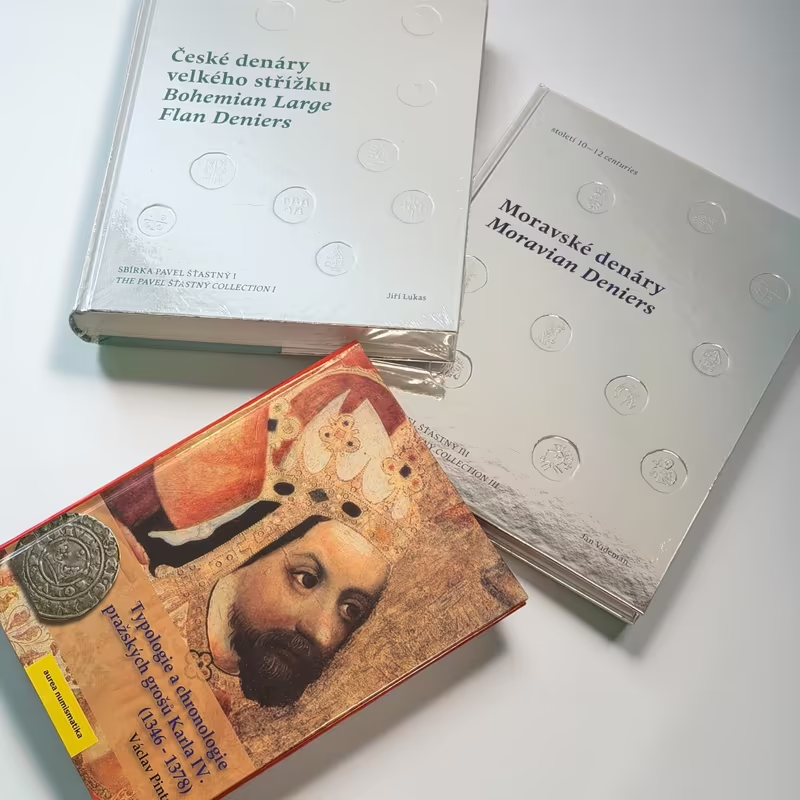
Sbírka denárů Pavla Šťastného, I. a III. díl + Pražské groše Karla IV. (dárek k nákupu)
Sbírka denárů Pavla Šťastného, I. a III. díl + Pražské groše Karla IV. (dárek k nákupu) Nabízíme vám dva zatím vydané díly čtyřsvazkové edice proslulé sbírky českých denárů a brakteátů Pavla Šťastného. Sbírka představuje nejúplnější komplet českých raně…
Skladem (>5 ks) - Code: XB1290-1New
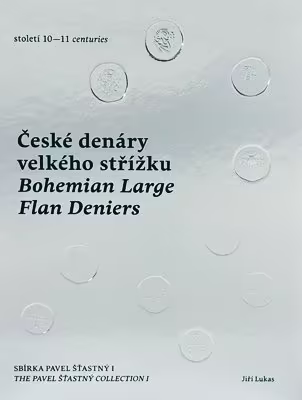
České denáry velkého střížku - Pavel Šťastný, I. díl
České denáry velkého střížku ze sbírky Pavla Šťastného - I. díl Nabízíme vám exkluzivně čtyřsvazkovou edici proslulé sbírky českých denárů a brakteátů Pavla Šťastného. Sbírka představuje nejúplnější komplet českých raně středověkých mincí 10. - 13.…
Skladem 2 ks