Charles III of the United Kingdom
Charles III is the current British king, who acceded to the throne on 8 September 2022 after the death of his mother Queen Elizabeth II, ending the longest period of waiting for the throne in British history. His reign represents the beginning of a new era of the British monarchy after the seventy-year reign of Elizabeth II, and as the first British sover…
Charles Philip Arthur George was born on 14 November 1948 at Buckingham Palace as the first child of Princess Elizabeth and Prince Philip, Duke of Edinburgh. At the time of his birth his grandfather George VI was king, and the young Charles became second in line of succession. After George VI's death in February 1952 his mother acceded as Elizabeth II, and the three-year-old Charles became heir to the throne and Duke of Cornwall. In 1958 he gained the title of Prince of Wales, which he bore until his accession to the throne.
Charles was educated at leading British schools including Gordonstoun in Scotland and Trinity College, Cambridge, where as the first British heir to the throne he obtained a university degree. In the years 1971–1976 he served in the Royal Navy, where he trained as a helicopter pilot and commanded the minesweeper HMS Bronington. His military service followed the tradition of British rulers and strengthened his bond with the armed forces.
In 1981 Charles married Lady Diana Spencer in the "wedding of the century", watched by hundreds of millions of viewers around the world. From the marriage two sons were born – Prince William in 1982 and Prince Harry in 1984. The marriage, however, was problematic from the outset, and the couple separated in 1992 and divorced in 1996. Diana's tragic death in 1997 in Paris triggered a crisis in the monarchy and Charles's popularity fell to a historic low. In 2005 Charles married his long-time partner Camilla Parker Bowles, who received the title of Duchess of Cornwall and, after his accession to the throne, became queen consort.
History
As Prince of Wales, Charles was the longest-serving heir to the throne in British history – he held the role for over 70 years. During this time he built up an extensive network of charitable organisations, especially the Prince's Trust, which since 1976 has helped more than a million young people. He became a pioneer in ecology and sustainable development, long before these topics became mainstream. His interest in architecture, organic farming and interfaith dialogue often aroused controversy, but he gradually won recognition for his visionary work.
Charles's interest in the environment was reflected in the founding of Duchy Originals, an organic food brand whose profits went to charity. His criticism of modern architecture led to the founding of the experimental town of Poundbury in Dorset, built on the principles of New Urbanism. As Prince of Wales he undertook hundreds of official foreign trips and became an unofficial ambassador for Britain, building personal relationships with many world leaders. His "black spider memos" – handwritten letters to ministers – sparked debates about the constitutional limits of royal interventions.
After the death of Elizabeth II on 8 September 2022 Charles automatically became king at the age of 73, becoming the oldest sovereign on accession to the British throne. His coronation took place on 6 May 2023 at Westminster Abbey as the first royal coronation of the 21st century. The ceremony was shorter and more modest than that of his mother in 1953, reflecting the multicultural character of modern Britain and Charles's emphasis on interfaith dialogue. As King Charles III he announced the intention to slim down the monarchy and reduce the number of working members of the royal family, in keeping with his long-standing vision of a more modern and efficient monarchy.
Coin portrait and numismatic changes
The accession of Charles III to the throne launched the greatest transformation of British coinage since 1952. His official coin portrait, created by the British sculptor Martin Jennings, was unveiled in September 2022. The portrait shows the king without a crown, facing to the left, thus reviving the tradition of alternating the direction of the portrait between sovereigns. The inscription on the coins reads CHARLES III • D • G • REX • F • D (Dei Gratia Rex Fidei Defensor – by the Grace of God King, Defender of the Faith). The first circulating coins with the portrait of Charles III – a 50-pence coin commemorating Elizabeth II – entered circulation in December 2022.
The Royal Mint is gradually introducing Charles's portrait on all British coins, while coins with the portrait of Elizabeth II remain legal tender and will circulate alongside for many years. It is estimated that some 29 billion coins with the portrait of Elizabeth II are in circulation, whose gradual replacement will take decades. In addition to the United Kingdom, the new royal portrait is also adopted by the Commonwealth countries that have retained the British sovereign as head of state, including Canada, Australia and New Zealand. Each country produces its own design with Charles's portrait according to local numismatic traditions.
In our auction and shop
- Code: SSVAH-G2024
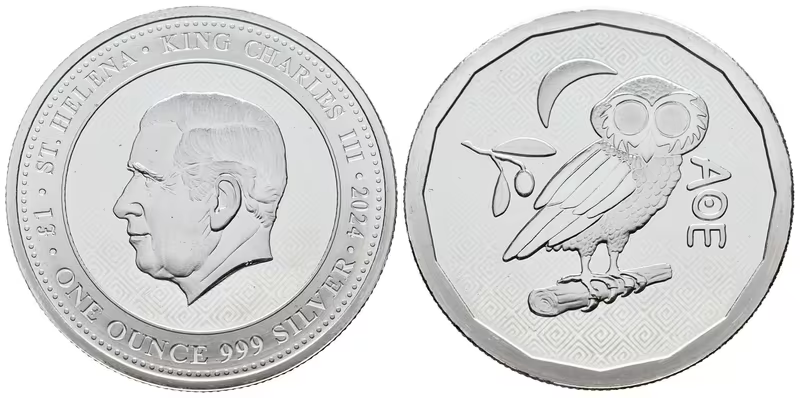
Svatá Helena, 1 Pound 2024 - 1 Oz (Athénská sova)
Svatá Helena, Karel III. (2022 -) 1 Pound 2024 - 1 Oz (Athénská sova), KM# 236 Ag (.999), 39 mm (31,1 g), v kapsli. Emise: 10 000 ks. Mincovna: Silver Towne Mint - USA. Stříbrná uncová investiční mince - 1 Oz. Lit.: KM# 236.
Skladem 1 ks - Code: RG-ZTOL14
Replika - Historický tolar - Karel III. 1733
Replika - Historický tolar - Karel III. 1733 Ag 999/1000 20 g Replika Tolar
- Code: RG-ZREP18
Replika - Historický 1/2 tolar - Karel III. 1724
Replika - Historický 1/2 tolar - Karel III. 1724 Ag - 333/1000, 10,37 g, vč. certfifikátu a kapsle
- Code: SAUST-P2023.1
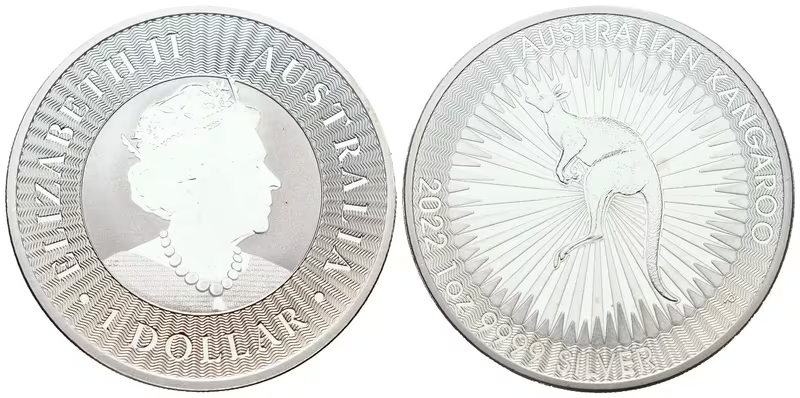
Austrálie, 1 Dollar 2023 - 1 Oz (Klokan)
Australské společenství, Karel III. (2022 -) 1 Dollar 2023 - 1 Oz (Klokan) Ag (.9999), 40,6 mm (31,1 g), BU (brilliant uncirculated). Mincovna: Perth Mint, Austrálie. Stříbrná uncová investiční mince - 1 Oz; série "Australian Kangaroo" (Australský…