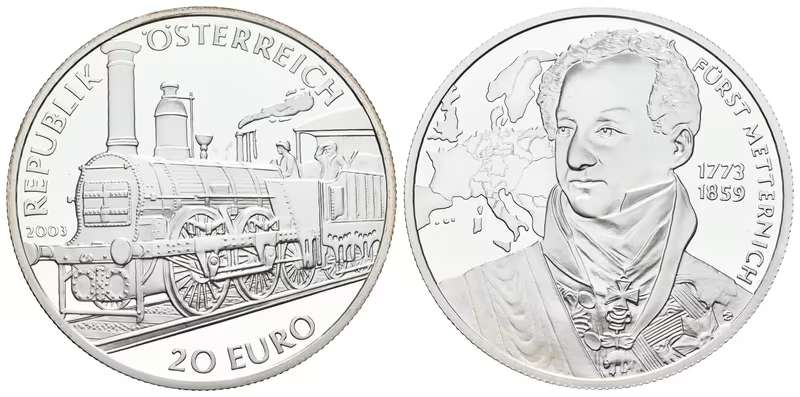
Klemens von Metternich
Klemens von Metternich (1773–1859) was an Austrian statesman and diplomat who in the first half of the 19th century belonged to the most influential figures of European politics. He is most associated with the post-war settlement after the Napoleonic Wars and with the conservative policy whose aim was to maintain the stability of monarchies and suppress r…
Klemens von Metternich was born into the milieu of the imperial nobility and already in his youth moved in the diplomatic circles that were key for the Habsburg Monarchy. At a time when Europe was being shaken by the Napoleonic Wars, it became essential for Austria not only to fight but also to negotiate – and Metternich gradually established himself precisely as a man who could combine political intuition with cold calculation of interests. His career culminated in the role of chief architect of Austrian foreign policy, which he directed over the long term as foreign minister and later as state chancellor.
Metternich’s best-known period is that around the Congress of Vienna, when after Napoleon’s defeat decisions were taken about the new shape of Europe. Metternich strove to return the continent to a balance of powers and to prevent further "revolutionary" upheaval. From his point of view it was key to maintain the legitimacy of dynasties and to create an international order in which no state would gain a preponderance that would force others into desperate coalitions. This policy often appears as a defence of the old world, yet at the same time it was a pragmatic attempt to prevent a repetition of the catastrophes of the Napoleonic Wars.
Domestically, Metternich is associated with the strengthening of supervision over public life, with censorship and with measures against radical movements. In the Habsburg Monarchy and in the wider German space he sought to slow the spread of revolutionary ideas and national programmes, which he perceived as a threat to the stability of the multinational state. His system rested on the notion that society should be governed from above and that rapid political changes lead more to chaos than to progress. In the short term this strategy could bring calm, yet at the same time it postponed the resolution of problems that were accumulating in society.
History
The turning point came in 1848, when Europe was shaken by a revolutionary wave. In the Habsburg Monarchy it became clear that the existing model of governance was no longer able to resist the pressures without fundamental changes. Metternich then lost political support and went into exile. Nevertheless his name has remained in history as a symbol of an era: the time when European politics tried to stabilise the world after revolutions and wars through diplomacy, alliances and a conservative order. In later years Metternich returned to the monarchy, but his decisive influence belonged to the past.
Metternich’s legacy is above all political: he belonged to the creators of the balance-of-power system and to the most visible representatives of 19th-century conservative diplomacy. For the Habsburg lands it is important that his period falls in the time when the state rested on firmly directed administration, representation and symbols of power. Precisely in such a milieu coins and medals play a significant role – as a means of state presentation, the commemoration of great events and the dissemination of the official image of the monarchy.
In numismatics, Metternich is usually recalled indirectly, that is, in connection with the time "after Napoleon" and with the atmosphere of restored order which the monarchies expressed also through commemorative strikes and ceremonial medals. These objects often celebrate peace, the legitimacy of rulers and the stability of the state. If Metternich appears directly, it is rather on medals or commemorative objects than on circulating coins, since the coin usually bore above all the ruler and state symbols, while figures of state administration were more often featured in medallic art.
Metternich’s significance and connections with coins
As a dictionary entry Metternich is also useful for orientation in Habsburg history: he helps to understand why the first half of the 19th century is perceived as a time of "conservative order", what values the state promoted and how these values were projected into public symbols – including numismatic and medallic motifs.
In our auction and shop
- Code: SRAK2-B2003B
Rakousko, 20 Euro 2003 - Metternich
II. republika (1945 - ) 20 Euro 2003 - K 230. výročí narození Klemense von Metternicha, KM.3104, PROOF, kapsle Ag 0,900, 34 mm (20 g)