Kingdom of Jerusalem
The Kingdom of Jerusalem was a Crusader state existing in the years 1099 to 1291 on the territory of today's Israel, Palestine, Lebanon and part of Syria. It represented the most significant outcome of the First Crusade and the longest-lasting Crusader state in the Near East.
The Kingdom of Jerusalem arose on 15 July 1099, when the Crusaders captured Jerusalem and elected Godfrey of Bouillon Defender of the Holy Sepulchre. Godfrey refused the royal title in the city where Christ had worn the crown of thorns. His brother Baldwin I accepted the royal crown in 1100 and launched the expansion of the kingdom. The Crusaders gradually captured the coastal cities of Jaffa, Haifa, Acre, Tyre and Sidon. The kingdom comprised four main states: the kingdom proper, the Principality of Antioch, and the counties of Edessa and Tripoli.
Under Baldwin II and Fulk of Anjou in the first half of the 12th century the kingdom reached its greatest extent. A unique feudal system arose, combining Western and Byzantine elements. The military orders of the Templars and Hospitallers defended the frontier fortresses. The Assises de Jérusalem created an elaborate legal system. The Latin patriarch resided in Jerusalem, but most of the inhabitants were Orthodox Christians and Muslims. The kingdom prospered from trade between Europe and the Orient.
History
The turning point came in 1187, when Sultan Saladin defeated the Crusader army at the Battle of Hattin and captured Jerusalem. The Third Crusade led by Richard the Lionheart restored the kingdom in a reduced form with its capital at Acre. Frederick II obtained Jerusalem diplomatically in 1229, but the city was definitively lost to the Khwarezmians in 1244. The kingdom survived as a coastal strip around Acre, dependent on the support of the Italian maritime republics.
The last period of the kingdom was marked by internal conflicts between the barons, the military orders and the Italian merchants. The gradual rise of the Mamluk Sultanate threatened the remnants of the Crusader holdings. Sultan Baibars captured Antioch in 1268. In 1289 Tripoli fell. The end came on 18 May 1291, when the Mamluk Sultan al-Ashraf Khalil captured Acre after a bloody siege. The last Crusaders abandoned Tyre and Sidon. The title of King of Jerusalem passed to the Cypriot and later to the Neapolitan rulers.
Coinage of the Kingdom of Jerusalem
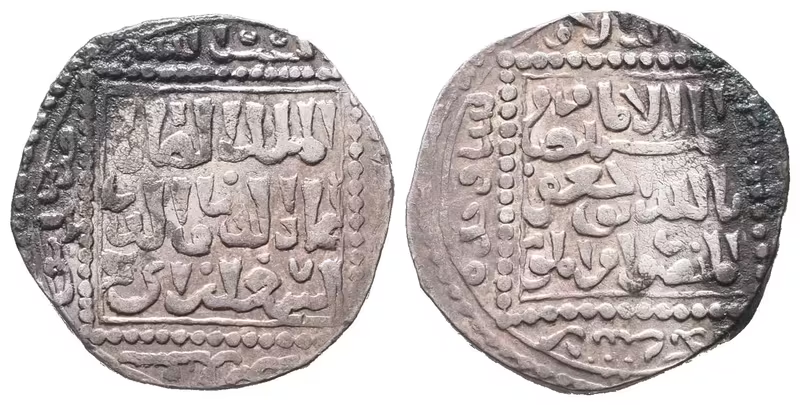
The Kingdom of Jerusalem struck silver denarii on the Western model with unique elements. The coins bore Latin inscriptions REX IERUSALEM and often a cross or the Temple of the Lord. A curiosity was the bilingual strikes with Arabic inscriptions for the Muslim population. Gold bezants imitated Byzantine and Fatimid coins for international trade. The quality of the strikes fluctuated with the political situation but generally maintained the Byzantine standard.
Mints functioned at Jerusalem, Acre and Tyre. After the loss of Jerusalem, Acre became the main production centre. Crusader coins document the economic relations between West and East. The Templar and Hospitaller orders struck their own coins for their possessions. The denarii of Jerusalem influenced the coinage of other Crusader states and the Cypriot kingdom. Today these coins are a valuable testimony to the Crusades and to medieval cultural exchange.
In our auction and shop
- Code: SAJJUB-1221
Ajjúbovci, Dirham
Ajjúbovci-Jeruzalemské království, imitace Ajjúbovská ve jménu As-Salih Ismail AH 635-642 (1237-1245 AD) Dirham b.l., rok 617-622 AH (1221-1225 AD)?, minc. Akko nebo Damašek, pod. jako Album 840-849 a Balog 767 , pěkná zachovalost a patina (3,03 g)