Kingdom of Sardinia
The Kingdom of Sardinia was a southern European state existing in the years 1297 to 1861, comprising the island of Sardinia and from 1720 also Piedmont, Savoy and Nice. Under the rule of the House of Savoy it became the leading force of Italian unification and the foundation of modern Italy.
The Kingdom of Sardinia was formally founded in 1297, when Pope Boniface VIII granted James II of Aragon the investiture of Sardinia and Corsica in exchange for the renunciation of Sicily. The actual Aragonese control of the island was, however, limited; the local giudicati and the city republics of Pisa and Genoa retained independence. Only Martin I of Sicily in the years 1409 to 1410 definitively attached Sardinia to the Aragonese Crown. The island remained part of Aragon and later of Spain until the beginning of the 18th century.
After the War of the Spanish Succession, Sardinia was obtained by Austria in 1713 under the Peace of Utrecht. In 1720, however, Emperor Charles VI exchanged Sardinia with the Duchy of Savoy for Sicily. Victor Amadeus II of Savoy became the first Savoyard king of Sardinia. The capital of the kingdom remained Turin in Piedmont, while the island of Sardinia was a poor and backward periphery. The Savoyard kings gradually extended their possessions in northern Italy at the expense of Austria and the smaller Italian states.
History
Under Charles Albert in the years 1831 to 1849 the Kingdom of Sardinia became the centre of the Italian national movement. Charles Albert issued in 1848 the liberal constitution known as the Statuto Albertino and led the First War of Italian Independence against Austria. After defeat at Novara he abdicated in favour of his son Victor Emmanuel II. The latter, together with the minister Camillo Cavour, led the Second War of Independence in alliance with France. In the years 1859 to 1860 Sardinia acquired Lombardy, Tuscany, Parma and Modena.
The decisive year 1860 brought the expedition of Giuseppe Garibaldi to Sicily and Naples. Garibaldi captured the Kingdom of the Two Sicilies and handed it over to Victor Emmanuel II. On 17 March 1861 Victor Emmanuel II was proclaimed King of Italy. The Kingdom of Sardinia was transformed into the Kingdom of Italy, while retaining the Sardinian constitution, laws and institutions. Turin was briefly the capital of unified Italy, until Rome was annexed in 1871.
Coinage of the Sardinian Kingdom
Sardinian coinage developed differently on the island and in the Piedmontese possessions. On Sardinia, Spanish reales and escudos were struck according to the Aragonese-Spanish system. After the transition to Savoyard rule, Charles Emmanuel III introduced a unified coinage system with the gold doppia weighing 9.7 grams and the silver scudo. Victor Amadeus III in 1755 reformed the coinage by introducing a new Piedmontese scudo divided into 6 lire.
Charles Albert carried out a monetary reform in 1816 by introducing the lira as the basic unit divided into 100 centesimi. This decimal system became the model for the later Italian lira. Gold coins of 100, 50 and 20 lire and silver coins of 5, 2 and 1 lira were struck. Mints functioned at Turin, Genoa and Cagliari. The quality of the minting was high, with detailed portraits of rulers. Sardinian coins document the economic modernisation and the political rise of the House of Savoy.
In our auction and shop
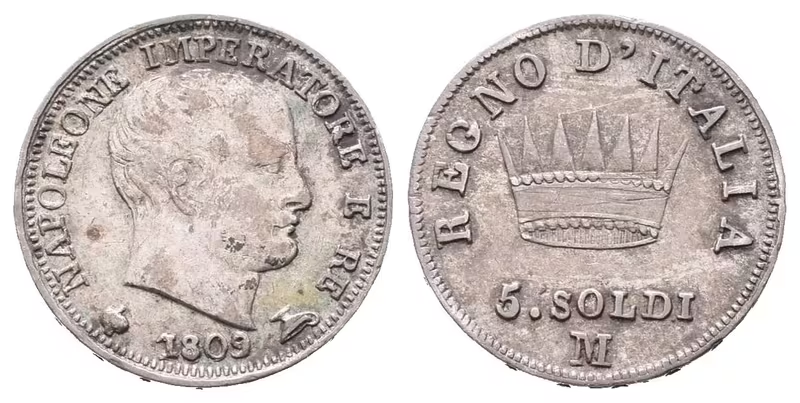
- Code: SFRA95-D1809M
Francie - Italské království, 5 Soldi 1809 M
Francie, Napoleon Bonaparte, jako Italský král, 1805 - 1814 5 Soldi 1809 M, Milano, C.5, pěkná zachovalost, jemná patina, drobné rysky a hranky
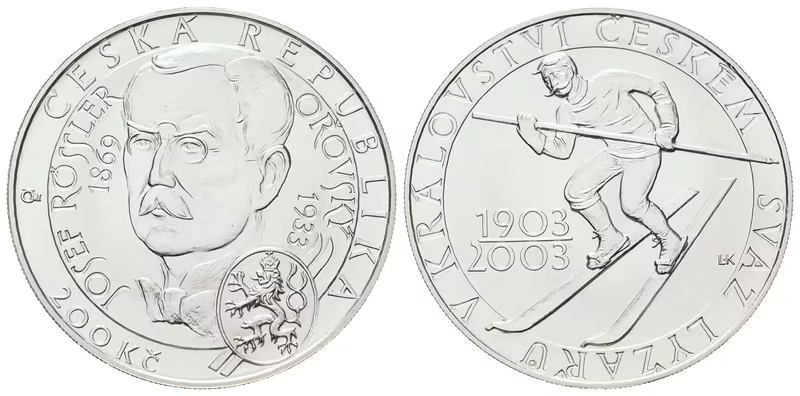
Skladem 1 ks - Code: MCZ042
200 Kč 2003 - Svaz lyžařů v Království českém
Česká republika (1993 - ) 200 Koruna 2003 - 100. výročí ustavení Svazu lyžařů v Čechách, autor Ladislav Kozák, Aurea C142, kapsle, certifikát, běžná kvalita Ag 0,900, 31 mm (13 g), raženo 10 790 ks (běžná kvalita), 4 284 ks (proof)
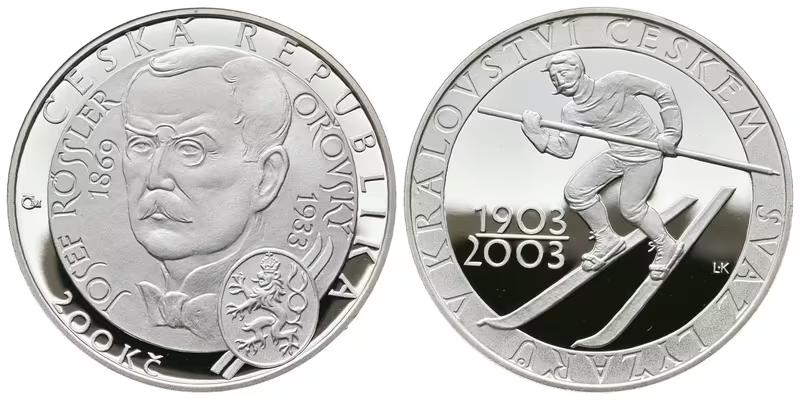
Skladem (>5 ks) - Code: MCZ042-PROOF
200 Kč 2003 - Svaz lyžařů v Království českém, PROOF
Česká republika (1993 - ) 200 Koruna 2003 - 100. výročí ustavení Svazu lyžařů v Čechách, autor Ladislav Kozák, Aurea C142, kapsle, certifikát, PROOF Ag 0,900, 31 mm (13 g), raženo 10 790 ks (běžná kvalita), 4 284 ks (proof)
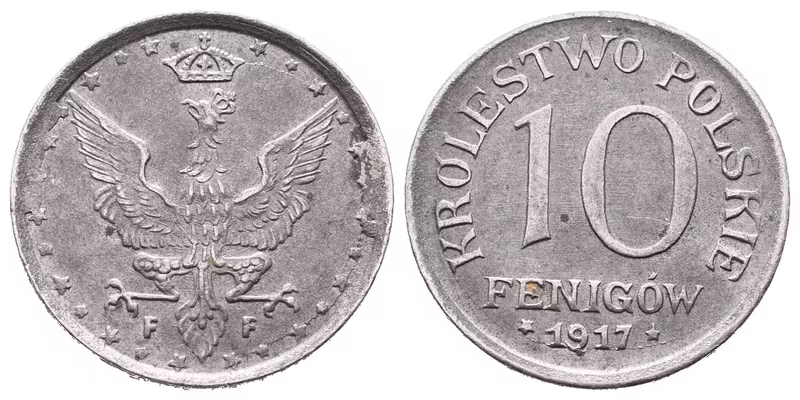
Skladem 1 ks - Code: SPOL-C1917F
Polsko, 10 Fenig 1917 (Fe)
Polsko, Regentské království Polské, 1916 - 1918 10 Fenigów 1918 F, KM.6, patina, pěkná zachovalost, zbytky lesku
Skladem 1 ks