House of Savoy
The House of Savoy (in Italian Casa Savoia, in French Maison de Savoie) was one of the oldest European royal dynasties, which ruled in Savoy, Piedmont, Sardinia and later united Italy from the 11th century until 1946. From the numismatic point of view they created an important coinage system, which developed from the medieval Savoyard deniers through the…
The House of Savoy gained minting rights for the first time under Humbert I the White-Handed (1003–1047), the founder of the dynasty. The first documented Savoyard coins were struck by Amadeus III (1103–1148) at the Susa mint — these were silver deniers with a cross and the inscription SECUSIA. These early strikes followed the Carolingian model and circulated mainly in the Alpine passes controlled by the dynasty.
A significant development came under Amadeus V the Great (1285–1323), who gained the title of imperial vicar and the right to strike gold coins. His gold florins on the Florentine model bore the Savoyard arms — a white cross on a red field. He also introduced grossi — heavy silver coins, which became the backbone currency of Savoyard trade. The mints at Chambéry, Turin and Nyon produced quality strikes.
In the 15th century Amadeus VIII (1391–1440), who became the antipope Felix V, carried out a coinage reform. He introduced a heavy teston with his own portrait — the first Renaissance portrait coin in the Alps. His gold ducats with the motif of the Annunciation to the Virgin Mary belonged among the most beautiful European coins. The acquisition of the ducal title (1416) was reflected in a richer iconography.
The shift of the centre of power to Piedmont under Emanuele Filiberto (1553–1580) marked a new era. The Turin mint became the main centre of production. Scudi on the Spanish model and talleri for international trade were introduced. Technically advanced minting machines from Augsburg made possible mass production of uniform quality.
History
The acquisition of Sardinia (1720) and the royal title for Victor Amadeus II brought the extension of the coinage system. The Sardinian mints in Cagliari and Sassari struck specific denominations — reales and cagliaresi. The continental scudo sabaudo contained 26.4 grams of silver and became an internationally recognised currency. Gold doppie competed with French louis d'or.
Napoleon temporarily ended Savoyard minting when he annexed Piedmont (1798–1814). After the restoration Victor Emmanuel I restored the coinage system, but had to face economic problems. Charles Albert (1831–1849) carried out a reform by introducing a new lira worth 5 grams of silver at 900/1000 fineness. This system became the basis of Italian currency.
Victor Emmanuel II (1849–1878), as the first king of united Italy (1861), extended the Savoyard coinage system to the whole peninsula. The Italian lira on the Piedmontese model replaced dozens of local currencies. The Savoyard arms remained on coins until the fall of the monarchy in 1946. The last king Umberto II ruled for only 34 days; his coins are extremely rare.
The medieval Savoyard system was based on the silver denier divided into 12 piccoli. The grosso was equal to 12 deniers. From the 14th century there existed a gold florin (fiorino) worth 12 grossi. This system with modifications functioned until the Napoleonic wars. The white teston (bianco) introduced in the 15th century contained 9.5 grams of silver.
Coinage system and important strikes
The modern system of the 17th–18th centuries used the scudo d'argento (26.4 g of silver) divided into 6 lire. The gold doppia contained 6.6 grams of gold. There was a complex hierarchy of denominations — ducatone, mezzo scudo, quarto di scudo, lira, soldi. The Sardinian variants had different values because of the different prices of precious metals on the island.
The modern decimal system of Charles Albert (1831) established: 1 lira = 100 centesimi. The marengo — a gold 20-lira coin (6.45 g of gold at 900/1000) — became the Italian equivalent of the napoleon. Silver 5-lira pieces contained 25 grams of silver. After unification the denominations were retained, but with a uniform design for the whole of Italy.
In our auction and shop
- Code: SRAK2-E1963
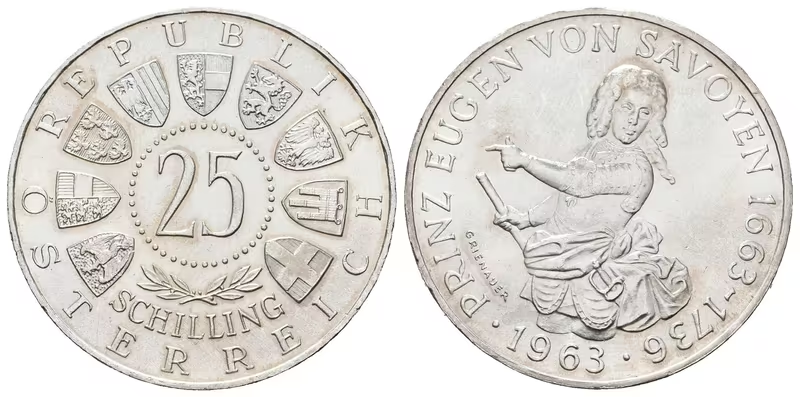
Rakousko, 25 Schilling 1963 - Savojský
II. Republika, 1945 - 25 Schilling 1961 - K 300. výročí narození prince Evžena Savojského, KM.2893, krásná zachovalost Ag 0,800, 30 mm (13 g)
- Code: SRAK1-B1936
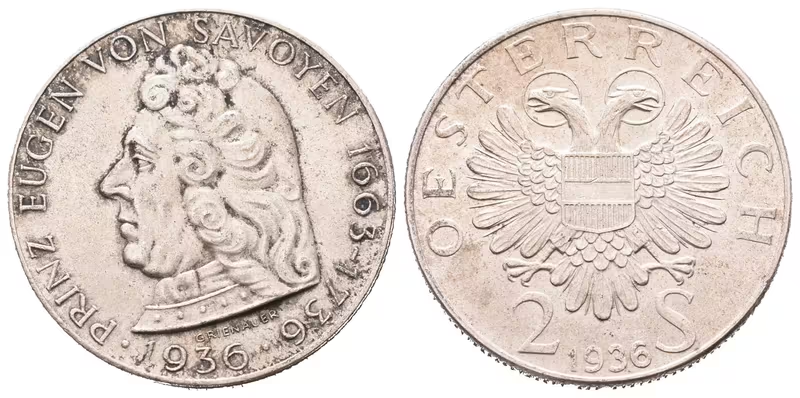
Rakousko, 2 Schilling 1936 - Evžen Savojský
Republika, 1919 - 1934/1938 2 Schilling 1936 - Princ Evžen Savojský, KM.2852, pěkná zachovalost, patina
- Code: ZD-2018ZLA
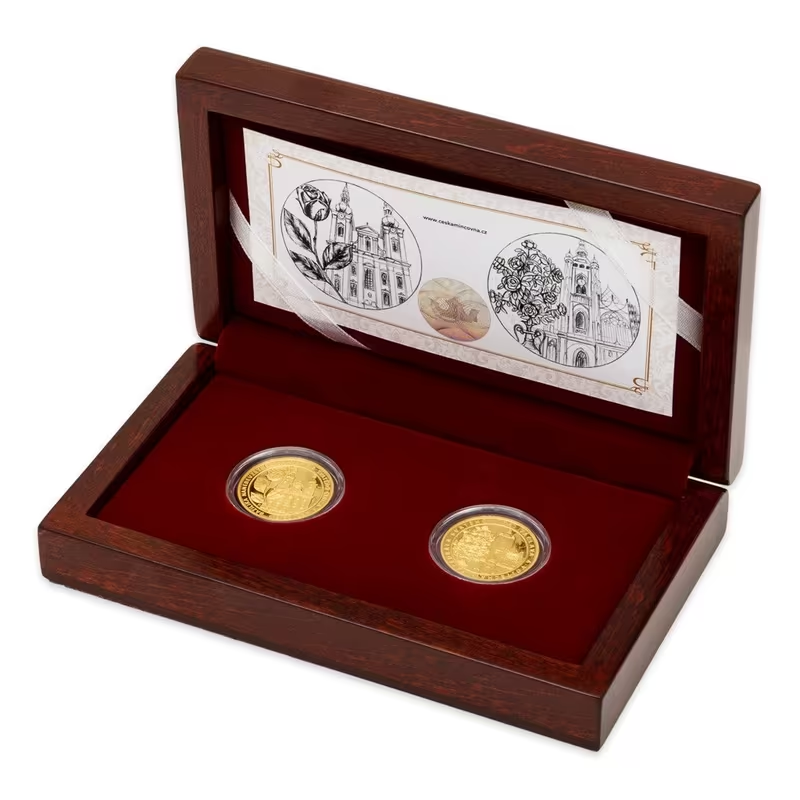
Sada mincí 2018 - Zlatá růže od papeže
Česká republika (1993 - ) Sada dvou mincí 2018 (Mária Filová) - Zlatá růže pro papeže - Velehradská bazilika, Katedrála sv. Víta 2x Au 0,9999, 22 mm (7,78 g), náklad 300 ks, certifikát, etue, papírový přebal, PROOF Když chce papež vyjádřit svou úctu a…