Victor Emmanuel II
Victor Emmanuel II (1820-1878) was the first king of unified Italy, reigning from 1861 until his death. Originally king of Sardinia-Piedmont from 1849, he led the unification of Italy with the help of Cavour and Garibaldi.
Victor Emmanuel was born in Turin as the son of King Charles Albert of Sardinia and Maria Theresa of Habsburg-Lorraine. He received a military education and showed more interest in hunting and mistresses than in politics. After his father's defeat at Novara in 1849, he ascended the throne in a critical situation – Piedmont defeated by Austria, revolutions suppressed. The young king surprised everyone – he preserved the constitution (the only one in Italy) and appointed Cavour as minister. "Re galantuomo" (the gentleman king) won the sympathies of Italian liberals.
With Cavour he formed a team – the king represented, the minister governed. The Crimean War of 1855 gained Piedmont international prestige. An alliance with Napoleon III brought victory over Austria in 1859 – Lombardy annexed. The price was high – Nice and Savoy to France. Garibaldi conquered Sicily and Naples in 1860 and handed them to the king at Teano. Plebiscites confirmed the unification. On 17 March 1861 Victor Emmanuel was proclaimed king of Italy. Turin, then Florence served as capitals, while Rome remained papal.
History
The Austro-Prussian War of 1866 brought Venetia. The Franco-Prussian War of 1870 made possible the occupation of Rome – on 20 September the breach at Porta Pia. The pope shut himself in the Vatican as a "prisoner". Victor Emmanuel entered the Eternal City but respected the Church. His final years were difficult – the death of his son Umberto, conflicts with the left. He died on 9 January 1878 and was buried in the Pantheon. "Padre della patria" (Father of the Fatherland) fulfilled the dream of the Risorgimento. His son Umberto I and grandson Victor Emmanuel III continued the dynasty until the republic of 1946.
Victor Emmanuel II created the first unified Italian monetary system. The lira, based on the French franc (Latin Monetary Union), replaced dozens of regional currencies. Gold 5, 10, 20, 50 and 100 lire and silver 5, 1 and 2 lire bore his bearded portrait and the inscription VITTORIO EMANUELE II RE D'ITALIA. The reverses depicted the Savoy arms or the denomination within a wreath. The design was classicist and dignified.
Victor Emmanuel II and Italian royal coinage
The transitional issues are interesting. Sardinian coins of 1850-1860 bore the title RE DI SARDEGNA. The first Italian coins of 1861 carry RE ELETTO (elected king). From 1863 onwards: RE D'ITALIA. The mints were marked by letters – M Milan, T Turin, R Rome, N Naples. Each retained local traditions. Victor Emmanuel struck the largest Italian gold coin – 100 lire (32.25 g of gold). Also the smallest – the 5-centesimi copper. Special issues for the Vatican after the occupation were controversial. After his death came commemorative coins with the inscription "Padre della patria". His coinage laid the foundations of the Italian lira, which existed until the euro in 2002. Numismatically they document the emergence of modern Italy from a mosaic of kingdoms, duchies and republics.
In our auction and shop
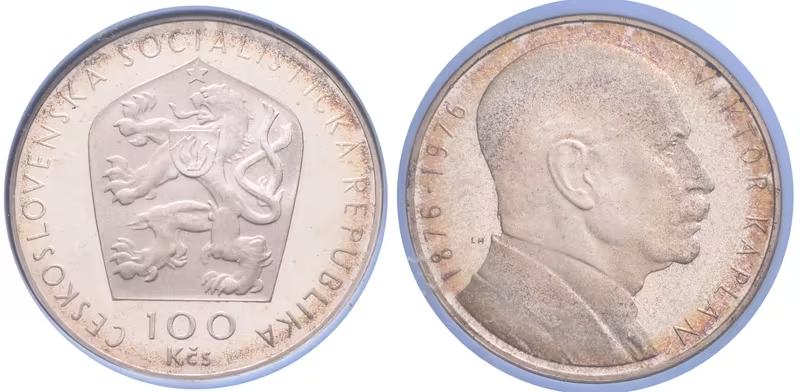
- Code: MC133-PROOF4
100 Kčs 1976 - Viktor Kaplan, PROOF
Československo (1953 - 1993) 100 Koruna 1976 - 100. výročí narození Viktora Kaplana, autor Luděk Havelka, Aurea 133, PROOF Ag 0,700, 33 mm (15 g), raženo 50 728 ks (běžná kvalita), 2 225 ks (proof) původní plastová kapsle, patina v ploše - viz foto
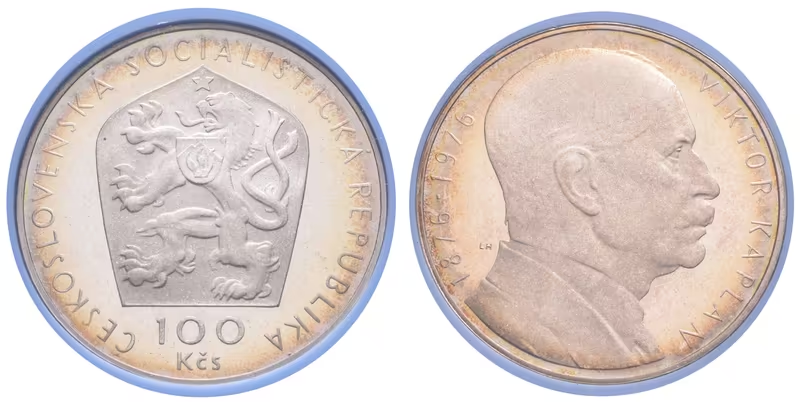
Skladem 1 ks - Code: MC133-PROOF3
100 Kčs 1976 - Viktor Kaplan, PROOF
Československo (1953 - 1993) 100 Koruna 1976 - 100. výročí narození Viktora Kaplana, autor Luděk Havelka, Aurea 133, PROOF Ag 0,700, 33 mm (15 g), raženo 50 728 ks (běžná kvalita), 2 225 ks (proof) původní plastová kapsle, patina v ploše - viz foto
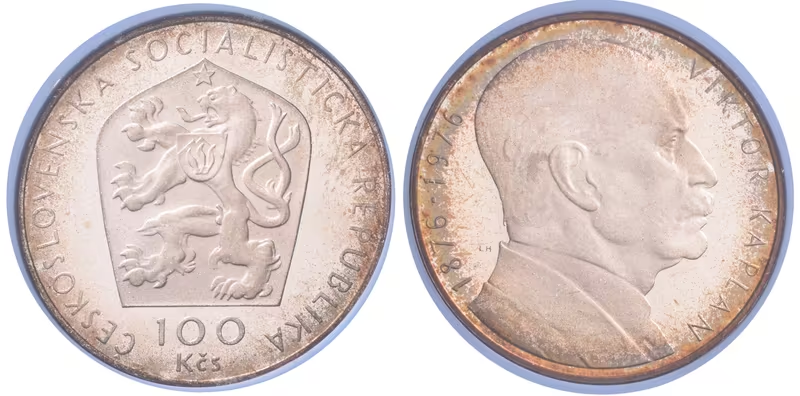
Skladem 1 ks - Code: MC133-PROOF
100 Kčs 1976 - Viktor Kaplan, PROOF
Československo (1953 - 1993) 100 Koruna 1976 - 100. výročí narození Viktora Kaplana, autor Luděk Havelka, Aurea 133, PROOF, Ag 0,700, 33 mm (15 g), raženo 50 728 ks (běžná kvalita), 2 225 ks (proof) původní plastová kapsle, patina v ploše - viz foto
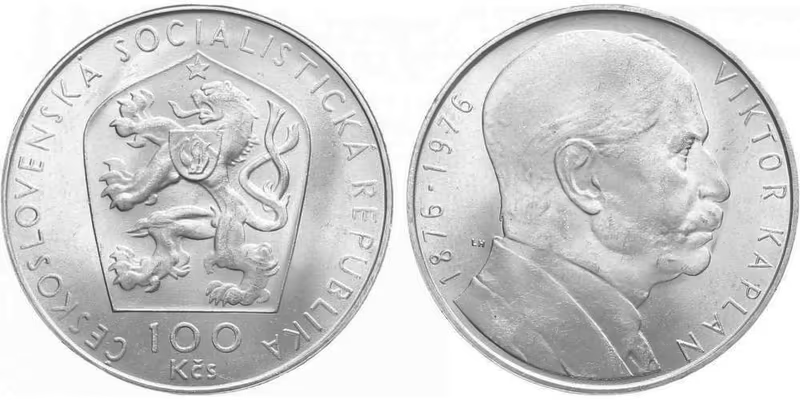
Skladem 1 ks - Code: MC133
100 Kčs 1976 - Viktor Kaplan
Československo (1953 - 1993) 100 Koruna 1976 - 100. výročí narození Viktora Kaplana, autor Luděk Havelka, Aurea 133, běžná kvalita, ilustrační foto Ag 0,700, 33 mm (15 g), raženo 50 728 ks (běžná kvalita), 2 225 ks (proof) Ilustrační foto – v případě…
Skladem (>5 ks)