Victor Emmanuel III
Victor Emmanuel III (1869–1947) was an Italian king of the House of Savoy who reigned from 1900 to 1946 and whose era encompassed both world wars and the rise of fascism. In numismatics he is known, among other things, for the fact that his portrait appears on a large portion of 20th-century Italian coins, and he himself actively pursued the study of coins.
Victor Emmanuel III was born on 11 November 1869 in Naples as the son of the future king Umberto I. After his father's assassination in 1900 he ascended the throne and became the third king of unified Italy. The Italian Kingdom was then a young state with ambitions of being a great power and with internal tensions between north and south, industry and countryside, and between the monarchy and growing political movements. The monarch in a constitutional monarchy had formally limited powers, yet his decisions – especially during crises – could significantly influence the direction of the country.
During his reign Italy entered the First World War (1915–1918) on the side of the Entente. The war brought heavy losses and social upheaval, and in the post-war period discontent escalated, creating space for radicalisation. Under these conditions Benito Mussolini and the fascist movement entered the political scene. A key moment came in 1922, when after the so-called March on Rome the monarch entrusted Mussolini with forming a government. This opened the way to the gradual weakening of parliamentary democracy and to the establishment of a dictatorship, although formally the monarchy continued to exist.
In the following years Italy transformed into a state in which propaganda and state symbolism penetrated the public space and the currency. The peak of foreign-policy expansion was the war against Ethiopia and the proclamation of an "empire" (1936), with titulature that appeared in the official environment. At the same time the regime increasingly bound itself to Nazi Germany, which drew Italy into the Second World War. Military failures and the internal collapse of the regime led in 1943 to Mussolini's fall. The king then had Mussolini arrested and appointed a new government, but this no longer fully restored public confidence: part of society perceived the monarchy as co-responsible for the previous course of events.
History
After 1943 Italy was divided and the country became a battlefield and a space of civil conflict. The monarch tried to save the institution of a crowned state by abdicating in 1946 in favour of his son. A referendum followed, in which Italians voted for a republic. This ended the Savoy monarchy, and Victor Emmanuel went into exile, where he died shortly afterwards. His historical image remains controversial to this day: on the one hand stands a long reign in extraordinarily difficult times, on the other the decisions and compromises that enabled the rise of the dictatorship and brought the country to wartime catastrophe.
In addition to political history, Victor Emmanuel III also has a marked "cultural" footprint: he belonged to monarchs with a strong interest in numismatics. He is associated with support for scholarly work on an extensive corpus of Italian coins and with the building of a coin collection, which makes him one of the most prominent royal figures in the history of Italian numismatics.
For collectors, Victor Emmanuel III is attractive above all because of the breadth of coin types produced during his reign. The obverse of Italian coins shows various versions of his portrait and titulature, while the reverses bear state arms and motifs typical of the period – from classical allegories and heraldry to the markedly "statist" symbolism of the 20th century. In practice one encounters circulating denominations in lire and centesimi as well as more valuable silver and gold strikes, in which not only the metal and year but also the historical context of the issue play a role.
Coins of Victor Emmanuel III and their numismatic significance
A special chapter consists of the First World War period and the subsequent economic changes, when both materials and the composition of currency in circulation altered. With later issues the appearance of coins also reflects the fascist era, including changes to state motifs and sometimes also to the stylisation of legends. For this very reason his coins are often collected "in stages": pre-war strikes, wartime and post-war issues, and finally coins from the period of regime symbolism. The advantage is that this is a very well-documented period, so years, varieties and mint marks allow for systematic collecting.
The numismatic legacy of Victor Emmanuel III, however, is not only that he was "on the coins". His personal interest in coins contributed to the fact that Italian numismatics became markedly more professional in the 20th century and acquired a firmer cataloguing foundation. Combined with the rich coinage of his reign, this creates a unique whole: a monarch whose political history is controversial, but whose mark on coins and on numismatic research is exceptionally pronounced.
In our auction and shop
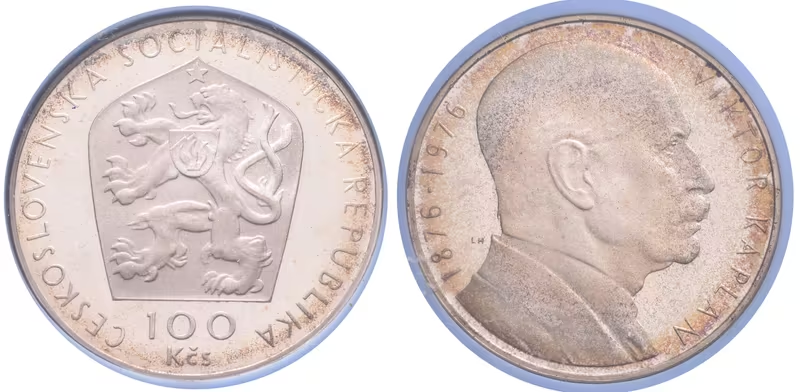
- Code: MC133-PROOF4
100 Kčs 1976 - Viktor Kaplan, PROOF
Československo (1953 - 1993) 100 Koruna 1976 - 100. výročí narození Viktora Kaplana, autor Luděk Havelka, Aurea 133, PROOF Ag 0,700, 33 mm (15 g), raženo 50 728 ks (běžná kvalita), 2 225 ks (proof) původní plastová kapsle, patina v ploše - viz foto
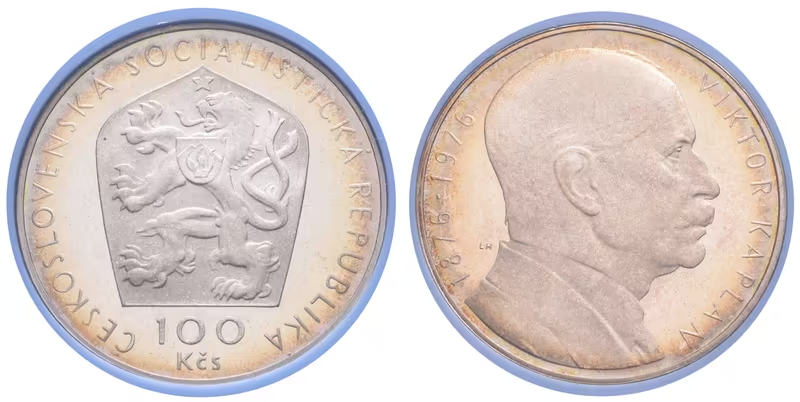
Skladem 1 ks - Code: MC133-PROOF3
100 Kčs 1976 - Viktor Kaplan, PROOF
Československo (1953 - 1993) 100 Koruna 1976 - 100. výročí narození Viktora Kaplana, autor Luděk Havelka, Aurea 133, PROOF Ag 0,700, 33 mm (15 g), raženo 50 728 ks (běžná kvalita), 2 225 ks (proof) původní plastová kapsle, patina v ploše - viz foto
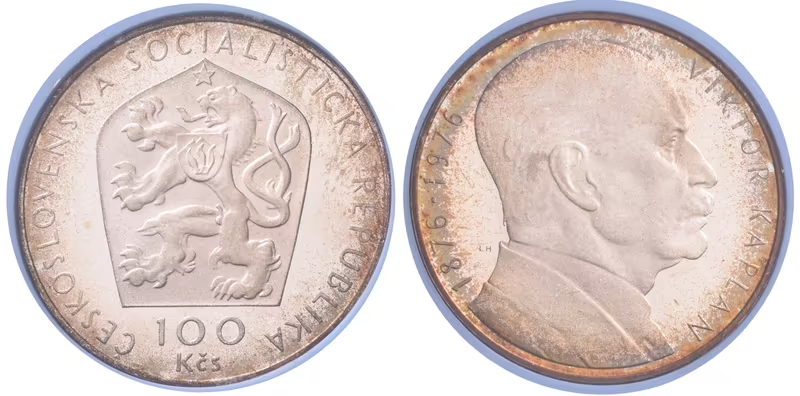
Skladem 1 ks - Code: MC133-PROOF
100 Kčs 1976 - Viktor Kaplan, PROOF
Československo (1953 - 1993) 100 Koruna 1976 - 100. výročí narození Viktora Kaplana, autor Luděk Havelka, Aurea 133, PROOF, Ag 0,700, 33 mm (15 g), raženo 50 728 ks (běžná kvalita), 2 225 ks (proof) původní plastová kapsle, patina v ploše - viz foto
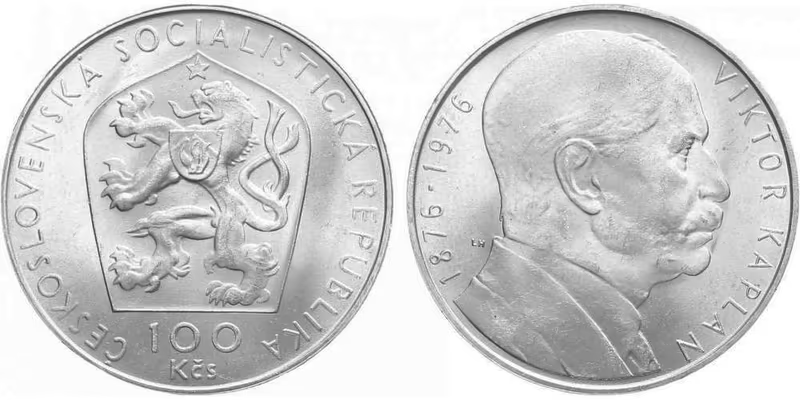
Skladem 1 ks - Code: MC133
100 Kčs 1976 - Viktor Kaplan
Československo (1953 - 1993) 100 Koruna 1976 - 100. výročí narození Viktora Kaplana, autor Luděk Havelka, Aurea 133, běžná kvalita, ilustrační foto Ag 0,700, 33 mm (15 g), raženo 50 728 ks (běžná kvalita), 2 225 ks (proof) Ilustrační foto – v případě…
Skladem (>5 ks)