Umberto I
Umberto I was an Italian king of the House of Savoy who ruled from 1878 to 1900. In history he is associated with the consolidation of the position of a unified Italy, with colonial policy and with the social tensions of the end of the 19th century.
Umberto I (1844–1900) was born as the son of Victor Emmanuel II, the first king of unified Italy. He grew up at a time when Italian unification was only just being completed, and the new state was searching for stable institutions, a common identity and an economic balance between regions. As crown prince, he underwent military training and appeared in public in a role intended to strengthen the prestige of the Savoy monarchy in the new kingdom.
He ascended the throne in 1878 after the death of Victor Emmanuel II. Umberto's reign falls in a period when Italy was striving to confirm its place among the European powers. At the same time, it was an era of rapid social change: industrialisation advanced unevenly, a large part of the population remained in poverty, and tension between towns and the countryside, or between north and south, was marked. To this were added political disputes, the rise of the workers' movement and radical currents, which perceived the monarchy as a symbol of the old order.
In foreign policy, Umberto I held to a line intended to secure Italy's safety and international weight. A significant framework became the Triple Alliance (Italy, Germany and Austria-Hungary), which had above all a strategic and defensive significance. For part of the Italian public, however, the alliance with Austria-Hungary was a sensitive subject, because the Italian national movement had a long history of conflict with Habsburg power. The political practice of the late 19th century thus often balanced between diplomacy, internal stability and the pressure of public opinion.
History
A visible chapter of Umberto's era was colonial expansion. Italy attempted to build its own colonial possessions in Africa, especially in the area of today's Eritrea and Somalia, later with the ambition of penetrating into Ethiopia. Colonial policy was presented as a sign of great-power status, but at the same time it brought high costs and, in the case of failures, provoked sharp criticism. It was precisely the ambiguous results and domestic social problems that contributed to the polarisation of society.
In domestic politics, Umberto I is often associated with an emphasis on the authority of the state and the monarchy. The end of the 19th century in Italy was marked by strikes, unrest and clashes with security forces. The atmosphere was also sharpened by assassinations and attempts thereat, which reflected the radicalisation of part of the political scene. Umberto I eventually died in an assassination in 1900; his death symbolically closed one stage of the Italian monarchy, and his son Victor Emmanuel III ascended the throne.
Umberto's reign is therefore assessed as a period in which the young Italian state strove to act as a European power, but at the same time grappled with deep social and political contradictions. From a historical perspective, the "visible" side of state representation is also important — symbols, ceremonies and also coins, which spread the image of the ruler throughout the country.
Coins and monetary context
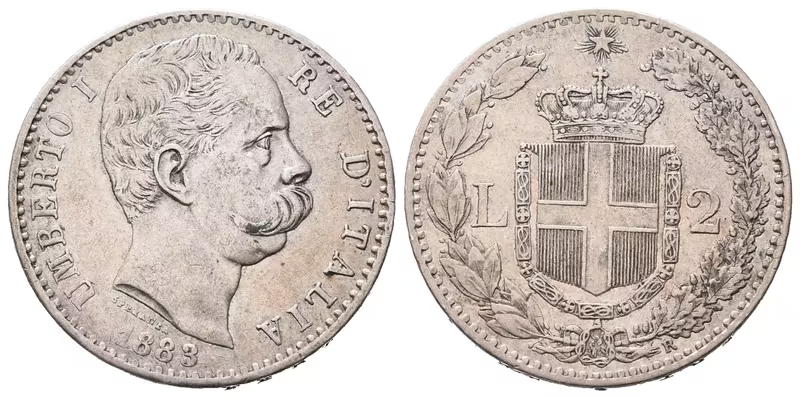
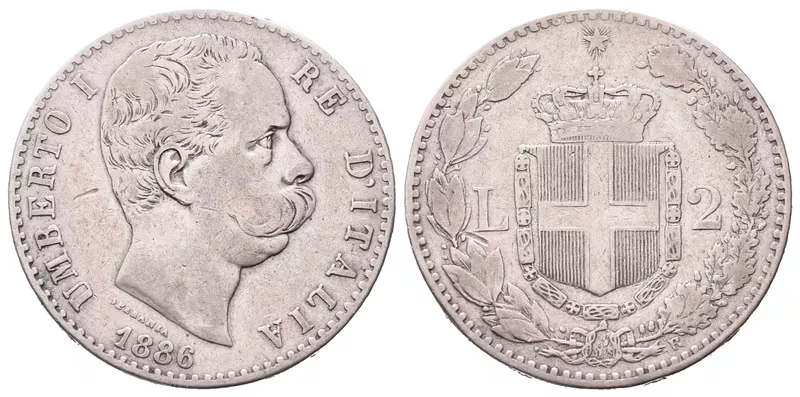
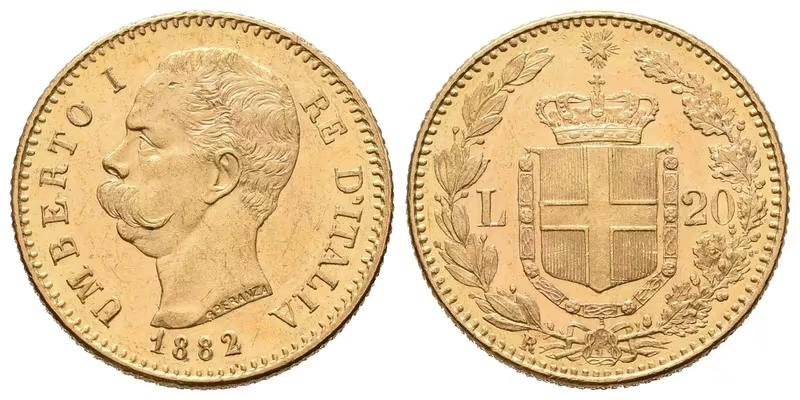
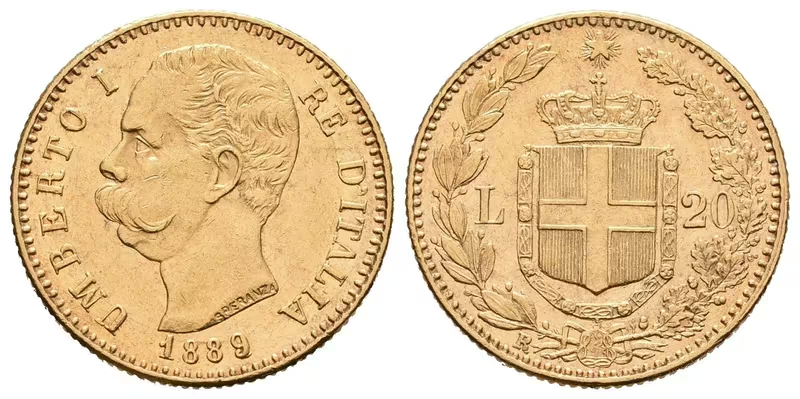
Under the rule of Umberto I, Italy operated a lira system based on decimal division and, in the international environment, linked to standards that made possible the comparability of gold and silver coins in a wider European space. For numismatics, Umberto I is typified above all by portrait coinage: on the obverse of the coins his profile appears with titulature, the reverse usually bearing the state coat of arms of the Savoys and the value designation in lire.
In circulation, small coins of base metals were used, silver denominations and also gold coins of higher values. It is precisely with gold and silver issues that you will often encounter the fact that, alongside the denomination, the state of preservation and the year of issue are also important for valuation. Umberto's coins are at the same time a good example of modern state coinage of the 19th century: uniform parameters, clear state symbolism and an emphasis on the legibility of inscriptions and value.
In collector descriptions, the year, denomination, metal, weight and diameter are commonly given, as well as the mint, where it is distinguishable for the given issue. Artistically, Umberto I's issues are valued for the clean portrait style typical of the second half of the 19th century. His coins thus carry not only financial but also historical information: they recall a period in which Italy was striving to consolidate its statehood while at the same time facing the tensions of a modernising society.
In our auction and shop
- Code: SITA98-B1883
Itálie, 2 Lira 1883 R
Itálie, Umberto I. (1878 - 1900) 2 Lire 1883 R, KM.23, pěkná zachovalost, zbytky lesku, patina, drobné rysky
Skladem 1 ks - Code: SITA98-B1886
Itálie, 2 Lira 1886 R
Itálie, Umberto I. (1878 - 1900) 2 Lire 1886 R, KM.23, patina, oběh, rysky
Skladem 1 ks - Code: ZSITA-89F1882
Itálie, 20 Lira 1882 R
Itálie, Umberto I. (1878 - 1900) 20 Lira 1882 R Au 0,900, 21 mm (6,4516 g), KM. 21
- Code: ZSITA-89F1889
Itálie, 20 Lira 1889 R
Itálie, Umberto I. (1878 - 1900) 20 Lira 1889 R Au 0,900, 21 mm (6,4516 g), KM. 21