Kingdom of Sicily
The Kingdom of Sicily under the rule of the Aragonese dynasty existed in the years 1282 to 1816 as a separate state formation comprising the island of Sicily. It arose after the Sicilian Vespers, when the island broke away from Angevin rule and accepted Peter III of Aragon as king.
Aragonese rule on Sicily began on 30 March 1282, when the Sicilian Vespers broke out — a popular uprising against the French rule of Charles of Anjou. The Sicilians invited the Aragonese king Peter III, the husband of Constance, daughter of the last Hohenstaufen king Manfred. Peter III landed at Trapani in August 1282 and was crowned king of Sicily at Palermo. The pope excommunicated Peter and proclaimed a crusade against Aragon, but the Sicilians defended the island against Angevin attempts at reconquest.
After the death of Peter III in 1285 Sicily was ruled by his son James II, who in 1295 concluded the Peace of Anagni with the pope. James renounced Sicily in exchange for Sardinia and Corsica, but the Sicilians refused the Angevin restoration and elected his brother Frederick III as king. There followed the twenty-year War of the Vespers, ended by the Peace of Caltabellotta in 1302. Frederick III retained Sicily as a vassal kingdom with the title King of Trinacria, while the Angevins ruled the mainland part as the Kingdom of Naples.
History
In the 14th century Sicily was shaken by conflicts between royal power and the baronial nobility. Under Frederick IV the Simple, in the years 1355 to 1377, baronial anarchy reached its peak. The kingdom was divided into four vicariates controlled by the powerful houses of Chiaramonte, Ventimiglia, Alagona and Peralta. Only Martin I the Younger, with the help of his father Martin I of Aragon, restored royal authority in the years 1392 to 1409 and attached Sicily directly to the Aragonese Crown.
From 1412 Sicily was ruled by kings of the Castilian house of Trastámara. Under Alfonso V the Magnanimous, the conquest of Naples in 1442 restored the unified Kingdom of the Two Sicilies, but after his death in 1458 it was again divided. Sicily remained part of the Aragonese Crown and from 1516 of the Spanish monarchy. Spanish rule lasted until 1713, when the island was obtained by Savoy and then in 1720 exchanged for Sardinia with Austria. In 1734 the Spanish Bourbons conquered Sicily and created a separate kingdom, which in 1816 merged with Naples into the Kingdom of the Two Sicilies.
Coinage of Aragonese Sicily
Aragonese Sicily preserved the tradition of Norman-Hohenstaufen coinage with its own modifications. The basic gold coin was the real weighing 4.5 grams, bearing the Aragonese shield and the Sicilian eagle. The silver tareno weighed about 3 grams and bore similar iconography. Smaller denominations included the carlino, grano and piccolo. Mints functioned at Palermo and Messina with high minting quality. Sicilian coins were prized for their stable content of precious metal.
Under Spanish rule from the 16th century onwards Sicilian coinage adapted to the Spanish system. Gold scudi, silver ducatons and smaller denominations were struck. The coins bore the portrait of the Spanish ruler and the Sicilian arms. A specifically Sicilian coin was the onza weighing 30 scudi, one of the largest European gold coins. The quality of the minting remained high down to the 18th century. Sicilian coins document the political changes and the economic development of the island.
In our auction and shop
- Code: SITANEA-A1309
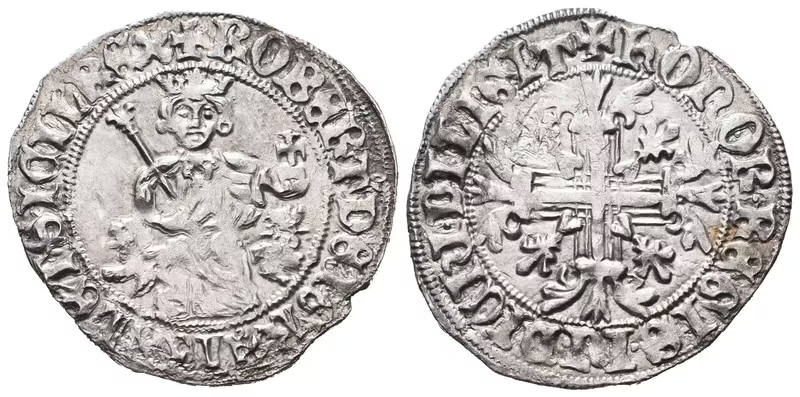
Itálie - Neapol, AR Gigliato b.l.
Itálie - království Neapole a Sicílie, Robert z Anjou (1309 - 1343) AR Gigliato b.l., minc. Neapol. Sedící panovník na trůně čelně, opis ROBERT DIE GRA IERL ET SICIL REX / Liliový kříž, opis HONOR REGIS IUDICIU DILIGIT. (3,95 g) Velmi pěkná zachovalost,…
Skladem 1 ks