Christian IV of Denmark
Christian IV of Denmark was King of Denmark and Norway who reigned from 1588 to 1648, the longest-reigning monarch in Danish history and a significant participant in the Thirty Years' War. He appears on Scandinavian and German coins as a symbol of a Renaissance ruler and patron of the arts, while his speciesthalers and portugalesers are among the most imp…
Christian was born on 12 April 1577 at Frederiksborg Castle as the son of King Frederick II of Denmark and Sophie of Mecklenburg. After his father's death in 1588 he became king at the age of only eleven, but actual rule was taken over by a regency council led by Chancellor Niels Kaas. The young prince received a thorough humanist education, mastered several languages including Latin, German, and French, and took an interest in architecture, navigation, and military affairs. The regency ended in 1596, when the nineteen-year-old Christian assumed full royal power and immediately launched an ambitious programme of modernisation and expansion of the Danish kingdom.
The first decade of Christian IV's independent rule was a period of economic flourishing and territorial expansion for Denmark. The king founded a number of new towns including Christiania in Norway, today's Oslo, and Kristianstad in Scania. He expanded the Danish navy into one of the most powerful fleets in Europe and supported overseas trade by founding the Danish East India Company in 1616. His architectural projects transformed Copenhagen into a representative Renaissance metropolis — he had the stock exchange, the Round Tower, and Rosenborg Castle built and extended the fortress of Kronborg. Christian IV took a personal part in designing the buildings, and his architectural style, known as the Christian IV Renaissance, influenced Scandinavian architecture for centuries.
History
The second half of Christian's reign was marked by unsuccessful wars that exhausted Danish finances and weakened the country's international position. The Kalmar War with Sweden between 1611 and 1613 ended with a Danish victory and the receipt of a high ransom for Älvsborg, but it brought no territorial gains. The decision to enter the Thirty Years' War in 1625 as the leader of the Protestant coalition in Lower Saxony proved to be a fatal mistake. Christian's army was defeated by the imperial troops of Albrecht von Wallenstein at the Battle of Lutter in August 1626, and the Jutland peninsula was occupied by Catholic forces. The Peace of Lübeck of 1629 preserved Danish territorial integrity but marked the end of Danish ambitions in northern Germany.
The last two decades of Christian's reign were a period of gradual decline of Danish power and of personal tragedies for the monarch. The Torstenson War with Sweden between 1643 and 1645 ended in a catastrophic defeat — Denmark lost the provinces of Jämtland and Härjedalen, the island of Gotland, and had to exempt Sweden from the Sound Toll. In the naval battle of Fehmarn in 1644 Christian was wounded and lost his right eye. The king, who outlived his wife and most of his children, died on 28 February 1648 in Copenhagen at the age of seventy, leaving Denmark weakened and in debt but culturally and architecturally enriched by his sixty years of rule.
Mint production and monetary innovations
Christian IV was one of the most significant mint-issuing monarchs of his time and personally supervised the quality and artistic execution of Danish strikes. He introduced new heavy silver denominations — speciesthalers weighing up to 90 grams and portugalesers worth ten thalers, which served primarily as representative currency and diplomatic gifts. The royal mints in Copenhagen, Elsinore, and Kongsberg in Norway produced technically perfect strikes with detailed portraits of the king in richly decorated Renaissance armour.
Danish coinage under Christian IV was distinguished by rich iconography with religious and dynastic motifs. On the reverses appeared Jehovah in Hebrew script, the Norwegian lion with a halberd, or complex heraldic compositions combining the arms of all the royal possessions. The king also introduced the dating of coins according to his birthday, the so-called "birthday thalers", which were struck each year on 12 April.
In our auction and shop
- Code: RX-Z-019
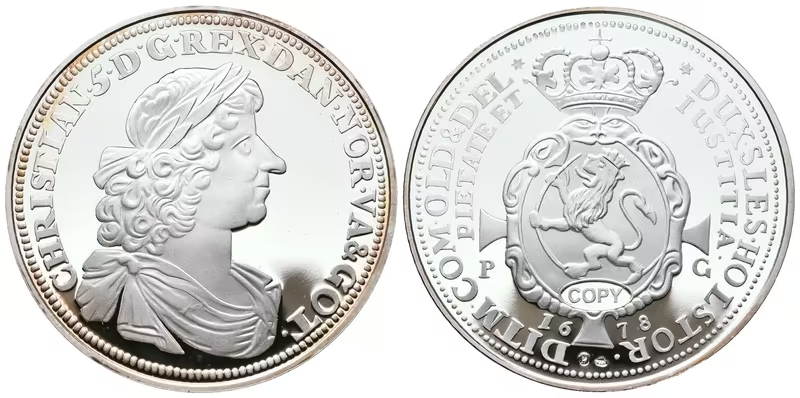
Dánsko, Speciedaler 1678 - Portrét Kristiána V., korunovaný erb s lvem - Holstein, Ditmarschen, Oldenburg, Delmenhorst, replika
Dánské království - Kristián V. (1670-1699) Speciedaler 1678 - Portrét Kristiána V., korunovaný erb s lvem - Holstein, Ditmarschen, Oldenburg, Delmenhorst Ag (.999), 40 mm (20 g), v kapsli. Stav mince odpovídá fotografii.
Skladem 1 ks - Code: RX-Z-022
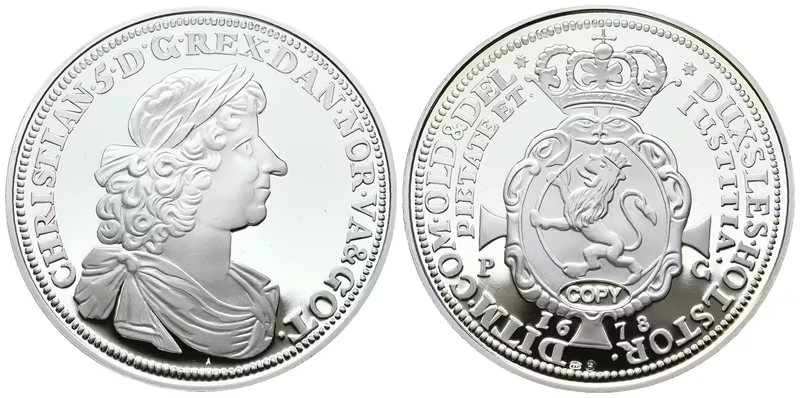
Dánsko, 1 Speciedaler 1678 - Portrét Kristiána V. / Korunovaný dánský erb se lvem, replika
Dánské království - Kristián V. (1670-1699) 1 Speciedaler 1678 - Portrét Kristiána V. / Korunovaný dánský erb se lvem Ag (.999), 40 mm (20 g), v kapsli. Stav mince odpovídá fotografii.
Skladem 1 ks - Code: RX-Z-012
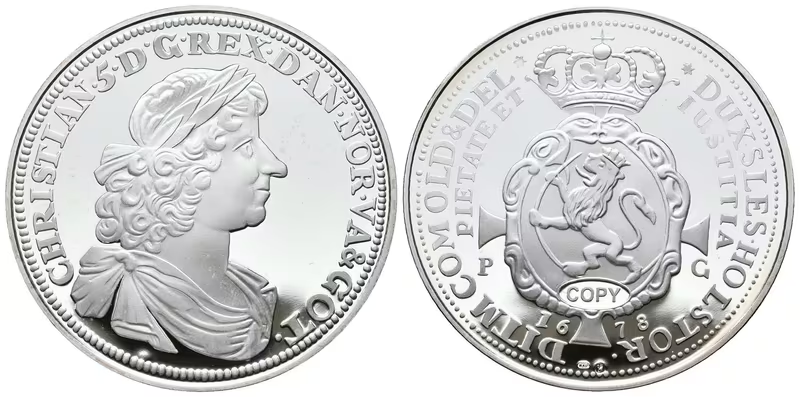
Dánsko, Speciedaler 1678 - Portrét panovníka / Korunovaný dánský lev, replika
Dánské království - Kristián V. (1670-1699) Speciedaler 1678 - Portrét panovníka / Korunovaný dánský lev Ag (.999), 40 mm (20 g), v kapsli. Stav mince odpovídá fotografii.
Skladem 1 ks - Code: RX-Z-013
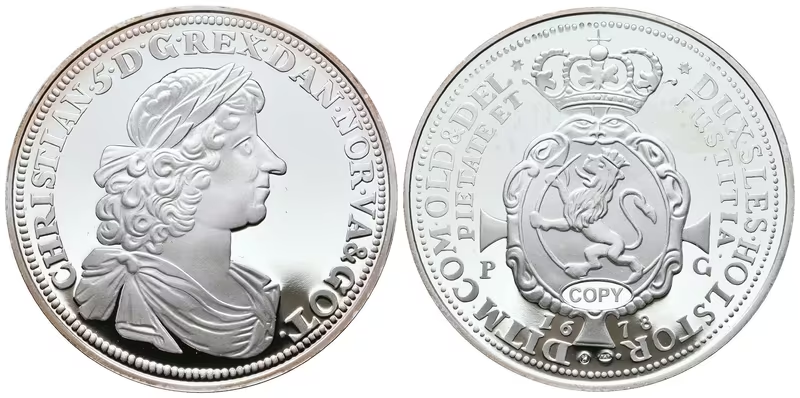
Dánsko, Speciedaler 1673 - Portrét Christiana V., dánský státní znak, replika
Dánské království - Kristián V. (1670-1699) Speciedaler 1673 - Portrét Christiana V., dánský státní znak Ag (.999), 40 mm (20 g), v kapsli. Stav mince odpovídá fotografii.
Skladem 1 ks