Kuna
The kuna was the national currency of Croatia from 1994 to 2023, when it was replaced by the euro, and its name derives from a medieval means of payment in the form of marten furs used in Slavonia. In numismatics the kuna represents a modern European currency with rich symbolism referring to Croatian history, with commemorative gold and silver kuna being…
The history of the kuna as a means of payment reaches deep into the Middle Ages, when in Slavonia and Dalmatia marten furs were used as a means of exchange and a unit of taxation. The first written mention of the kuna as an accounting unit comes from 1018 in a charter of King Zvonimir. In the 13th century the Slavonian bans began to strike silver coins called banovac, on which was depicted the emblem of a marten between two stars. This historical tradition became the basis for the choice of name of the modern Croatian currency after gaining independence. The kuna as a symbol of Croatian statehood survived centuries of foreign rule — Hungarian, Habsburg, and Yugoslav.
The modern kuna was first introduced during the Second World War in the puppet Independent State of Croatia in 1941, when it replaced the Yugoslav dinar. This Ustasha kuna was divided into 100 banica according to the historical model and existed until 1945. After the war Croatia was incorporated into socialist Yugoslavia and used the Yugoslav dinar. During the existence of Yugoslavia any mention of the kuna was considered an expression of Croatian nationalism and was suppressed by the communist regime.
History
After the declaration of Croatian independence on 25 June 1991 the new government introduced a transitional currency — the Croatian dinar, which circulated from December 1991 to May 1994. The dinar was only a temporary solution during the war of independence and quickly succumbed to inflation. The kuna was introduced as the permanent national currency on 30 May 1994 at a rate of 1,000 Croatian dinars to one kuna. The new currency was stable from the outset thanks to the strict monetary policy of the Croatian National Bank and its link to the German mark, later to the euro.
During its almost thirty years of existence the kuna maintained relative stability and became a symbol of Croatian economic autonomy. The Croatian National Bank successfully defended the kuna against speculative attacks during the financial crisis of 2008 and maintained its rate within a narrow band against the euro. Croatia's entry into the European Union in 2013 meant a commitment to adopt the euro, which was fulfilled on 1 January 2023. The kuna was exchanged for the euro at the fixed rate of 7.53450 kuna to one euro, ending the history of the youngest European national currency.
Coinage system and technical parameters
The kuna was divided into 100 lipa, a name derived from the Slavonic designation for the linden, the national tree of Croatia. The coinage system included denominations of 1, 2, 5, 10, 20, and 50 lipa in smaller coins and 1, 2, and 5 kuna in standard coins. Commemorative coins of 25 kuna were struck in silver on special occasions. The coins depicted Croatian flora and fauna — for example the marten on the 5 kuna, the nightingale on the 1 kuna, or rosemary on the 10 lipa.
Banknotes in denominations of 5, 10, 20, 50, 100, 200, 500, and 1,000 kuna depicted significant figures of Croatian history and culture, including Ban Josip Jelačić, the poet Ivan Gundulić, and the inventor Nikola Tesla. The design of the banknotes was created by leading Croatian artists and contained advanced security features including holograms and microprint. The print quality of the Croatian banknotes was internationally recognised.
In our auction and shop
- Code: BCHOR002A
- Code: BCHOR013A
- Code: MC170-PROOF4
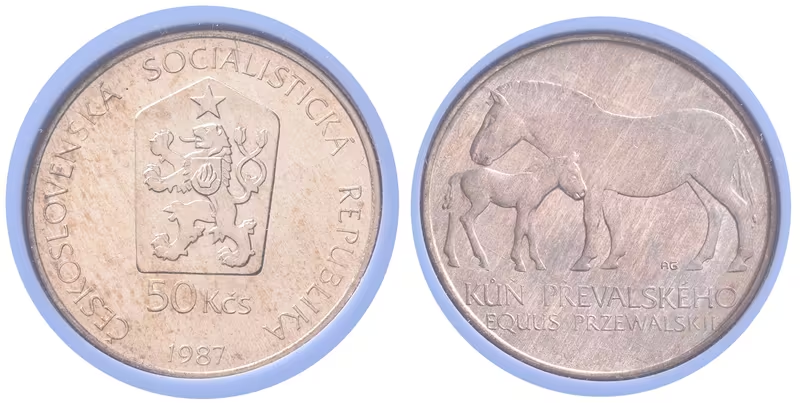
50 Kčs 1987 - Kůň Převalského, PROOF
Československo (1953 - 1993) 50 Koruna 1987 - Zachování chovu koně Převalského v ZOO Praha, autor Anton Gábrik, Aurea 170, PROOF, Ag 0,500, 27 mm (7 g), raženo 52 374 (běžná kvalita), 4 645 ks (proof) původní plastová kapsle, patina v ploše - viz foto
Skladem 1 ks - Code: MC170-PROOF3
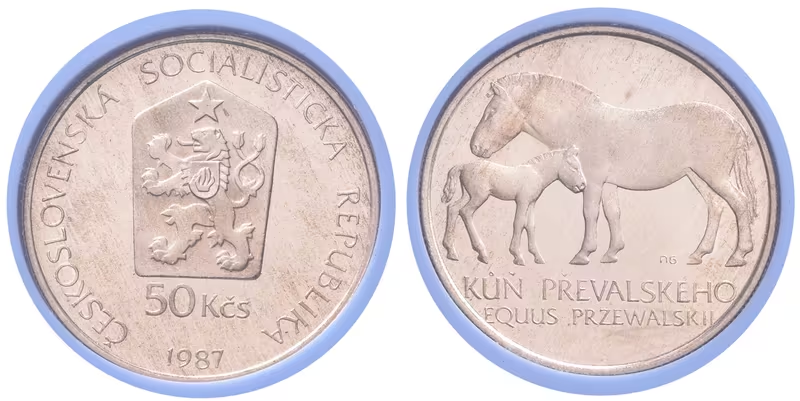
50 Kčs 1987 - Kůň Převalského, PROOF
Československo (1953 - 1993) 50 Koruna 1987 - Zachování chovu koně Převalského v ZOO Praha, autor Anton Gábrik, Aurea 170, PROOF, Ag 0,500, 27 mm (7 g), raženo 52 374 (běžná kvalita), 4 645 ks (proof) původní plastová kapsle, patina v ploše - viz foto
Skladem 1 ks