Liard
The liard was a small copper or brass coin of low value, struck in France, the Netherlands and southern Germany from the 14th to the 19th century. The name probably comes from the grey colour of worn coins (French liard meaning grey) and became a synonym for worthlessness in many European languages.
The first liards were struck in France under King Philip VI of Valois around 1340 as coins worth 3 deniers, that is a quarter of a sou. Originally they contained a small amount of silver but gradually became purely copper. The name may also come from the town of Liards in Dauphiné, where the first specimens were struck. The liard was the smallest French coin intended for the small payments of the poorer classes. The obverse usually bore the royal monogram or a fleur-de-lis, the reverse a cross or a crown.
In the 15th and 16th centuries the minting of liards spread to Burgundy and the Netherlands. The Dukes of Burgundy struck liards with the Cross of Saint Andrew. After gaining independence, the Dutch Republic continued to mint liards into the 19th century. Dutch liards, also called oord, had a value of 1/4 stuiver. In southern Germany and Alsace liards were called "Blaffert" after their pale colour. The quality of liards was often poor: they were struck from poor copper, wore out quickly and were forged on a massive scale.
History
In France the liard remained in circulation until the French Revolution. In 1793 the revolutionary government introduced the decimal system, but liards continued to be used unofficially. The last French liards were struck in 1793 with revolutionary symbols. In the Netherlands and Belgium liards survived longer: in the Netherlands until the monetary reform of 1816, in Belgium until independence in 1830. The Swiss cantons struck liards until the middle of the 19th century. Gradually the name liard became a pejorative term for a worthless object or a small sum.
The liard represented the lowest level of the monetary economy of the early modern period. In the French livre–sou–denier system the liard had a value of 3 deniers, that is a quarter of a sou or 1/80 of a livre. This small value made the liard a coin of the poor: day labourers, beggars, servants. For a liard one could buy a piece of bread, an onion or a candle. The saying "n'avoir pas un liard" (not to have a liard) meant utter poverty.
The liard in the monetary system
Technically the liards were simple copper strikes, often of poor quality. They were struck not only by royal mints but, with permission, also by towns and nobles. This led to a great number of variants and varying quality. Liards were so little valued that they were often not even counted individually but weighed. The counterfeiting of liards was widespread: the costs of production were minimal and the penalty for forging small coins more lenient. Of note are the "black liards" struck from a mixture of copper and lead, which quickly blackened. In numismatics liards are popular for their variety: there exist thousands of variants from various mints. Paradoxically, some rare variants of liards now have a higher collectors' value than contemporary silver coins.
In our auction and shop
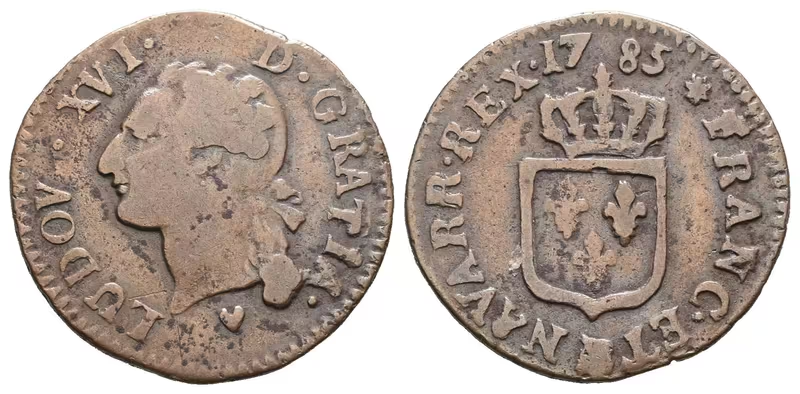
- Code: SFRA91-I1785BB
Francie, Liard 1785
Francie, Ludvík XVI. (1774 - 1792) 1 Liard 1785 BB, Strasboug, KM.585 R!
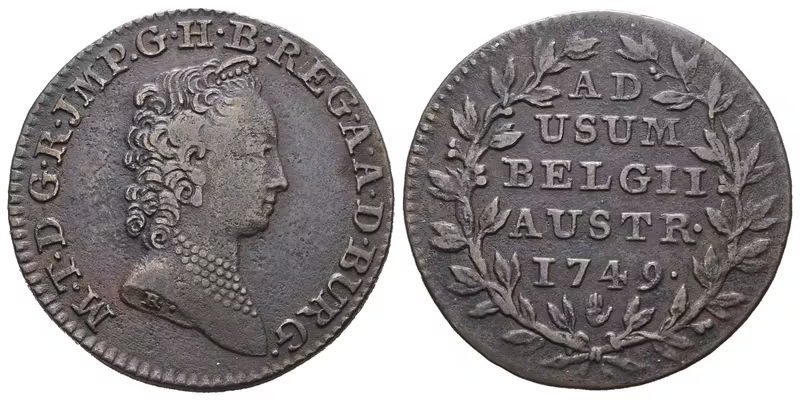
Skladem 1 ks - Code: M82X-HA1749
Marie Terezie, Liard 1749
Marie Terezie (1740 - 1780) Liard 1749, Antverpy, N.169, KM.2, pěkná zachovalost, patina