Liberia
Liberia is a state on the west coast of Africa, on the Atlantic Ocean, known for having been founded in the 19th century as a republic for freed slaves and free Black people from America. The capital is Monrovia and the currency the Liberian dollar; the country has a long tradition of its own coins and banknotes.
The history of Liberia is exceptional in the African context in that the country's foundation is directly connected with the American abolitionist movement and with the question of what to do with the freed slaves in the United States. In the first third of the 19th century the American Colonization Society began to operate on the coast of present-day Liberia, organising the transfer of free Black people and freed persons to West Africa. Settlements gradually arose there whose inhabitants brought American cultural and political patterns with them, which from the beginning was reflected in the form of administration, education and public institutions.
In 1847 the independent Republic of Liberia was proclaimed. The state long relied on an elite of descendants of immigrants, often called Americo-Liberians, who controlled politics and economic institutions. Alongside them, however, there existed a numerous indigenous population with its own social structures, languages and traditions. It was precisely the relationship between the immigrant elite and the original inhabitants that was among the sensitive themes of the country's development, and influenced the way state authority was built in the interior.
History
In the 20th century Liberia became economically more significant thanks to foreign investment, especially in mining and plantation agriculture. At the same time, however, political imbalance and tension persisted, culminating in the coup of 1980. A long stage of instability followed, which in the 1990s turned into devastating civil wars. The conflicts severely damaged infrastructure, the economy and state institutions, and their effects were apparent for a long time after the conclusion of peace.
In the new millennium the country has sought to rebuild state administration, security and the economy. A significant role has been played by international aid, peace missions and the gradual strengthening of institutions. Liberia has thus become an example of a state which, after dramatic upheavals, is seeking a stable political and economic path while preserving a distinctive identity linked with its republican foundation and unique historical origin.
State, currency and numismatic context
Liberia uses the Liberian dollar, which in practice exists alongside other forms of payment and financial instruments. Circulating coins and banknotes have changed over time according to economic conditions and the availability of metals and printing capacities. In numismatics, Liberian issues are interesting both historically (a reflection of republican symbolism) and from a collector's point of view, since the country has also issued commemorative and thematic strikes that appear in international collectors' circulation.
On coins and banknotes, state symbols and motifs connected with the identity of the republic often appear: the emblem, the flag, inscriptions emphasising freedom and statehood, and sometimes also significant figures or national themes. For collectors it is important to distinguish between actual circulating currency and commemorative issues intended primarily for the collectors' market, since these two categories have different significance and different price formation. With circulating coins the year, preservation and availability are decisive, while with commemorative strikes the mintage, execution and theme play a role.
In our auction and shop
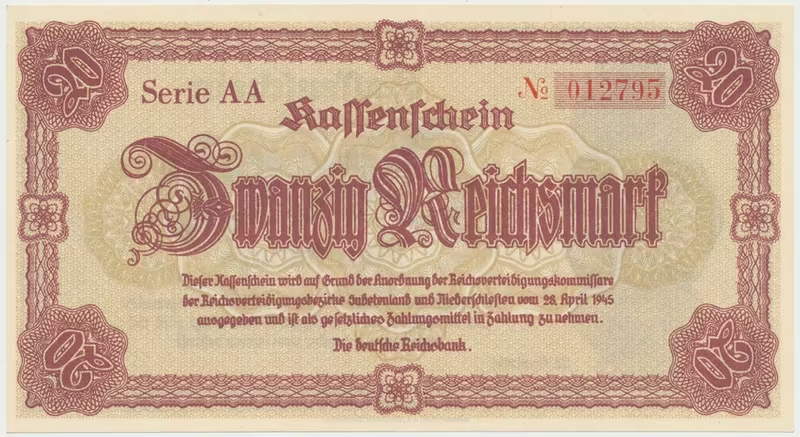
- Code: BREICHDR1AAA
Reichenberg (Liberec) - Deutsche Reichsbank, 20 K 28. 4. 1945, první série AA, HH.188.1.1a
Nouzovky na našem území, 1900 - 1950 Reichenberg (Liberec) - Deutsche Reichsbank, 20 K 28. 4. 1945, první série AA, HH.188.1.1a N/UNC
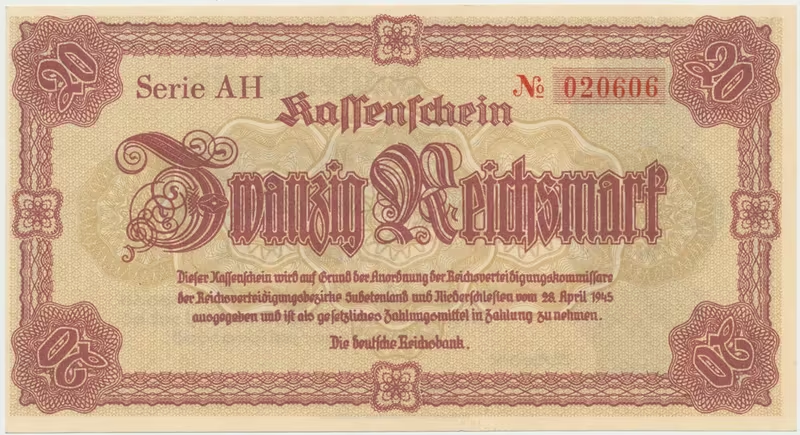
Skladem 1 ks - Code: BREICHDR1AAH
Reichenberg (Liberec) - Deutsche Reichsbank, 20 K 28. 4. 1945, série AH, HH.188.1.1a
Nouzovky na našem území, 1900 - 1950 Reichenberg (Liberec) - Deutsche Reichsbank, 20 K 28. 4. 1945, série AH, HH.188.1.1a N/UNC
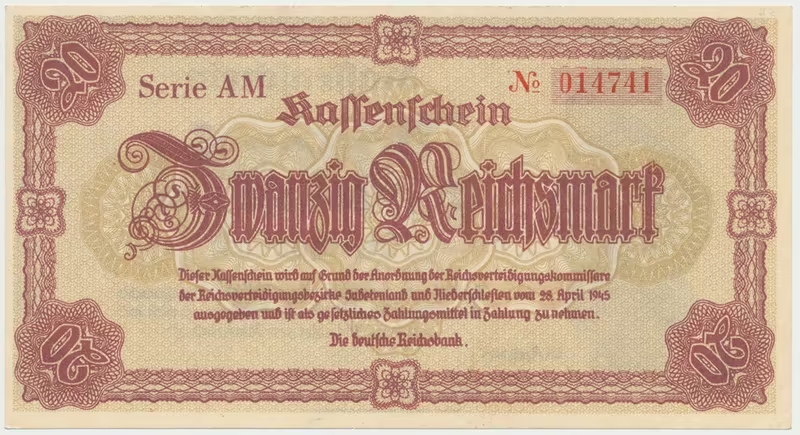
Skladem 1 ks - Code: BREICHDR1AAM
Reichenberg (Liberec) - Deutsche Reichsbank, 20 K 28. 4. 1945, série AM, HH.188.1.1a
Nouzovky na našem území, 1900 - 1950 Reichenberg (Liberec) - Deutsche Reichsbank, 20 K 28. 4. 1945, série AM, HH.188.1.1a N/UNC
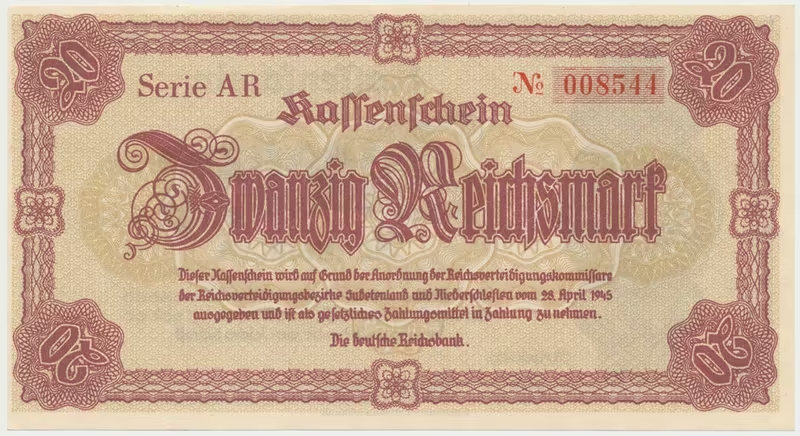
Skladem 1 ks - Code: BREICHDR1AAR
Reichenberg (Liberec) - Deutsche Reichsbank, 20 K 28. 4. 1945, série AR, HH.188.1.1a
Nouzovky na našem území, 1900 - 1950 Reichenberg (Liberec) - Deutsche Reichsbank, 20 K 28. 4. 1945, série AR, HH.188.1.1a N/UNC
Skladem 1 ks