Maria Theresa of Naples and Sicily
Maria Theresa of Naples and Sicily was a Holy Roman Empress, Queen of Bohemia and Hungary as the wife of Emperor Francis II (later Francis I of Austria). She came from the House of Bourbon and was the granddaughter of Empress Maria Theresa.
Maria Theresa of Naples and Sicily was born on 6 June 1772 in Naples as the eldest daughter of King Ferdinand I of Naples and Sicily of the Bourbon–Two Sicilies family and his wife Maria Carolina of Habsburg-Lorraine. Her mother was the daughter of Empress Maria Theresa, which made the young princess a direct granddaughter of the famous sovereign. The aunt of Maria Theresa of Naples and Sicily was the French queen Marie Antoinette, with whom she shared more than mere kinship — both women shared a similar fondness for social life and entertainment.
The princess grew up in a large family at the Neapolitan court. By the time of her marriage another fifteen siblings had been born, although most of them died in childhood. Upbringing at the southern Italian court was less formal than in Vienna, which shaped the character of the future empress, who delighted in merriment and social pleasures.
The marriage with the Austrian Archduke Francis was part of a dynastic policy linking Bourbon and Habsburg-Lorraine interests. The wedding took place first by proxy (per procurationem) on 15 August 1790 in Naples, with her younger sister Luisa marrying Francis's brother Ferdinand on the same day. The actual marriage was concluded on 19 March 1791 in Vienna. The spouses were double first cousins — Maria's mother Maria Carolina was the sister of Francis's father Leopold II, and Maria's father Ferdinand I of Naples and Sicily was the brother of Francis's mother Maria Ludovika.
This extraordinarily close kinship later had tragic consequences for their offspring. Most of the couple's children suffered from various health problems caused by genetic degeneration resulting from the long-standing intermarriage within the Habsburg dynasty.
History
The coronation year 1792 brought Maria Theresa the highest honours. In June she was crowned Queen of Hungary alongside her husband in Pressburg (today's Bratislava). A month later, on 14 July 1792, Francis was crowned Holy Roman Emperor at Frankfurt am Main. The imperial couple then moved to Prague, where the Bohemian coronations took place. On 9 August 1792 Francis was crowned King of Bohemia, and on 11 August 1792 the coronation of Maria Theresa as Queen of Bohemia followed in the Cathedral of St Vitus.
The new empress enjoyed social life and courtly splendour. She organised parties and theatrical performances, in which she herself appeared as an actress, similarly to her ill-fated aunt Marie Antoinette at Versailles. Her mother Maria Carolina vainly tried to restrain her daughter and warned her against excessive extravagance. Maria Theresa, however, remained faithful to her nature and sought entertainment despite the increasingly dramatic events in a Europe convulsed by revolutionary wars.
The marriage was fruitful — Maria Theresa bore twelve children. Among the most prominent offspring was the first-born daughter Marie Louise, who in 1810 became the second wife of Napoleon Bonaparte and Empress of the French. The eldest son Ferdinand inherited the throne as Ferdinand I the Benign, but suffered from epilepsy and developmental delay, which limited his governing capacity. Similar health problems also affected other children.
Maria Theresa of Naples and Sicily died on 13 April 1807 in Vienna shortly after the birth of her twelfth daughter Amalia Theresa, who survived her mother by only a few hours. The empress was only thirty-four years old. Her early death ended fifteen years of marriage with Francis, who subsequently married twice more.
Numismatic significance
Maria Theresa of Naples and Sicily occupies a specific place in numismatics thanks to the coronation mintages of 1792. The triple coronation within the space of a few months — Hungarian, Imperial and Bohemian — provided an opportunity for the issuing of a series of commemorative medals documenting these solemn events.
The Prague coronation of 11 August 1792 was the last coronation of a Bohemian queen in history, since Francis's subsequent wives were no longer crowned. The coronation medals of that year depict the young empress in typical late Baroque style, often paired with her husband Francis. The medals bear Latin inscriptions and symbolism combining Habsburg and Bourbon heraldry.
In the context of Czech coinage, Maria Theresa of Naples and Sicily is recalled chiefly through modern commemorative medals. The Prague Mint included her portrait in the series of Bohemian Queens, thereby paying tribute to the last crowned Queen of Bohemia. These medals, struck in gold and silver, depict the empress in a dignified portrait and recall her brief but significant role in the Bohemian royal tradition.
Medallic production linked with Maria Theresa of Naples and Sicily also includes mintages commemorating the births of royal children, especially the heir Ferdinand in 1793. These medals document dynastic continuity and the hopes placed in the new generation of the Habsburg-Lorraine family.
In our auction and shop
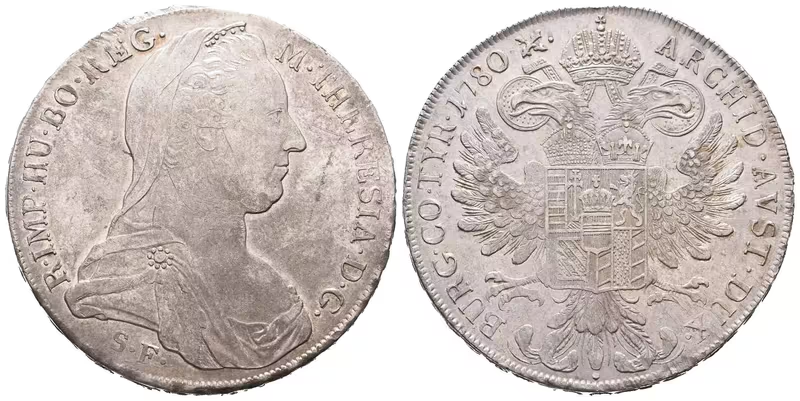
- Code: M82E-AK1780-H40A
Marie Terezie, Tolar 1780 SF
Marie Terezie (1740 - 1780) Konvenční tolar 1780 SF, Benátky, stará ražba z let 1833 - 1838, Hafner H40a T3/IIa, var. s tečkou pod ocasem_R! krásná zachovalost, zbytky lesku, lesk na Rv., tmavá patina, rysky a drobné hranky
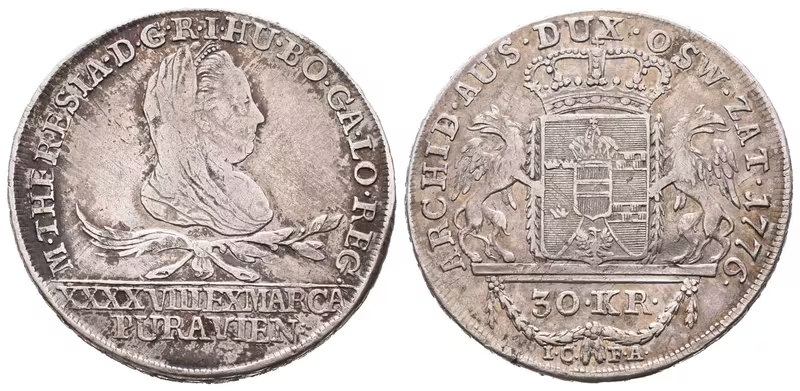
Skladem 1 ks - Code: M82I-AA1776.1
Marie Terezie, 30 Krejcar 1776, Vídeň
Marie Terezie (1740 - 1780) 30 Krejcar 1776 IC-FA - pro Halič, Vídeň, N.150, Eyp.234_R! Velmi pěkná zachovalost, krásný Rv., zbytky lesku, jemná patina, drobné rysky
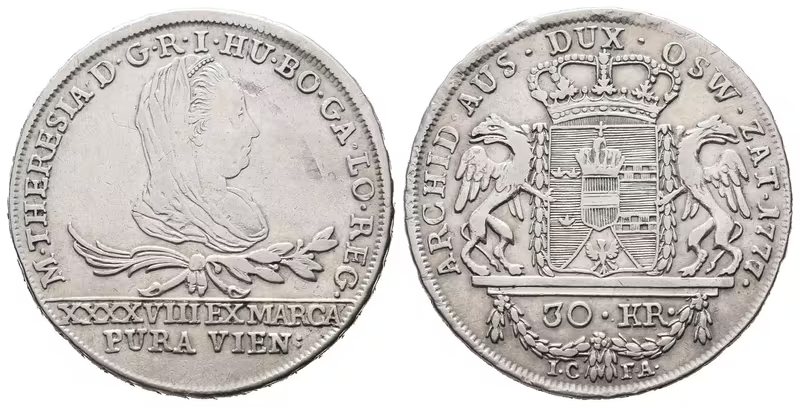
Skladem 1 ks - Code: M82I-AA1777
Marie Terezie, 30 Krejcar 1777, Vídeň
Marie Terezie (1740 - 1780) 30 Krejcar 1777 IC-FA - pro Halič, Vídeň, N.150, Eyp.234, přerytý letopočet ze 1776_R! Pěkná zachovalost, patina, zbytky lesku, rysky a úhozy na Av.
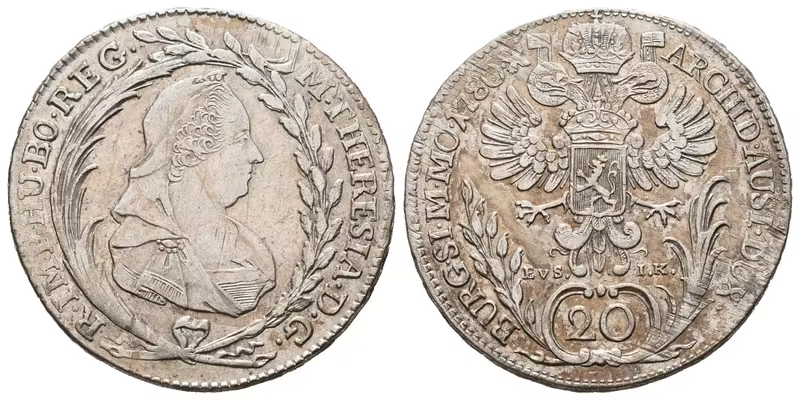
Skladem 1 ks - Code: M82K-BA1780.1
Marie Terezie, 20 Krejcar 1780, Praha
Marie Terezie (1740 - 1780) 20 Krejcar 1780, EvS-IK, Praha-Erdmann+Kendler, Hal.1953, velmi pěkná zachovalost, patina, zbytky lesku, just.
Skladem 1 ks