Medallion
A medallion is a large-format mintage on the borderline between coin and medal, usually with more pronounced relief and a representative conception. In antiquity and later it served chiefly as a ceremonial gift on important occasions, not as ordinary currency, and is therefore worked considerably more "luxuriously" than coins.
In numismatics, the medallion is used as a designation for medals of larger dimensions, or as the traditional name for some ancient bronze and silver mintages that differ in character from ordinary coins. The basic idea is simple: alongside means of payment intended for ordinary settlement, pieces were also created whose purpose was representation, memory and prestige. Such mintages did not need to fulfil an everyday function of circulation, and could therefore afford a larger diameter, more careful engraving, richer composition and an altogether more festive impression.
In ancient Rome, medallic mintages were associated chiefly with the environment of the imperial court and the higher strata of society. The purpose was not to "replace the coin" but to create an object that would be a clearly legible symbol of power and favour. These pieces were given as gifts, particularly for exceptional moments — for example, at celebrations, anniversaries, during important visits or as decorations for services. In some periods medallions were also associated with New Year gift-giving, where a gift in the form of a quality mintage functioned as a visible confirmation of the bond between giver and recipient. Since these were objects outside ordinary payment circulation, their mintage tended to be relatively small, and even at the time of creation they could represent a certain exclusivity.
A special chapter of late Roman times is represented by the so-called contorniates — a separate group of bronze medallions that differ not only in style but also in content. They often bore scenes inspired by ancient mythology, traditional motifs and "classical" themes, which on ordinary coins of the same period are not so common. In specialist interpretations it is sometimes considered that such motifs may have emphasised the continuity of traditional Roman culture at a time when society was transforming religiously and ideologically, and Christianity was asserting itself more strongly. Whatever the specific purpose of the contorniates, their distinctness shows that a medallion was not merely a "larger medal" but also a space for a different type of message than that carried by ordinary currency.
History
In later centuries, the word medallion is used in practice for large, ceremoniously conceived mintages that in character approach the medal but may retain a "coinage" way of expression — the portrait of the sovereign, titulature, state symbols or commemoration of an event in an official tone. The common denominator remains representation and the function of gift-giving: a medallion is an object intended to be kept, to be presented and to commemorate, not to be worn down in everyday circulation. Precisely for this reason, original ancient medallions in the strict sense are often valued as exceptionally rare — not only because of their age but also because, even then, they were produced in considerably smaller numbers than standard coins.
A medallion is usually characterised by a larger diameter than an ordinary coin and often by more pronounced relief, which stands out better on a larger surface. Thanks to this it can carry a more detailed portrait, richer symbolism or a scene with more elements. On quality pieces, the effort towards an "artistic" impression is apparent: cleaner composition, thoughtful arrangement of inscriptions and motifs and an altogether ceremonial character. It is precisely the generous surface and higher relief that also raise the demands on the dies and the striking itself, so that medallions are usually associated with the careful work of experienced engravers.
Functionally this is most often a gift and commemorative object. In antiquity, a medallion could express the sovereign's favour, reward for service or a diplomatic gesture. In late Roman times, among the contorniates, thematic freedom comes to the fore — mythological and traditional scenes that may act as a conscious reminder of the "old" cultural world. In modern times, medallic mintages are used at anniversaries, commemorations of personalities and institutions or as representative gifts, where not only the information but also the prestige of execution is important.
Appearance, execution and function
From the coin, the medallion differs chiefly in that it is not intended for ordinary circulation and need not be governed by the need for rapid, mass production. From the medal it may again differ by a "coinage" way of narration — for example, official titulature, a stricter state style or continuity with traditional sovereign portraits. In practice, the term thus designates above all a higher category of mintage, in which numismatic value combines with representation and artistic impression.
In our auction and shop
- Code: RX-CINA3000
Čína - Medailon s Čínskou zdí
Medailon s Čínskou zdí, červený plast a mosazný rámeček, etue, 62 mm
Skladem 1 ks - Code: FNEPR-1789
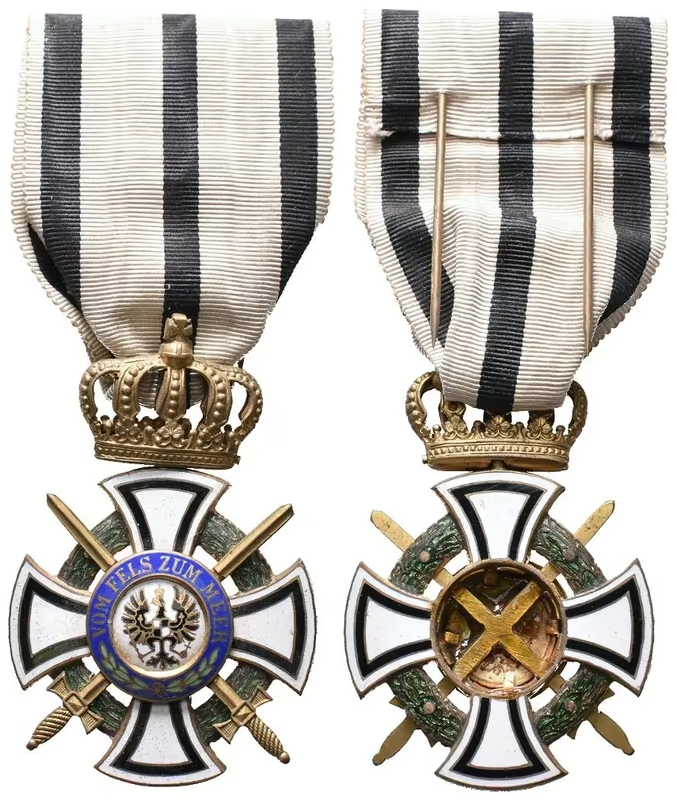
Prusko, Královský domácí řád Hohenzollernů
Německo - Prusko ( Preußen) Královský domácí řád Hohenzollernů, rytířský kříž s meči (Königlicher Hausorden von Hohenzollern Kreuz der Ritter mit Schwertern ), bronz zlacený, smalty, stuha, OEK 1789 Vypadlý zadový medailon se smaltem jinak velmi pěkná…
Skladem 1 ks - Code: XB1300-0405
Chaurova sbírka - Mince Ferdinanda III. (1627 - 1637 - 1657)
Zuzana Holečková České, moravské a slezské mince 10. - 20. století - Mince Ferdinanda III. (1627 - 1637 - 1657) , Praha 2019, 196 stran, vázané Tato publikace je svazkem věnovaným mincím Ferdinanda III. Jde o soubor celkem 250 zlatých a stříbrných mincí…
Skladem 5 ks - Code: FA-378C
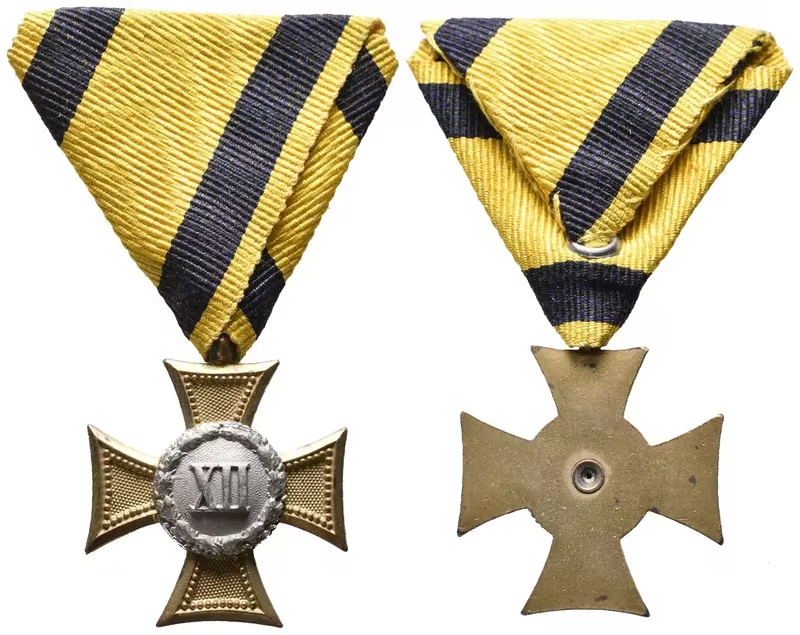
Vojenský služební odznak pro poddůstojníky a mužstvo, kříž II. třídy
Rakousko - Uhersko / Rakouské císařství Vojenský služební odznak pro poddůstojníky a mužstvo, kříž II. třídy za 12 let služby, vydání 1890 - 1913, středový medailon s vavřínovým věncem, bronz zlacený a stříbřený, Marko 378c Velmi pěkná zachovalost,…