Ticinum Mint
The Ticinum Mint was a late Roman imperial mint in the northern Italian city of Ticinum (today's Pavia), which supplied circulation with coins chiefly in the 3rd-4th centuries. For numismatics it is important for the quantity of issues and the legible mint marks, by which the coins can be reliably identified.
The Ticinum Mint came into being at a time when the Roman Empire was trying to stabilise the monetary system anew and to keep key military and transport junctions under control. Ticinum lay on the river Ticino in the vicinity of the Po and at the crossroads of routes which connected the Po Valley with Alpine passes and with the great cities of northern Italy, especially Mediolanum (Milan). It was precisely this location that made it a suitable place for a mint: coins had to be transported quickly and in large volume, often for the payment of the army and for supplying the region with circulating tender.
The foundation of the mint is usually placed in the period of the reign of Aurelian, when part of the coin production was to be moved from Mediolanum to Ticinum. This makes sense also in practical terms: in the late 3rd century the network of mints changed according to where it was necessary quickly to supply the market and the army. In the following decades the mint maintained itself even during the reorganisation of the empire under Diocletian. The reform of the administration and of the currency strengthened the importance of regional mints, since the state needed standardised issues in several centres, not only in Rome.
The peak of Ticinum's importance falls in the period of the Tetrarchy and the early Constantinian era. It was then that a large quantity of bronze denominations came into being which were used in everyday circulation, and at the same time more valuable coins were also struck here in certain periods. For collectors, Ticinum is also attractive because its production well "copies" the great history: changes in the titulature of rulers, propagandistic motifs on the reverses, and transformations of the size and quality of the circulating tender. On the coins one can thus follow the transition from the crisis of the 3rd century to the relatively more stable system of the 4th century.
History
The activity of the mint ended in the 4th century, when coin production in Italy and the West further concentrated in other centres, and the state gradually adjusted the network of operations according to current needs. In the specialist literature, the time of Constantine I the Great is often given as the end of operation at Ticinum, when the mint was closed and minting capacity moved elsewhere. For numismatics this is important because the closing of the mint creates a clear boundary: later coins no longer bear Ticinum as a mint mark, and both collector and archaeological finds can be more easily sorted chronologically.
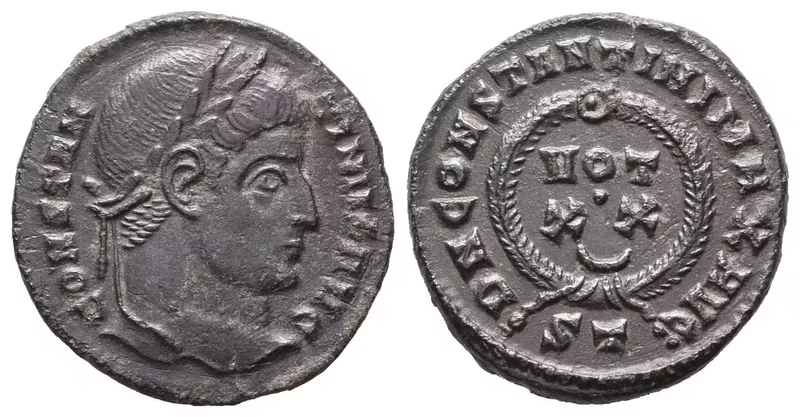
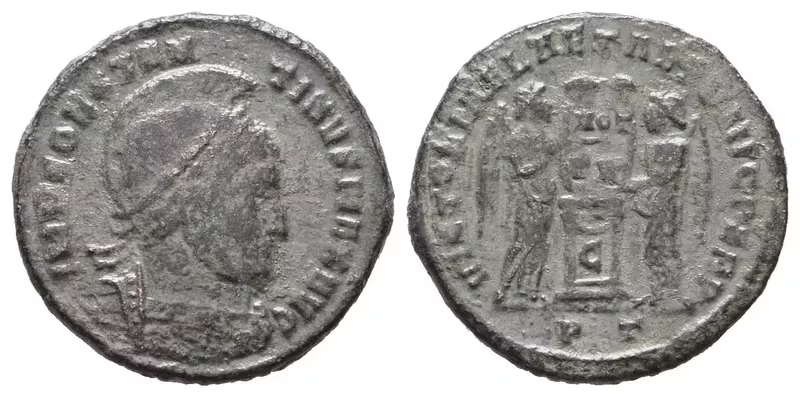
The Ticinum Mint is recognisable chiefly by marks in the exergue (the lower part of the reverse) and by markings of the workshops (officinae), which are added by a letter or symbol. With late Roman bronzes one may encounter various forms of marks, typically abbreviations derived from the name of the city - for example forms such as TIC, TT or PT - and in the Constantinian period also by designations of the type SMT (an abbreviation for the "sacred mint" associated with the place). The specific variant depends on the period and on the system of marking used.
Most commonly, bronze coins intended for ordinary circulation have been preserved from Ticinum, for the identification of which a combination of three elements is key: (1) the portrait and titulature of the ruler (dating), (2) the reverse motif (type of issue), and (3) the mint and workshop mark. The same reverse types were often struck simultaneously in several mints of the empire, so the motif alone is not enough. If, however, the exergue mark is legible, Ticinum can be identified very reliably. For practice it is good to count on the fact that with circulating bronzes the exergue is often the most worn, and therefore when assessing it is useful to look also for "backup" features: the style of script, the type of wreath or figure on the reverse, or the layout of the inscription.
Mint marks, types of issues and identification
From the point of view of numismatic significance, Ticinum is a typical "strategic" mint of the late empire: its coins are common in finds from northern Italy and the wider western area, and they show well how the Roman state used mints as a logistical tool. For collectors, Ticinum at the same time represents a clear theme, because the clear mint mark allows the building of cohesive series according to rulers, periods and individual issue types.
In our auction and shop
- Code: BE136-AU140
Constantinus I., follis
Constantinus I. (306 - 337), follis - mincovna Ticinum, VOT XX ve věnci RIC 140
- Code: BE136-AU82
Constantinus I., follis
Constantinus I. (306 - 337), follis - mincovna Ticinum, dvě Viktorie se štítem RIC 82