Ticinum
Ticinum was an ancient city in northern Italy on the river Ticino, considered the predecessor of present-day Pavia. In Roman times it was distinguished by its strategic position on the routes between the Po and the Alps, and in late antiquity it also became famous as the site of an important imperial mint.
Ticinum lay in the region the Romans called Gallia Transpadana, that is, "the land beyond the Po", and its importance was from the outset given by its location on the river Ticinus (today the Ticino) close to its confluence with the Po. According to ancient authors, the origin of the city was linked with the local tribes of northern Italy; what is certain above all is that it was a natural transport hub. The rivers here permitted navigation and the transport of goods, and at the same time this was a place where roads converged from the Po plain towards the Alpine passes and into the western part of northern Italy.
In Roman times the road network played a particular role. Ancient descriptions emphasise that, from the main communications in the Po region, branches separated leading to Mediolanum (Milan) and precisely to Ticinum, from where they continued onward to further cities of the north. Thanks to this, Ticinum was important not only economically but also militarily: whoever controlled the river crossings and the roads in this part of the plain had an advantage in the movement of troops and in supplies. The city gradually became a municipium and fitted into the standard framework of Roman administration, in which the local elites participated in the running of the community and were at the same time connected to Roman institutions.
History
Late antiquity brought a shift in the character of the city. Northern Italy increasingly became a space of military conflicts, since it was precisely through here that the roads led into and out of Italy. Thanks to its position, Ticinum acquired a more pronounced strategic importance and appears in the sources also in connection with events at the end of the Western Roman Empire. In 476 a defeat of the troops which supported the last Western Roman emperor took place at Ticinum, which ranks among the symbolic moments of the demise of Western imperial power. The following period of Ostrogothic and later Lombard rule transformed the city into an important centre of northern Italy; it is precisely from the Lombard era that the name Papia derives, from which the present-day name Pavia arose.
Medieval and modern Pavia then continued to grow on the ancient ground plan and retained the position of a regional centre. Although many ancient buildings have been overlaid by later construction, the continuity of the place is evident: the city remained "on the same river and the same roads", and its importance has merely shifted in different periods between commercial, administrative and military functions. It is precisely this long continuity that makes Ticinum/Pavia a good example of how ancient infrastructure was able to leave its mark on the form of a city even after the fall of Roman power.
The mint and numismatic significance
In numismatics, Ticinum is famous above all as an imperial mint of the late Roman period. The mint here began to function more prominently in the 3rd century, and in subsequent decades it ranked among the important minting centres of northern Italy, particularly in the period when the empire relied on a dense network of regional mints to supply both the army and civilian circulation. Its output consisted mainly of bronze denominations, but in some periods more precious strikes were also produced here, which corresponds to the role of the city near key military routes.
For collectors it is important that coins from Ticinum can often be identified by the mint marks in the exergue on the reverse. These tend to take various forms according to the period and the marking system used, usually in combination with the mark of the workshop (officina). In practice, identification is most certain when a legible mark, the titulature of the ruler and the reverse type are combined, because the same motifs could be struck at other mints too. Ticinum thus represents a "textbook" example of how late Roman coins function as a source: not only for the portrait of the emperor, but also for the logistics of the empire, which needed mints within reach of the army and the main lines of communication.
In our auction and shop
- Code: BE129-0100Recommended
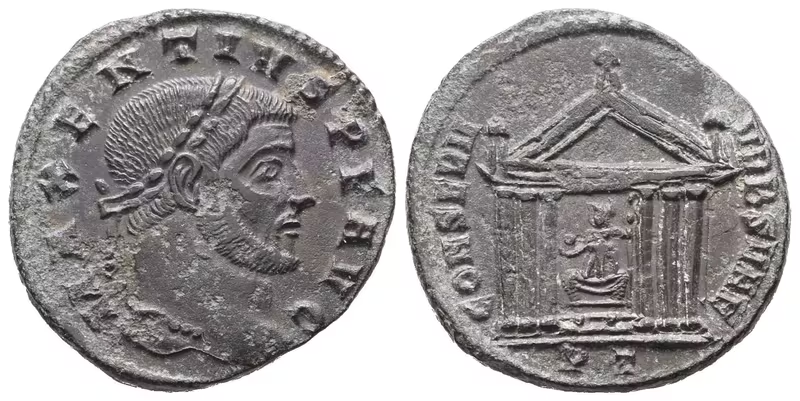
Maxentius, follis, Ticinum, RIC 100, SVAE
Maxentius (306 - 312) mincovna Ticinum, socha sedící Romy v chrámu se šesti sloupy, CONSERV - VRB SVAE, RIC 100, SVAE
Skladem 1 ks - Code: BE136-0131
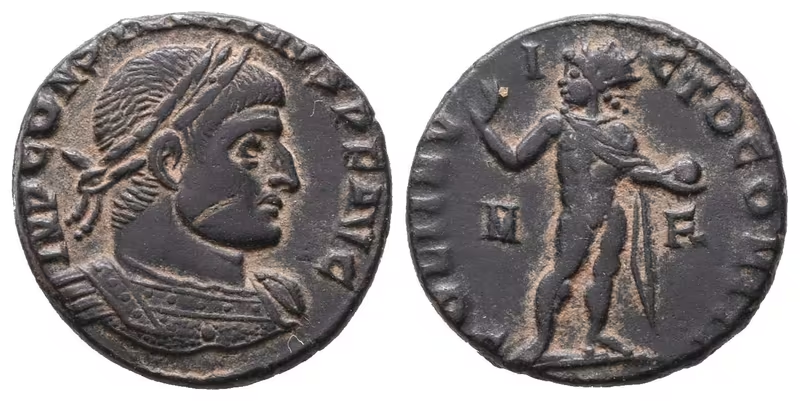
Constantine I., follis, Ticinum, RIC 131a
Constantine I. (306 - 337) mincovna Ticinum(?), raženo 312 - 313, stojící Sol držící glób a pravou rukou zdravící, RIC 131a
Skladem 1 ks - Code: BE136-AU140
Constantinus I., follis
Constantinus I. (306 - 337), follis - mincovna Ticinum, VOT XX ve věnci RIC 140
- Code: BE136-AU82
Constantinus I., follis
Constantinus I. (306 - 337), follis - mincovna Ticinum, dvě Viktorie se štítem RIC 82