Potosi Mint
The Potosi Mint was a famous colonial mint in today's Bolivia, which struck silver coins from the silver of the Cerro Rico mountain. Its "eight reales" (Spanish dollars) ranked among the most widely used trade coins of the world and circulated in Europe, the Americas and Asia.
In the 16th century Potosi was transformed into one of the richest cities of Spanish America thanks to the discovery of exceptionally lucrative silver deposits in the Cerro Rico mountain. Mining quickly took on an industrial pace, and the Spanish administration needed to transform the metal into controlled currency: for taxes, for financing the colonial administration and for long-distance trade, which rested on silver. The rise of a local mint was therefore a logical step - instead of transporting the raw material elsewhere for processing, the metal could be measured, tested and struck directly at the source.
A key role in the organisation of Potosi coinage was played by the viceroy Francisco de Toledo, who in the 1570s pressed for the building of the mint as a state instrument of control and revenue. From the first decades, silver reales were struck here above all, especially the largest and most sought-after denomination of 8 reales, later known as the "Spanish dollar" or "piece of eight". It was precisely these coins that became the global tender of their day: thanks to a stable standard and high silver content, merchants accepted them across empires, often even where Spanish power never directly ruled.
Early Potosi production is typically represented by the so-called macuquinas (cobs) - irregular, hammer-struck coins with an abbreviated image and often partly illegible legend. The irregular shape was not intentional "for effect" but a consequence of the technique and the speed of production. Nevertheless, even these pieces had enormous importance, because the main guarantee was the weight and fineness, not aesthetic perfection. In Potosi circulation, problems typical of large minting operations were addressed at the same time: wear of dies, fluctuations of quality and also the temptation to reduce the precious-metal content. Scandals over the worsened quality of issues led in the 17th century to stricter controls, to an emphasis on clear marks and gradually also to a more systematic dating of part of the production.
History
In the 18th century, Spanish colonial coinage was significantly modernised. From the Potosi Mint we also know more mechanical, more regular issues with pronounced motifs and a better controlled edge, which better resisted clipping and counterfeiting. In this period the Potosi eight reales and their fractions became even clearer for trade, which strengthened their circulation in the Atlantic and in the Pacific. The mint was thus not only a "factory for coins" but one of the key nodes of the world economy, because the silver of Potosi helped to finance European states, colonisation and international exchange of goods.
The mint building belonged to the most representative structures of the colonial city, and its importance endured even after the abatement of the great silver boom. Today it is known as Casa de la Moneda and functions as a museum and monument commemorating the era when "Potosi silver" influenced prices, trade and monetary systems on several continents.
The most typical coins from Potosi are silver reales, especially the 8 reales, and their fractions. With older cobs, the essential recognising combination is: the Potosi mint mark, the assayer's mark (initials of the responsible person) and parts of the legend with the king's name and titles. Because the blanks are irregular, it is common that some piece of data is missing or cut off by the edge - the value is therefore significantly increased by good legibility of the marks and a "more complete" image. With later, more regular issues, identification is easier: the year, denomination, type of motif and consistency of detail decide, while the edge is also observed, which on a quality strike will indicate whether the coin has not been subsequently manipulated.
Issues, marking and collector identification
Potosi coins are popular and often imitated. Warning signs may be soft, "blurry" details, a suspiciously uniform texture of the surface or traces of casting on the edge. With more valuable pieces it makes sense to check the weight and diameter, to compare the marks with verified types and to perceive natural traces of circulation. For collectors, the most sought-after are well-legible eight reales, pronounced type variants and coins with an attractive historical context, for example pieces from finds or from shipwrecks, provided they have a documented origin.
In our auction and shop
- Code: SLOTY-K1998
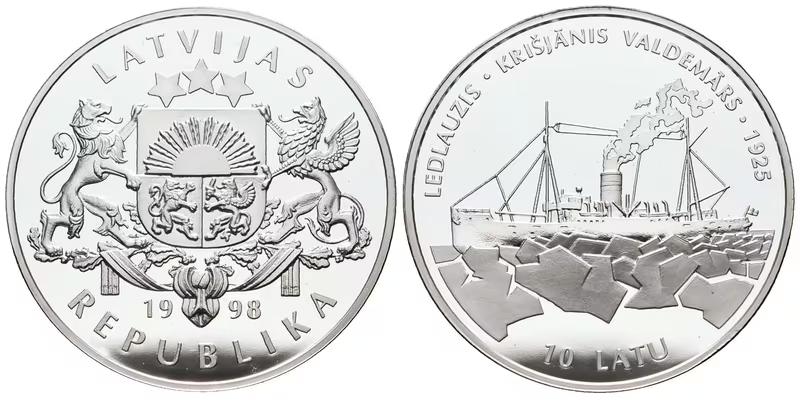
Lotyšsko, 10 Latu 1998 - Ledoborec Krisjanis Valdemars
Lotyšská republika (1993-2013) 10 Latu 1998 - Ledoborec Krisjanis Valdemars, KM# 32 Ag (.925), 38,61 mm (31,47 g), proof, v kapsli. Emise: 10 000 ks. Série "Historie mořeplavby - Lotyšské lodě". Mincovna: Valcambi, Balerna - Švýcarsko. Autor: Arvīds…
Skladem 1 ks - Code: MCC17-2019
20 Koruna 2019 - Vilém Pospíšil
Česká republika (1993 - ) Významné osobnosti československé měny 20 Koruna 2019 - Vilém Pospíšil , Aurea C17, krásná zachovalost, ilustrační foto
Skladem (>5 ks) - Code: MCZS2004-EU
Ročníková sada mincí 2004 - Vstup ČR do EU
Česká republika, 2004 Ročníková sada mincí 2004 - Vstup ČR do Evropské unie ilustrační foto, komisní prodej - obaly mohou být opotřebené
Skladem (>5 ks) - Code: SLOTY-K1995
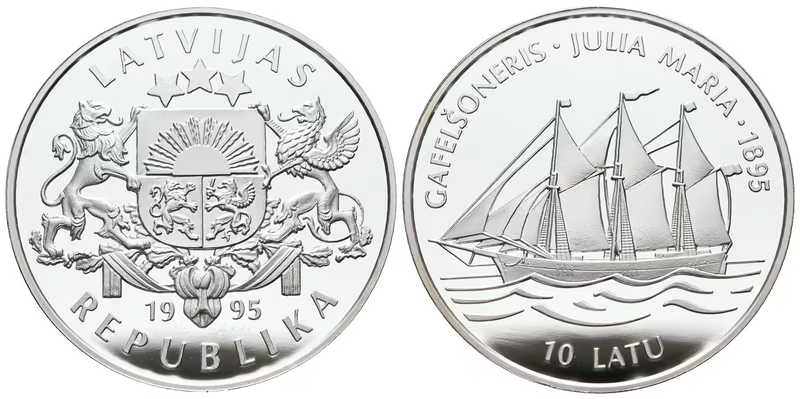
Lotyšsko, 10 Latu 1995 - Plachetnice Julia Maria
Lotyšská republika (1993-2013) 10 Latu 1995, 100. výročí plachetnice Julia Maria, KM# 25 Ag (.925), 38,61 mm (31,47 g), proof, v kapsli. Emise: 20 000 ks. Série "Historie mořeplavby - Lotyšské lodě". Mincovna: Valcambi, Balerna - Švýcarsko. Autor: Jānis…
Skladem 1 ks