Olav V
Olav V was the Norwegian king who ruled from 1957 to 1991, known for his exceptional popularity and reputation as the "people's king". He ascended the throne after the death of Haakon VII, and his long reign is linked with the stable development of post-war Norway and with a personal, unostentatious style of monarchy.
Olav V (full name Alexander Edward Christian Frederik) was born on 2 July 1903 in England into Danish-British kinship, but his life soon became firmly bound up with Norway. When in 1905 his father, the Danish prince Carl, was elected Norwegian king as Haakon VII, the monarchy became a symbol of newly restored Norwegian statehood. At that time the young prince was given the new, "Norwegian-sounding" name Olav, to make clear that the royal house wished to be perceived as native and national. His childhood and adolescence were spent largely in Norway, which had great significance for his later image as a sovereign who felt himself to be part of society, not a distant court.
As Crown Prince Olav prepared for the role which in a constitutional monarchy rests on representation, continuity and the ability to embody the state in times of crisis. In the interwar period he also entered into dynastic politics by his marriage to Märtha of Sweden (wedding in 1929). The marriage produced three children, of whom the most significant from the point of view of succession was the future king Harald V. In personal terms, however, Olav later had to come to terms with the fact that Märtha died in 1954, that is, even before his accession to the throne. For the rest of his life he then reigned without a queen consort at his side, which reinforced an impression of a certain austerity and civility of the court.
A significant turning point was the Second World War. Norway was attacked by Nazi Germany in 1940 and the royal family, along with the government, went into exile, from where they supported the legitimacy of the state and resistance against the occupation. Olav's role in this period is associated with the strengthening of morale and symbolic unity; the post-war return of the monarchy to Norway then contributed to the royal house remaining a broadly accepted element of the political system. In 1955, moreover, Haakon VII's health worsened and Olav for some time acted as regent, so that he had practical experience of the exercise of royal duties even before his formal accession.
History
After the death of Haakon VII he ascended the throne on 21 September 1957 as Olav V. His reign lasted more than three decades and is often described as a period in which the Norwegian monarchy consolidated its modern, "civic" face. Olav set great store by unostentatiousness, sport and natural contact with people, which was reflected in his nickname "king of the people" (Folkekongen). In the context of a constitutional monarchy it is important that the king did not rule politically in a direct sense, but his authority rested on the trust of the public, on respect for democratic institutions and on the ability to be a stable symbol of the state in the rapidly changing 20th century.
Olav died on 17 January 1991 in Oslo, and the throne passed to Harald V. In public memory he remained inscribed as a sovereign who managed to combine tradition with a modern way of life, and whose popularity transcended ordinary political and social boundaries.
Olav V's informal manner of appearing had a practical effect on how the monarchy was perceived in the age of mass media. Instead of distant ceremoniousness, accessibility, modesty and personal example were emphasised. What in other countries might come across as a "popularisation" of the office, in Norway strengthened trust that the royal house did not work against democratic arrangements but was rather their complement and a stabilising element.
The image of the sovereign and his trace in coinage
From the numismatic point of view, Olav V is interesting above all as the portrayed sovereign on Norwegian circulation coins of the second half of the 20th century. With modern monarchies it is usually expected that the sovereign's portrait on the obverse serves as a mark of state continuity, while the reverse motifs carry national symbolism (arms, heraldic animals, motifs connected with history or culture). Collectors therefore follow above all the year of issue, portrait variants, mint marks, changes in alloys and exceptional strikings, for example commemorative issues released for jubilees or significant state events. Precisely on coins one can clearly see how the tradition of "the sovereign on the metal" is maintained even in modern times, though within a different political and social framework than in earlier centuries.
In our auction and shop
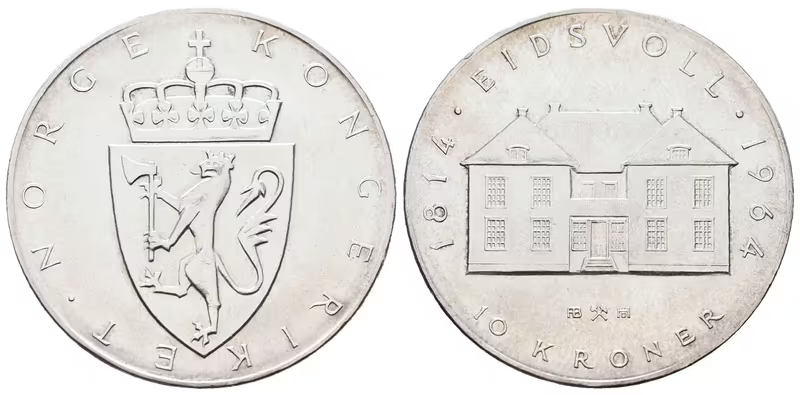
- Code: SNOR97-E1964
Norsko, 10 Kroner 1964 - Ústava
Norské království, Olav V. (1957 - 1991) 10 Kroner 1970 - K 150. výročí ústavy, KM. 413, ražební lesk, patina Ag 0,900, 35 mm (20 g)
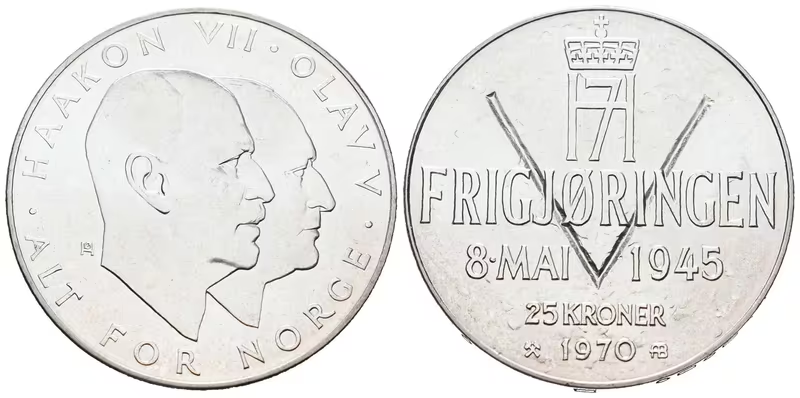
Skladem 1 ks - Code: SNOR97-D1970.2
Norsko, 25 Kroner 1970 - Osvobození
Norské království, Olav V. (1957 - 1991) 25 Kroner 1970 - K 25. výročí osvobození, KM. 414, luxusní zachovalost, ražební lesk Ag 0,875, 39 mm (29 g)
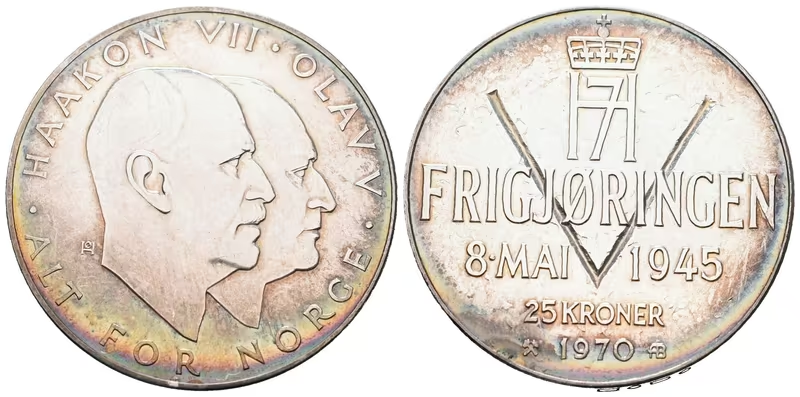
- Code: SNOR97-D1970
Norsko, 25 Kroner 1970 - Osvobození
Norské království, Olav V. (1957 - 1991) 25 Kroner 1970 - K 25. výročí osvobození, KM. 414, luxusní zachovalost, ražební lesk, patina Ag 0,875, 39 mm (29 g)
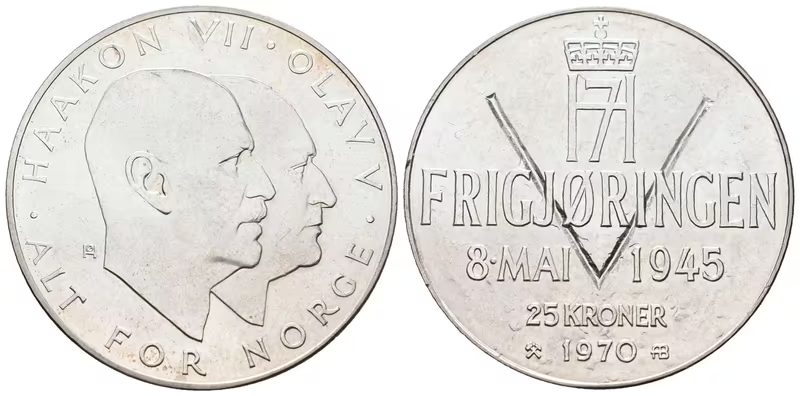
- Code: SNOR97-D1970.1
Norsko, 25 Kroner 1970 - Osvobození
Norské království, Olav V. (1957 - 1991) 25 Kroner 1970 - K 25. výročí osvobození, KM. 414, luxusní zachovalost, ražební lesk Ag 0,875, 39 mm (29 g)