Paul I of Russia
Paul I of Russia (1754-1801) was a Russian emperor who reigned for only five years from 1796 until his assassination. The son of Catherine II the Great, with whom he had a conflicting relationship, he attempted to reform the empire along Prussian lines.
Paul was born in Saint Petersburg, officially the son of Peter III and Catherine II, although his paternity was disputed. After the coup of 1762 Catherine kept him away from power, and he was raised by enlightened tutors. Paul grew up in an atmosphere of suspicion - his mother had murdered (or had ordered the murder of) his official father. The relationship between mother and son was strained - Catherine considered disinheriting him in favour of her grandson Alexander. Paul lived at Gatchina, where he built up his own miniature army modelled on the Prussian pattern.
After Catherine's death in 1796, Paul finally acceded to the throne at the age of 42. He immediately abolished his mother's reforms and dismissed her favourites. He introduced Prussian military drill, uniforms with pigtails and parade-ground marching. He issued a law of succession - primogeniture instead of the election of the sovereign. He limited serfdom to three days a week. He banned the import of books and foreign travel. His chivalric obsession led to his acceptance of the title of Grand Master of the Order of Malta in 1798 - a Protestant at the head of a Catholic order! Foreign policy was chaotic - first against France together with Austria, then an alliance with Napoleon against England.
History
Paul's paranoia grew - he saw conspiracies everywhere. He built the Mikhailovsky Castle as a fortress, but died there on his very first night. On 23 March 1801 a group of officers led by Pahlen broke into his bedchamber. Paul was strangled with a scarf, officially a "stroke". His son Alexander I knew of the conspiracy but did not prevent it. The murder was celebrated - Paul was unpopular for his unpredictability. His reforms were immediately repealed. Yet some survived - the law of succession remained in force until 1917. Paul was a tragic figure - intelligent but mentally unstable, a product of a dysfunctional family and absolute power.
Paul struck remarkably high-quality coins despite his short reign. His roubles and gold imperials rank among the artistic peaks of Russian coinage. The portrait by Lebrecht depicts the emperor in profile with his characteristic snub nose. The reverse bears the double-headed eagle with the Maltese cross on its chest - a unique combination. The legend reads PAVEL I IMPERATOR I SAMODERZHETS VSEROSSIYSKIY.
Paul I and Russian imperial coinage
Of particular interest are the Maltese strikes. As Grand Master of the order Paul struck special roubles with a cross and crown. These "Maltese roubles" are the rarest Russian coins of the 18th century. Paul also experimented with coin alloys - the first Russian platinum coins were being prepared during his reign (only realised under Alexander I). The quality of mintage was exceptional - Paul personally inspected the dies. After his death some coins were withdrawn and melted down because of the Maltese symbolism. Alexander I had his father's portraits erased from public buildings. This is why Paul's coins are scarce - a five-year reign and the subsequent destruction. Numismatically they document a short, bizarre epoch of Russian history, when the tsar was simultaneously the Grand Master of a Catholic order.
In our auction and shop
- Code: XB1290-1New
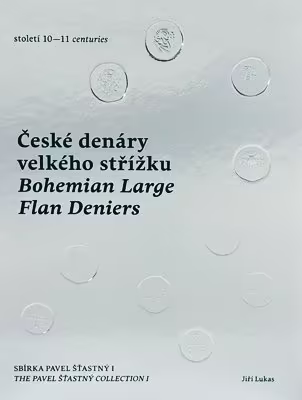
České denáry velkého střížku - Pavel Šťastný, I. díl
České denáry velkého střížku ze sbírky Pavla Šťastného - I. díl Nabízíme vám exkluzivně čtyřsvazkovou edici proslulé sbírky českých denárů a brakteátů Pavla Šťastného. Sbírka představuje nejúplnější komplet českých raně středověkých mincí 10. - 13.…
Skladem 2 ks - Code: XB1290-3
Moravské denáry - Pavel Šťastný, III. díl
Moravské denáry 10. - 12. století ze sbírky Pavla Šťastného - III. díl Nabízíme vám exkluzivně čtyřsvazkovou edici proslulé sbírky českých denárů a brakteátů Pavla Šťastného. Sbírka představuje nejúplnější komplet českých raně středověkých mincí 10. -…
Skladem (>5 ks) - Code: SRUS85-E1801
Rusko, 2 Kopějka 1801 EM
Rusko, Pavel I., 1796 - 1801 2 Kopějka 1801 EM, Jekaterinburg, Bitkin2.118, Uzd.2993, patina
- Code: SREC91-B1963
Řecko, 30 Drachma 1963
Řecké království, Pavel I., 1947 - 1963 30 Drachmai 1963 - K 100. výročí královské dynastie, KM.86, lesk, patina, drobné rysky