Pentanummium
The pentanummium was a Byzantine bronze coin worth five nummi, struck from the late 5th to the 7th century. The name comes from the Greek pente meaning five and the Latin nummus.
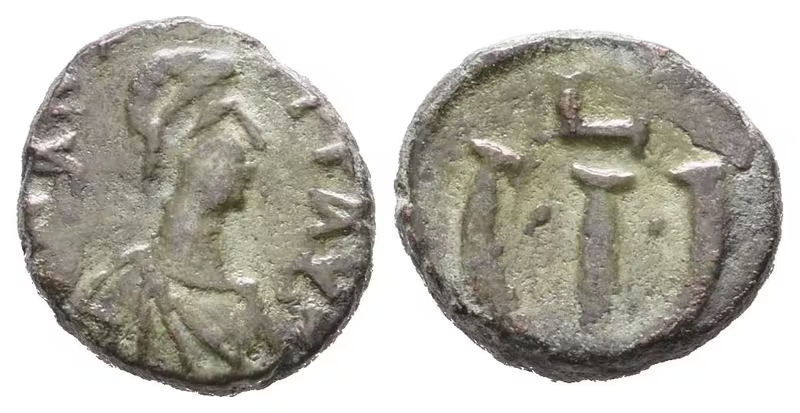
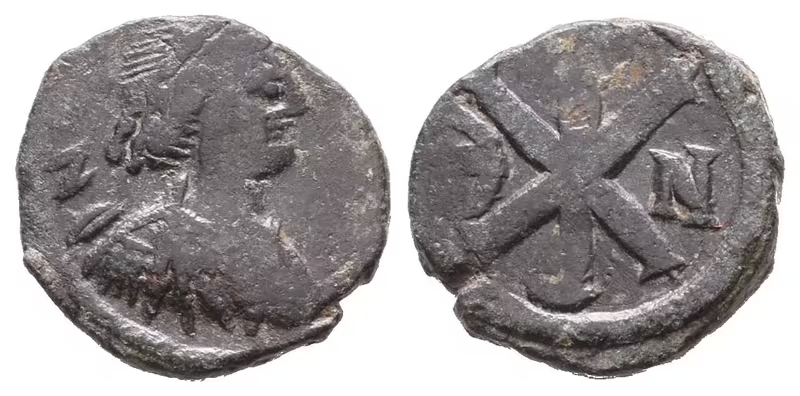
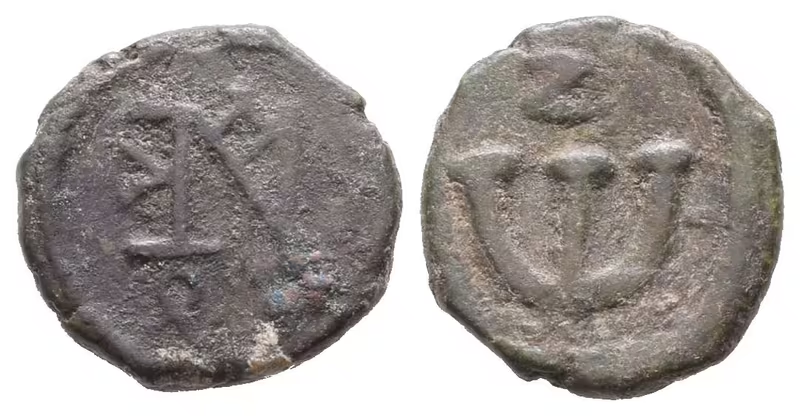
The pentanummium was introduced by Emperor Anastasius I in 498 as the smallest denomination of his monetary reform. The reform created a hierarchical system of bronze coins ranging from the follis to the pentanummium. This small coin originally weighed 2 to 2.5 grams with a diameter of 12 to 15 millimetres and bore the mark Є according to the Greek numeral system meaning five. The obverse bore a schematic imperial portrait or monogram, the reverse the value Є often accompanied by a cross.
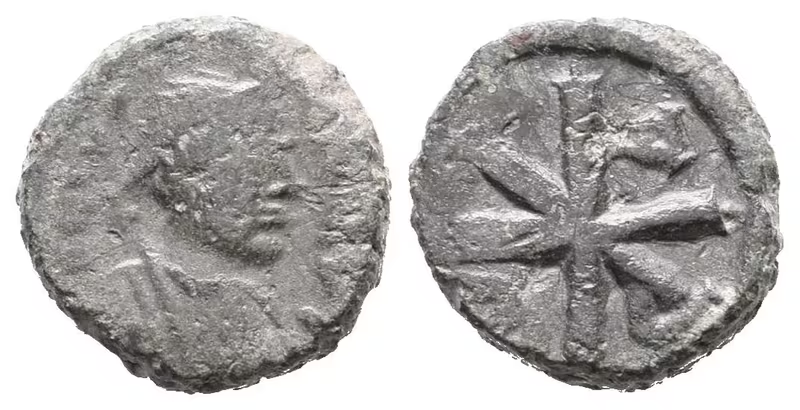
Under Justinian I the pentanummium was struck irregularly according to the needs of local circulation. Justinian's pentanummia are rarer than the larger denominations, which suggests limited production. The weight fell to 1.5 to 2 grams and the quality of mintage was often very low. Many pentanummia have illegible inscriptions and unclear motifs due to the small surface and wear of the dies. The provincial mints in Antioch and Alexandria struck pentanummia only exceptionally.
History
In the 7th century the striking of the pentanummium almost ceased. Heraclius and his successors struck pentanummia only as emergency issues during crises. The weight fell below 1 gram and the diameter to a mere 10 millimetres. These late pentanummia were often incompletely struck or restruck on older coins. Archaeological finds of pentanummia from this period are extremely rare.
The definitive end of the pentanummium came at the end of the 7th century. Economic inflation rendered such a small denomination practically worthless. The last known pentanummia date from the time of Constantine IV around the year 680. In the 8th century the pentanummium disappeared entirely from the Byzantine monetary system. Its function was partly taken over by the larger decanummium, but rather there was an overall simplification of the denominational structure.
Characteristics and use of the pentanummium
The pentanummium was the smallest Byzantine coin in regular circulation. The small diameter and low weight made the coin easily lost. The mark Є was often unclear or missing entirely. The quality of the copper was low with a high lead content. The dies for pentanummia wore out quickly, leading to illegible strikes. Some pentanummia are so small that they can be mistaken for lead seals.
The economic importance of the pentanummium was limited. It served for the absolutely smallest transactions such as the purchase of a few olives or a little salt. The purchasing power was so low that it was often necessary to pay several pentanummia at once. Archaeological finds of pentanummia are scarce, which suggests their rapid loss or recycling. The concentration of finds in port cities may be connected to their use as small alms.
In our auction and shop
- Code: BF001-0029
Anastasius I., pentanummium, Konstantinopol, Sear 29
Anastasius I. (491-518) mincovna Konstantinopol, císař doprava / nominál, Sear 29
Skladem 1 ks - Code: BF002-0093.1
Justin I., pentanummium, Konstantinopol, Sear 93
Justin I. (518 - 527) mincovna Konstantinopol, císař doprava / Chi Rho, Sear 93
Skladem 1 ks - Code: BF002-0093.2
Justin I., pentanummium, Konstantinopol, Sear 93
Justin I. (518 - 527) mincovna Konstantinopol, císař doprava / Chi Rho, Sear 93
Skladem 1 ks - Code: BF004-0375.1
Justin II. a Sophia, pentanummium, Konstantinopol, Sear 375
Justin II a Sophia (565 - 578) mincovna Konstantinopol, monogram / nominál, Sear 375
Skladem 1 ks