Phocas
Phocas (c. 547–610) was a Byzantine emperor who came to power by a military coup in 602. His troubled reign marked the Byzantine Empire with internal conflicts and external threats, but coins from his period are a valuable record of this turbulent epoch for collectors.
Flavius Phocas came from a military background and before his accession to the throne served as an officer in the Byzantine army on the Danube frontier. In 602 he led a military revolt against Emperor Maurice, whose unpopular policy of austerity and the continuation of the campaign in the Balkans aroused dissatisfaction among the legions. The rebel army marched on Constantinople, where Maurice lost support and was executed together with his family.
Phocas was proclaimed emperor on 23 November 602 and his reign was marked from the outset by violence and instability. The new emperor had to contend with the opposition of the Byzantine aristocracy, which regarded him as a usurper of low birth. Purges and persecutions followed, which weakened the empire internally.
The external situation was no more favourable. The Persian king Khosrow II used the internal upheaval in Byzantium as a pretext for attack, ostensibly to avenge the murdered Maurice. Persian armies penetrated deep into Byzantine territory and occupied key provinces in Mesopotamia, Syria and Anatolia. Phocas was unable to confront this threat effectively, which further undermined his authority.
History
The end of Phocas's reign came in 610, when Heraclius, son of the exarch of Carthage, rose against him. Heraclius's fleet sailed to Constantinople, where most of the population and the army joined him. Phocas was captured, tortured and executed. Heraclius became emperor and inaugurated an era of restoration of Byzantine power.
The coins of Phocas constitute interesting numismatic material from the period of the Byzantine crisis at the beginning of the 7th century. The obverse shows the emperor's likeness with a distinctive full beard, a crown and imperial insignia. Phocas's portraits have pronounced features and are easily recognisable among Byzantine strikes.
The most common denominations from Phocas's reign are the bronze follis and its fractions, which served for everyday commercial dealings. They were struck at the Constantinople mint and at provincial mints such as Thessalonica, Nicomedia, Cyzicus and Antioch. Gold solidi from this period are rarer and document the continued striking of prestige coins even in a time of political turbulence.
Coinage under Phocas
A characteristic feature of Phocas's coins is the depiction of the emperor in consular uniform or in military dress, which corresponded to his military background. On the reverses appear standard Byzantine motifs including the cross, angels or the mint mark. Coins from the later years of his reign often show a decline in quality, which reflects the empire's economic difficulties.
In our auction and shop
- Code: XA-2005
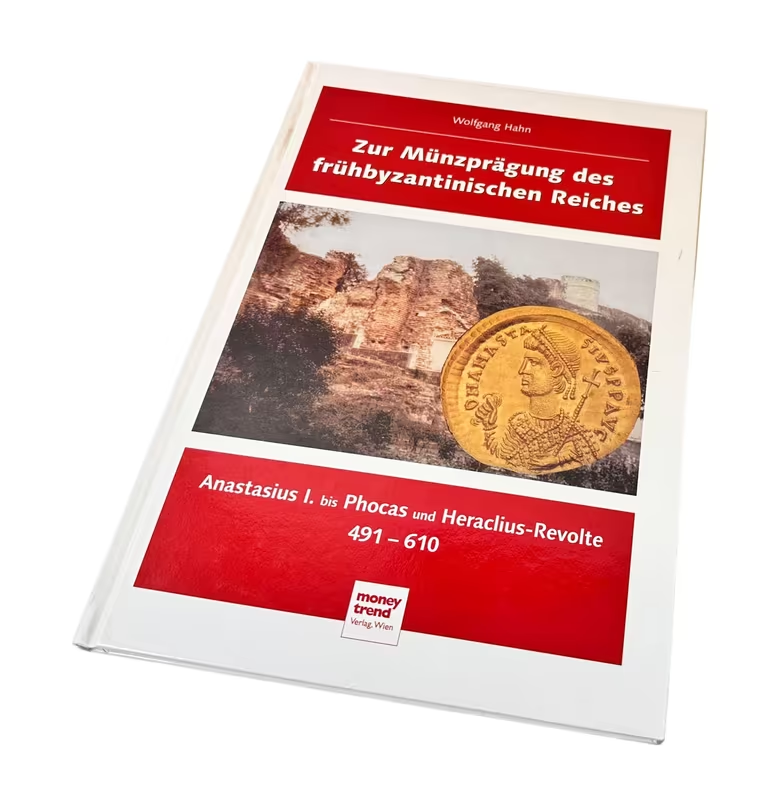
Zur Münzprägung des frühbyzantinischen Reiches
Zur Münzprägung des frühbyzantinischen Reiches, Anastasius I bis Phocas und Heraclius-Revolte 491 - 610 Wolfgang Hahn Anastasius I. bis Phocas und Heraclius - Revolte 491 - 610 Wien 2005, 222 stran, vázané