Plantagenets
The Plantagenets were the English royal dynasty which ruled in 1154–1485 and fundamentally shaped the medieval history of England and its relations with France. In their era the foundations of the English parliamentary system were laid, long wars were waged, and the administration of the kingdom as well as the form of power were transformed.
The name Plantagenet is derived from a nickname of the house of Anjou: tradition associates it with the fact that Geoffrey V of Anjou wore as his emblem a sprig of broom (Latin planta genista). The dynasty came to the English throne in 1154, when Henry II Plantagenet, son of Geoffrey and the English heiress Matilda, succeeded. His accession meant the end of a period of internal upheaval and at the same time the beginning of the "Angevin" era, when English kings ruled extensive territories in France. This power conglomerate, often referred to as the Angevin Empire, was not a unified state in the modern sense but a collection of holdings and feudal bonds which required constant diplomacy, military force and negotiation with the local nobility.
Under Henry II Plantagenet the functioning of royal administration and the law changed markedly. The monarch strengthened the royal judiciary and laid important foundations for what later developed into English common law. At the same time, however, his reign was marked by sharp conflicts, among them the dispute with the Church, symbolically linked with the death of Archbishop Thomas Becket. From the outset the dynasty was exposed to tensions between the king's centralising efforts and the ambitions of powerful barons, which recurred in English history throughout the 13th century.
Henry's successor was Richard I the Lionheart, famed for his participation in the Crusades and his chivalric reputation. In England itself, however, he was present for only short periods, and royal policy often relied on regents and the administrative apparatus. After him came John Lackland, whose reign became one of the key moments of English constitutional history: as a result of disputes with the nobility and the loss of a significant part of the French holdings, in 1215 he was forced to confirm Magna Carta. This document is regarded as a symbol of the restraint of royal arbitrariness and as a precedent for later negotiations between the monarch and the political elite, even though its immediate effects were more complex and were the subject of further conflicts in practice.
History
In the 13th century the dynasty continued with the reigns of Henry III and especially Edward I, who strengthened royal authority and intervened significantly in the affairs of Wales and Scotland. It was precisely this period that is associated with a more prominent role for assemblies and with the gradual crystallisation of parliamentary institutions. Under Edward III in the 14th century the Hundred Years' War broke out, a long conflict with France whose roots lay both in feudal relationships and in dynastic claims. At the same time England was struck by the plague epidemic, which transformed society, the labour market and relations between social classes. Towards the end of the 14th and into the 15th century, dynastic disputes intensified, which culminated in the Wars of the Roses between two branches of the Plantagenets — the Lancastrians and the Yorkists.
The Plantagenet dynasty ended in 1485, when at the Battle of Bosworth Richard III fell and Henry VII Tudor came to the throne. This closed the period of the late Middle Ages in England, during which expansion in and losses of French territories alternated with the growth of state institutions and recurrent internal crises. The Plantagenets left a legacy that is not confined to a mere list of kings: they shaped the form of royal administration, the law and political negotiation, which became a characteristic feature of English development.
The Plantagenets are not a homogeneous "single house" in the simple sense, since over the centuries various branches and rival lines arose. Dynastic marriages, inheritance and feudal rights played a fundamental role, capable of either uniting or dividing territories on both sides of the English Channel. It is precisely for this reason that the theme of legitimacy keeps recurring in the history of the Plantagenets: who has the right to rule, who is the "rightful" heir and what weight is to be given to promises, charters and the recognition of the nobility. In times of war and political crisis, legitimacy often rested both on lineage and on the actual ability to retain power.
The house, its branches and contemporary context
For numismatics the period of the Plantagenets is of interest both for the long-term stability of the silver penny system and for repeated reforms of the coinage. In the 12th–13th centuries the quality control of coins gradually improved, the network of mints developed, and in practice the concept of the sterling as a trustworthy silver currency became established. The changes in the type of English penny are also significant: under Henry III the so-called "long cross" type took hold (a practical motif which made edge-clipping of silver more difficult), and under Edward I a major recoinage took place, which introduced a more uniform form of the currency. Such reforms show that royal power expressed itself not only on battlefields and in charters but also in everyday payments — coins were among the most visible symbols of the king's authority across the country.
In our auction and shop
- Code: SVEL90-E2016
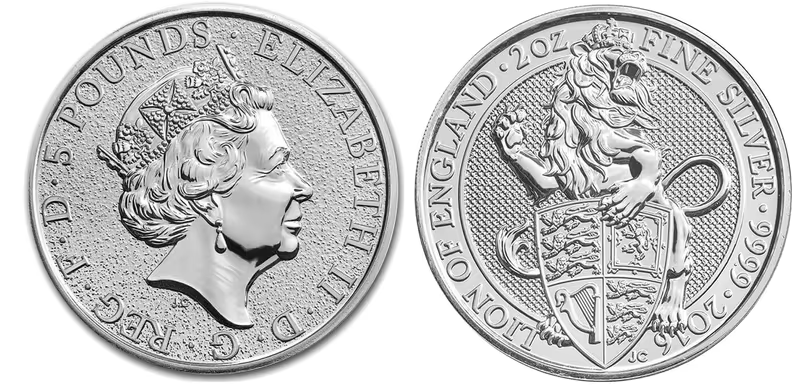
Velká Británie, 5 Pounds 2016 - Lion of England
Velká Británie, Elizabeth II. (1952 - 2022) 5 Libra 2016 - Lion of England (Anglický lev) Ag 0,9999, 38,61 mm (62,2 g), 2 Oz The Queen's Beasts The Lion 2 Oz Britská královská mincovna se v roce 2016 rozhodla vydat minci ze setu, který se bude razit…
- Code: SVEL90-E2017G
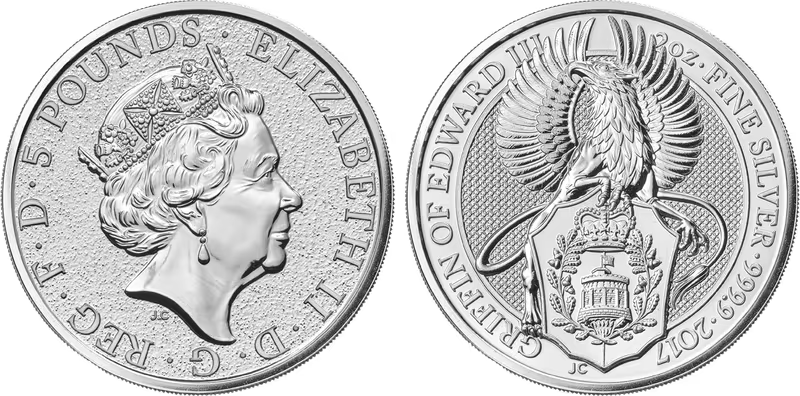
Velká Británie, 5 Pounds 2017 - Griffin of Edward III.
Velká Británie, Elizabeth II. (1952 - 2022) 5 Libra 2017 - Griffin of Edward III. (Grif Edwarda III.) Ag 0,9999, 38,61 mm (62,2 g), 2 Oz Queen's Beasts jedna z vlajkových lodí série investičních mincí vydaných The Royal Mint. Byla vytvořena na počest 65.…