Richard I the Lionheart
Richard I the Lionheart (1157-1199) was an English king of the House of Plantagenet, famous as an exceptionally capable military commander and participant in the Third Crusade. He reigned from 1189 to 1199, but spent most of his rule outside England, devoting himself to wars, diplomacy, and the defence of the extensive Angevin empire.
Richard I the Lionheart was born on 8 September 1157 as the son of the English king Henry II and Eleanor of Aquitaine. He grew up in an environment in which the English crown ruled vast territories in France - notably Normandy, Anjou, and Aquitaine - and in which politics was based on dynastic ties, feudal obligations, and constant disputes with rivals. Already in his youth he became a significant lord in France: as Duke of Aquitaine he had to deal with revolts by the local nobility, assert the authority of his house, and at the same time build his reputation as an energetic warrior. The epithet "Lionheart" is connected precisely with the image of a fearless commander, which became firmly linked with his personality in contemporary accounts and later tradition.
Plantagenet family politics were tense. Relations between Henry II and his sons repeatedly grew strained, and in some conflicts Richard even acted against his father, often in alliance with his brothers and with the French king. These disputes had both dynastic and pragmatic motives: they concerned the division of powers, the control of territories, and the question of who would actually decide. When Henry II died in 1189, Richard ascended the English throne and at the same time inherited the extensive set of continental possessions that formed the power base of the house. Soon after his coronation, however, it became clear that Richard did not intend to be a "settled" ruler: his attention was directed primarily towards international politics and the expedition to the Holy Land.
The Third Crusade (1189-1192) was a key episode in Richard's life. He entered history as one of the most prominent Crusader leaders of his time. The journey was itself politically demanding: it involved negotiations with both allies and rivals, securing supplies, and controlling strategic points in the Mediterranean. Richard earned respect during the campaign as a military commander, but he also clashed with the complicated reality of Crusader politics, where personal ambition, the rivalry of European rulers, and the interests of local Crusader states intersected. Although he did not succeed in recapturing Jerusalem, his military successes and negotiations contributed to an agreement that allowed Christian pilgrims access to the holy places.
History
After his return from the Crusade, Richard faced another dramatic twist: on the way home he was captured and subsequently held in captivity, which led to an extraordinary financial strain on his realm. The ransom was one of the best-known events of his reign and significantly affected administration and the economy, because it was necessary to gather enormous resources through taxes and extraordinary contributions. While Richard was outside the country, part of the power in England and on the continent was naturally taken over by his officials, and at the same time room was opening up for the ambitions of his brother John Lackland. It was during this period that it became apparent how fragile the stability of a realm can be when it rests on the personal authority of the ruler and on his ability to be present where it is politically necessary.
After his release, Richard again concentrated primarily on continental wars, especially clashes with the French crown. Many contemporaries and later authors noted that England was for him largely a financial and administrative hinterland, while the real centre of gravity of his politics lay in France, where the goal was to maintain and defend the family's domains. Richard died on 6 April 1199 from injuries sustained during a siege on French territory. After his death, John Lackland ascended the throne, opening another chapter of Anglo-French conflicts that later led to the weakening of the Anglo-Norman dominion on the continent.
Richard's reign is often viewed through the prism of wars and the Crusade, but the administrative and financial side was also important. The king's long absence forced the English institutions to function relatively independently: the offices collected taxes, administered the law, and ensured the revenues that financed the king's politics. At the same time it became clear how dependent the medieval monarchy was on money: campaigns, ransom, and military operations required a reliable flow of revenue and the ability to mobilise resources quickly.
Reign, symbolism, and coins
From a numismatic point of view, Richard I is associated with English coinage of the late 12th century. In his time the silver penny dominated, forming the basis of circulation, and it was precisely in this era that types characteristic of medieval England today were struck - with a prominent cross on the reverse and the king's name in the legend. Coins from Richard's time have survived in great numbers, but they are nevertheless important: they show the stability of the monetary system, the network of mints, and how the ruler "spoke" to everyday circulation through legends and symbols. With collector-attractive pieces, attention is paid in particular to variants of legends, the quality of the strike, and specific mint markings, because it is precisely these details that often distinguish an ordinary strike from a less common variant.
Richard's reputation as a "chivalrous king" survives to this day, mainly in legends, literature, and popular culture. For the historian, however, he remains interesting also as a ruler who governed in a transitional era: his realm was enormous but difficult to maintain without personal presence and without a constant political balance with neighbours. Coins and charters from his period thus remind us that behind the romantic image of the Crusader stood above all the harsh world of finance, administration, and long-term struggles for power.
In our auction and shop
- Code: RX-USA-016New
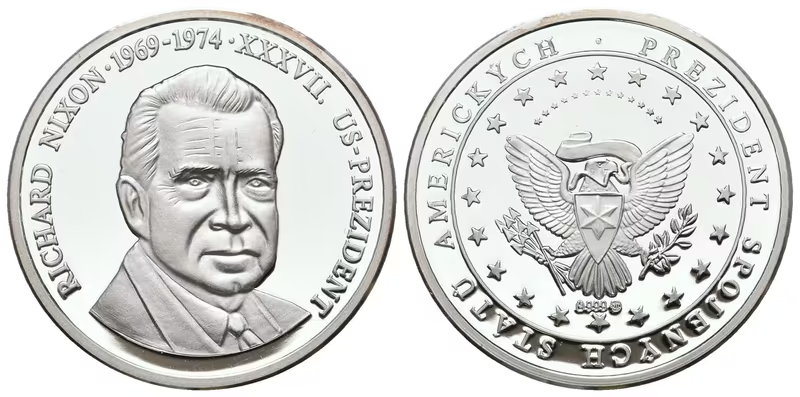
USA, medaile 1974 - Richard Nixon, XXXVII. prezident USA, Prezidentský pečeť USA
Soukromá ražba - série Prezidenti USA Medaile 1974 - Richard Nixon, XXXVII. prezident USA, Prezidentský pečeť USA Ag (.925), 30 mm (8,5 g), v kapsli. Stav mince odpovídá fotografii. Jedná se o druhotný prodej. (Možná oxidace, atd.. ! - VIZ FOTOGRAFIE !)
Skladem 1 ks - Code: RG-2013RIWA
AR Medaile b.l. (2013) - Richard Wagner - 200. výročí narození
Česká republika (1993 - ) AR Medaile b.l. (2013, Miroslav Schovanec) - 200. výročí narození Richarda Wagnera (1813 - 1883) Ag 0,999, 37 mm (31,1 g), 1 Oz, číslo 146 (raženo 616 ks), kapsle, etue, certifikát, PROOF Stříbrná pamětní medaile z cyklu…
Skladem 1 ks - Code: RX-USA-017
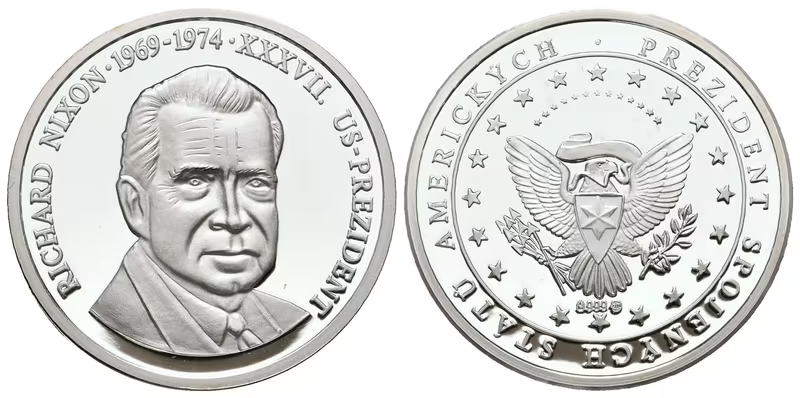
USA, medaile - Richard Nixon, XXXVII. prezident USA, 1969-1974
Soukromá ražba - série Prezidenti USA Medaile - Richard Nixon, XXXVII. prezident USA, 1969-1974 Ag (.999), 30 mm (8,4 g), v kapsli. Stav mince odpovídá fotografii.
- Code: SRAK2-C2009.1
Rakousko, 10 Euro 2009 - Richard Lví srdce
II. republika (1945 - ) 10 Euro 2009 - Richard Löwenherz. Ag 0,925 (17,3 g), KM.3180, původní etue, certifikát a přebal