Kingdom of Poland
The Kingdom of Poland was a Central European state existing in various forms from 1025 to 1918, which arose with the coronation of Bolesław the Brave and at the height of its power controlled vast territory from the Baltic to the Black Sea. The Kingdom of Poland is significant in numismatics for its rich coinage, especially Polish denarii with the eagle,…
The Kingdom of Poland was established in 1025 with the coronation of Duke Bolesław I the Brave, who became the first king of Poland. The foundations of the Polish state had been laid by his father Mieszko I, who accepted Christianity in 966 and united the Polish tribes under the rule of the Piast dynasty. Bolesław's coronation meant the official recognition of Poland as a kingdom equal to other European powers and the beginning of a millennium-long tradition of the Polish kingdom.
After Bolesław's death came a period of internal struggles and weakening, which culminated in the pagan uprising of 1034–1040. The country reverted for a time to paganism, and only Casimir I the Restorer managed to restore the Christian state and royal power. His son Bolesław II the Bold attempted to renew royal dignity, but his conflict with the Church and the murder of Bishop Stanisław of Szczepanów led to his overthrow.
The 12th and 13th centuries were characterised by the feudal fragmentation of Poland into individual principalities. The Piast princes divided the land according to the testament of Bolesław III Wrymouth of 1138, which established a rotational system of rule. Thus the independent principalities of Mazovia, Silesia, Greater Poland, Lesser Poland and others came into being, which waged constant wars among themselves for supremacy.
The unification of Poland was completed by Casimir III the Great (1333–1370), the last king of the Piast dynasty. Casimir restored a unified Polish kingdom, extended it with Galicia and Volhynia, carried out important reforms of law and administration and founded the University of Kraków. His reign is regarded as the golden age of medieval Poland, when the country reached significant economic and cultural flowering.
After the extinction of the Piasts, the Angevins and later the Jagiellons ascended the Polish throne. Louis I of Anjou ruled Poland and Hungary simultaneously, while his daughter Jadwiga in 1386 married the Lithuanian Grand Duke Władysław Jagiełło. This marriage gave rise to the Polish-Lithuanian Union, which became the foundation of the future powerful Rzeczpospolita (Commonwealth of Both Nations).
History
The 15th and 16th centuries represented the golden age of the united Polish-Lithuanian kingdom. Under the rule of the Jagiellons, Poland-Lithuania reached the greatest territorial extent in European history — from the Baltic to the Black Sea and from the Oder to the Dnieper. The victory at Grunwald in 1410 ended the expansion of the Teutonic Order in the east, while the victory at Orsha in 1514 halted Russian expansion westward.
The golden age continued under the last Jagiellons, especially under Sigismund I the Old and Sigismund II Augustus. Kraków became a significant Renaissance centre, the sciences and arts flourished, and the Renaissance reconstruction of the Wawel was completed. In 1569 the Union of Lublin was concluded, which formally united Poland and Lithuania into a single Rzeczpospolita with an elective king and a common diet.
After the extinction of the Jagiellons in 1572, Poland became an elective monarchy, in which the nobility elected the king. This period brought both successes (John III Sobieski and the victory at Vienna in 1683) and gradual decline caused by the anarchy of the nobility, the liberum veto in the diet and interference by neighbouring powers. The Saxon kings Augustus II and Augustus III were already more puppets in the hands of foreign powers.
Decline culminated under the reign of the last Polish king, Stanisław August Poniatowski (1764–1795). Despite attempts at reform including the adoption of the Constitution of 3 May 1791, the first written constitution in Europe, it was not possible to halt the disintegration of the state. The three partitions of Poland (1772, 1793, 1795) among Russia, Prussia and Austria meant the definitive end of the Polish-Lithuanian kingdom and the loss of independence for 123 years.
The Kingdom of Poland was restored several times in various forms — as the Duchy of Warsaw (1807–1815), Congress Poland (1815–1915) and finally as an independent Polish republic in 1918. The millennium-long tradition of the Polish kingdom thus ended with the establishment of the modern Polish republic after the First World War.
Polish royal coinage
Polish coinage began as early as under the first Piasts in the 10th century. The oldest Polish coins were struck by Duke Mieszko I around 980 — they were silver denarii with the inscription "MISICO" imitating German models. The first royal coins were struck by Bolesław the Brave with the title "REX", thereby emphasising his royal right. These early coins had a simple appearance with a cross and the royal name, but gradually typically Polish motifs emerged.
The characteristic symbol of Polish coins became the eagle — initially without a crown, later crowned as a symbol of royal power. The first eagles appear already on the coins of Bolesław the Brave and gradually developed into the characteristic form of the Polish heraldic eagle. Alongside the eagle, royal portraits, crosses, holy patrons and later also the Lithuanian Pahonia (a horseman) appeared on Polish coins.
In the 14th century Casimir the Great introduced the Polish groschen modelled on the Czech Prague groschen. These high-quality silver coins were struck in Kraków and bore on the obverse a royal crown with the inscription "KAZIMIRUS REX POLONIE" and on the reverse the Polish eagle. Polish groschens became an important means of payment in Central Europe, and their quality rivalled the best European coins of the time.
The Renaissance period brought the introduction of gold coins — ducats and their multiples. Especially beautiful were the ducats of Sigismund I the Old with Renaissance portraits of the king and allegories. After the Union of Lublin in 1569, coins were struck with Polish-Lithuanian motifs combining the Polish eagle with the Lithuanian horseman. The large silver coins were thalers and their multiples with detailed portraits of the Jagiellonian kings.
Under the rule of the elective kings, coinage adapted to the new circumstances. The Polish złoty became the basic monetary unit as early as the 16th century and is still in use today. The Saxon kings struck representative coins with their own portraits but preserved the Polish heraldic symbols. The last royal coins were struck by Stanisław August Poniatowski with a modern portrait likeness in the style of Enlightenment numismatics.
In our auction and shop
- Code: RX-Z-014
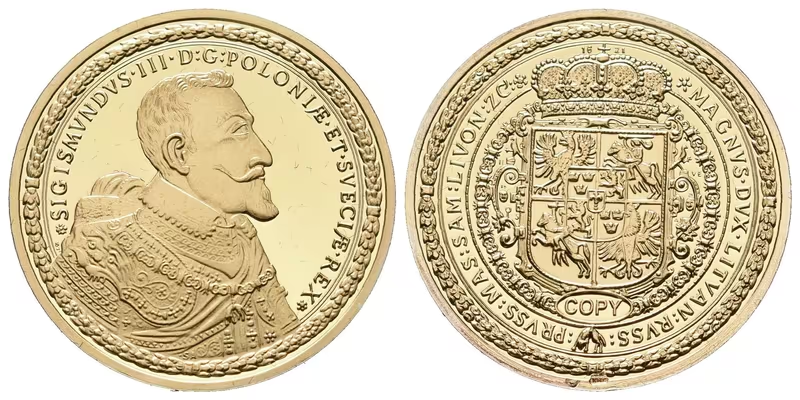
Polsko, Taler - Zikmund III. Vasa, polský a švédský král - portrét a královský erb, replika
Polské království (1587-1632) Taler - Zikmund III. Vasa, polský a švédský král - portrét a královský erb Ag (.925), 25 mm (10 g), BU, v kapsli. Stav mince odpovídá fotografii. Jedná se o druhotný prodej. (Možná oxidace, atd.. ! - VIZ FOTOGRAFIE !)
Skladem 1 ks - Code: SPOL-C1917F
Polsko, 10 Fenig 1917 (Fe)
Polsko, Regentské království Polské, 1916 - 1918 10 Fenigów 1918 F, KM.6, patina, pěkná zachovalost, zbytky lesku
Skladem 1 ks - Code: SPOL91-G1661
Polsko, 6 Groš 1661 GBA
Polsko, Jan II. Kazimír, 1648 - 1668 6 Groš 1661 GBA, Lvov, KM.91, oxidace V druhé polovině 17. století dochází k "zaplevelení" oběhu v Německu, Českém království a Slezsku nekvalitní Polskou drobnou mincí. Nechvalně známé byly především polské trojáky…
Skladem 1 ks - Code: SPOL-B1917F
Polsko, 20 Fenig 1917 (Fe)
Polsko, Regentské království Polské, 1916 - 1918 20 Fenigów 1917 F, KM.7, patina