John III Sobieski
John III Sobieski was the Polish king who reigned from 1674 to 1696, a celebrated military commander and saviour of Christian Europe from Ottoman expansion, who decided the Battle of Vienna in 1683. On Polish and European coins he appears as a symbol of victory over the Turks, while his thaler strikes and ducats belong among the most sought-after numismat…
Jan Sobieski was born on 17 August 1629 at Olesko Castle in present-day Ukraine into a noble family of the middle nobility. His father Jakub Sobieski was castellan of Kraków, and his mother Teofila Sobieska came from the Daniłowicz family. The young Jan received an excellent education at the Jagiellonian University in Kraków, where he studied philosophy and mathematics, later continuing his studies in Western Europe. During his Grand Tour he visited France, England and the Netherlands, where he became acquainted with modern military art and fortifications. After his return to Poland he began his military career at the time of the gravest trials of the Polish-Lithuanian Commonwealth, when the country faced invasions by the Swedes, Russians, Cossacks and Tatars.
Sobieski won military fame during the Polish-Ottoman Wars, in which he proved himself a brilliant strategist and cavalry commander. His finest hour came in the Battle of Chocim in November 1673, where at the head of the Polish army he crushingly defeated the Ottoman army. This victory opened the way to the Polish throne for him — after the death of King Michael Korybut Wiśniowiecki he was elected King of Poland on 21 May 1674. His election was supported by the middle nobility and by French diplomacy, which saw in him an opponent of Habsburg influence. The coronation took place on 2 February 1676 in Kraków Cathedral on Wawel Hill, where he took the name John III.
History
The pinnacle of Sobieski's career as a sovereign was the rescue of Vienna from the Ottoman siege in 1683. When the Grand Vizier Kara Mustafa besieged the imperial capital with an army numbering over one hundred thousand men, the Emperor Leopold I of Habsburg fled, and the desperate situation demanded immediate help. John III Sobieski concluded an alliance with the Emperor and at the head of a Polish-Lithuanian army of twenty thousand men set out to the aid of Vienna. On 12 September 1683 he personally led the decisive charge of the heavy cavalry hussars from the Kahlenberg, which scattered the Ottoman army and definitively ended Turkish expansion into Central Europe. After the victory he wrote to his wife Marie Casimire the famous words paraphrasing Julius Caesar: "We came, we saw, God conquered".
The last years of Sobieski's rule were marked by internal conflicts in Poland, unsuccessful attempts to strengthen royal power and dynastic ambitions for his sons. The economic situation of the country deteriorated, and the opposition of the magnates blocked his reform efforts. The king suffered from health problems caused by obesity and gout, which in the last years of his life almost immobilised him. John III Sobieski died on 17 June 1696 at Wilanów near Warsaw at the age of sixty-six, leaving behind a Poland weakened but still a significant European power.
Coinage and numismatic legacy
The coin production under the reign of John III Sobieski reflected both the economic problems of Poland and the effort at representation of royal power. The main mints in Kraków, Bydgoszcz and Lviv struck gold ducats with the king's bust and the Polish eagle, which today belong among rare collector pieces. Silver strikes included thalers, half-thalers, orts and six-groschen pieces depicting the sovereign in a wig in the French fashion and with the Latin inscription IOANNES III D G REX POLONIAE. The quality of the strikes gradually declined due to the shortage of precious metals and the fiscal problems of the state.
The most precious numismatic memorials are the medals struck in honour of the victory at Vienna, which were produced not only in Poland but also at Habsburg and papal mints. These medals depict Sobieski as the saviour of Christendom with inscriptions celebrating the defeat of the Turks. Of interest are also the private strikes of the Gdańsk patricians, who produced representative thalers with Sobieski's portrait for diplomatic gifts.
In our auction and shop
- Code: SPOL-A1933.1
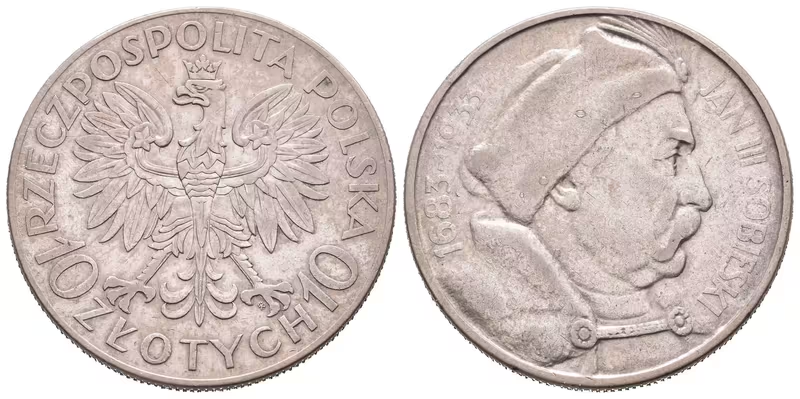
Polsko, 10 Zlotých 1933 - Jan Sobieski
Polsko, II. republika, 1918 - 1939 10 Zlotých 1933 - Jan III. Sobieski, KM.23, vyraženo 300 000 ks, patina, rysky jinak pěkná zachovalost
Skladem 1 ks - Code: SPOL-A1933
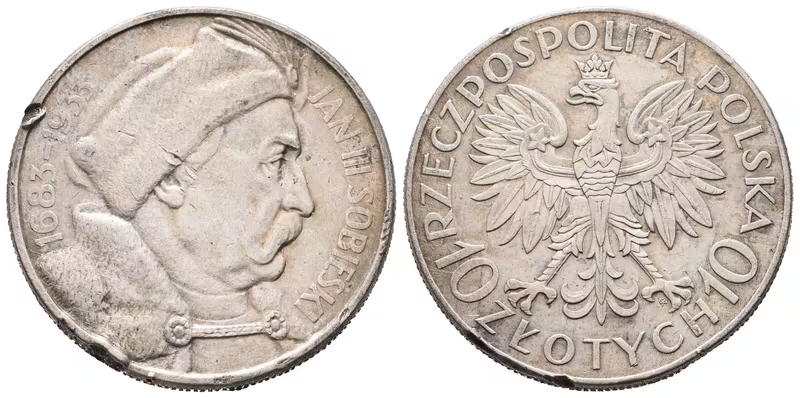
Polsko, 10 Zlotých 1933 - Jan Sobieski
Polsko, II. republika, 1918 - 1939 10 Zlotých 1933 - Jan III. Sobieski, KM.23, vyraženo 300 000 ks, zbytky lesku, patina, rysky a drobné hranky
Skladem 1 ks - Code: MEPOL91N2010