Poltura
The poltura is a small coin used in Central and Eastern Europe, whose name derives from the meaning "one and a half" and originally denoted a value of 1½ groschens. In Habsburg Hungary the poltura was struck from the end of the 17th century as a small circulation denomination for everyday payments.
The poltura has its linguistic and numismatic origin in the Polish environment. The name is related to the Polish word półtora ("one and a half") and in coinage became established for a coin of the value of 1½ groschens, which appeared in the Polish-Lithuanian state in the early modern period. In common parlance the designation półtorak was also used for this denomination. Such coins were important above all because they filled the "intermediate value" between small and higher silver denominations and simplified counting in everyday circulation.
Since trade and monetary relations in Central Europe were strongly intertwined, the name poltura gradually spread also beyond Poland. In the Habsburg lands the term took root above all in Hungary, where from the end of the 17th century it was used for small strikes tied to the local monetary practice. From 1695 coins designated as polturas were struck in Hungary, which are interpreted in their period context as a half of the "three-kreuzer" value, that is, a denomination standing on the border between small and middling circulation. At this time small coins were key for markets, crafts and small-change payments, where larger silver pieces were used less often.
History
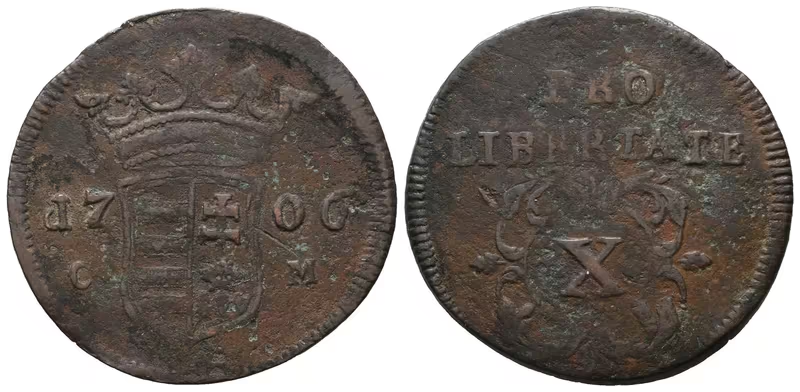
A more distinctive chapter of the Hungarian polturas is formed by the strikes connected with the anti-Habsburg uprising led by Francis II Rákóczi at the beginning of the 18th century. In 1703–1711 a series of small, generally less valuable coins arose, which were to ensure circulation under extraordinary wartime and administrative conditions. In such periods the pressure for rapid production of currency was usually great: the state or the insurgent administration needed to pay the army, supplies and routine operations, while quality precious metal might be lacking. For this reason, with small denominations we more often encounter less noble materials and simpler execution than with representative silver and gold strikes.
The poltura thus illustrates well how the names of coins "migrate" between countries and how their specific meaning can shift slightly according to the local monetary system. Whereas in the Polish context it denotes above all a coin of the value of 1½ groschens, in the Hungarian environment the poltura is firmly associated with the small currency of the late 17th and early 18th century. For numismatics this denomination is interesting also in that we find it both in ordinary circulation and in issues arising under extraordinary political conditions, where coins often serve as a direct imprint of the contemporary need to "have something to pay with".
Value, appearance and use in circulation
Polturas belonged to the small coins intended for everyday payments: purchases at the market, wages in small amounts, fees and ordinary services. Their main purpose was practical — to permit more precise change-giving than the lowest denominations alone provided, while remaining small enough and accessible enough. With strikes of this kind it is usual for both the fineness and the metal composition to change over time according to the availability of raw material and how strictly the minting standard was enforced.
The appearance of polturas differs according to issuer and period, but typically they bear royal monograms, crowns, value marks or simple heraldic motifs, which were legible on small coins even at a smaller diameter. With issues struck in years of crisis, a coarser style, fluctuations in the quality of flans and sometimes more marked differences between individual pieces may appear. In describing a poltura it is therefore important to state not only the name but also the specific country, year (or period) and the link to the monetary system, since precisely these details determine how a poltura is to be properly classified and valued.
In our auction and shop
- Code: SPOL89-C1616
Polsko, Poltorák 1616, Krakov
Polsko, Zikmund III. Vasa, 1587 - 1632 Półtorak (3 Polker, Brummer) 1616, minc. Krakow (W), Kop.842, zbytky lesku
Skladem 1 ks - Code: M74FAW1706A