Kingdom of Portugal
The Kingdom of Portugal was a historical state in the south-west of the Iberian Peninsula, which became independent of León in the 12th century and gradually completed the Reconquista on the territory of present-day Portugal. In the modern period it became renowned for its overseas discoveries and colonial empire; the monarchy came to an end in 1910.
The roots of the Kingdom of Portugal reach back to the period of Christian expansion on the Iberian Peninsula. Out of the original County of Portucale, which was part of the wider political framework of the Christian states of the north, an independent kingdom gradually evolved. The founder is traditionally regarded as Afonso I of Portugal, who in the course of the 12th century consolidated his power and pressed for independence. At this time also the institutions and nobility were taking shape that would share in the administration of the country, and Christian settlement was pushing the frontier further to the south.
Medieval Portugal was firmly bound up with the process of the Reconquista, that is, the gradual conquest of territory from Muslim control. The completion of this process on the territory of present-day Portugal gave the kingdom more stable borders and allowed it to concentrate on internal administration, trade and relations with its neighbours. Portugal retained a specific political identity also thanks to its geography: the Atlantic was a natural "open gateway" to the sea and at the same time an important source of livelihood and contacts.
A fundamental turning point came at the transition between the Middle Ages and the modern period, when Portugal became one of the main drivers of European maritime expansion. In the 15th and 16th centuries sea routes were established along the African coast and into the Indian Ocean, later also to America. Overseas enterprise meant not only prestige but also an influx of wealth and the emergence of extensive trade networks. It was precisely at this time that Portuguese state power and economy rested on the control of strategic points and on trade in precious goods, which made Portugal a significant European power.
History
Internal development, however, was not without upheaval. At the end of the 16th century the Kingdom of Portugal found itself in a personal union with Spain (the so-called Iberian Union), which changed its position in Europe as well as overseas. Although Portugal in some respects preserved its own institutions, the period of shared dynastic rule was perceived as a weakening of independence and exposed Portuguese holdings to the pressure of rivals. In the mid-17th century Portugal regained its independence and the Braganza dynasty came to the throne, which rested on the restoration of state sovereignty and on the reorganisation of power.
From the 18th century the country grappled with the transformations of European politics, with economic challenges and with the need to modernise its administration. In the 19th century liberalising and constitutional tendencies grew stronger, leading to the restriction of absolute power and to a gradual transition to a constitutional monarchy. At the same time the relationship of the metropolis to its overseas possessions was changing, and questions of colonialism, trade and national identity came to the fore. At the beginning of the 20th century long-standing political and social tensions culminated in the fall of the monarchy and the proclamation of the republic in 1910, with which the Kingdom of Portugal as a form of state came to an end.
The Kingdom of Portugal had strong dynastic and state symbolism, which was reflected in coats of arms, seals, the representation of rulers and also in coinage. Coins were in the pre-modern period among the most effective means of spreading the authority of the state: they bore the name and title of the ruler, heraldic elements and religious or ideological motifs. In the Portuguese environment silver and gold strikes were long employed, intended both for internal circulation and for commercial dealings, which, given the Atlantic connections, were of exceptional importance.
State, symbolism and the context of coins
In practice, for historical Portuguese coins one looks above all at the period from which they come (the Middle Ages, the era of overseas discoveries, the time of the constitutional monarchy), what their denomination and metal are, and what royal or state emblems they bear. The inscription, the type of crown, the form of the shield and the overall artistic execution, which changed over time along with political and cultural trends, are also essential for identification. With strikes connected to overseas trade their wider circulation and role in international payments are often emphasised in addition.
As a historical term the Kingdom of Portugal is used in history, in political geography and in numismatics chiefly to distinguish the monarchical period from the later republic. In the context of coins and medals it is a useful designation, since it helps quickly to place a strike in the proper state framework — that is, in the time when the legitimacy and image of the state were closely tied to the person of the ruler and to dynastic emblems.
In our auction and shop
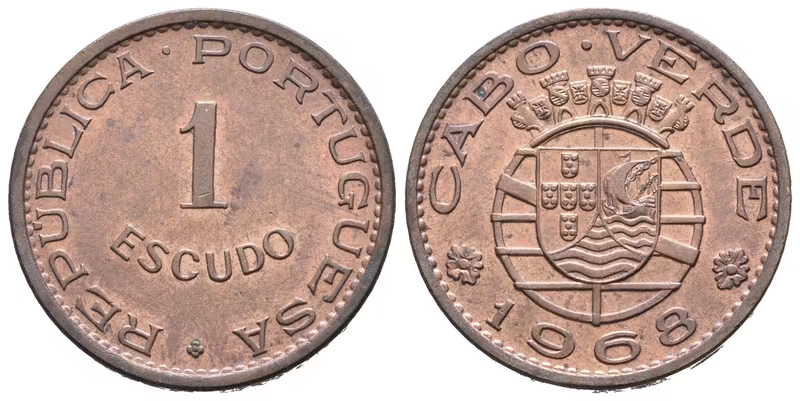
- Code: SPORTKA-E1968
Kapverdské ostrovy, 1 Escudo 1968
Portugalské Kapverdské ostrovy, republika (1910 - 1975) 1 Escudo 1968, KM.8, krásná zachovalost, lesk, patina
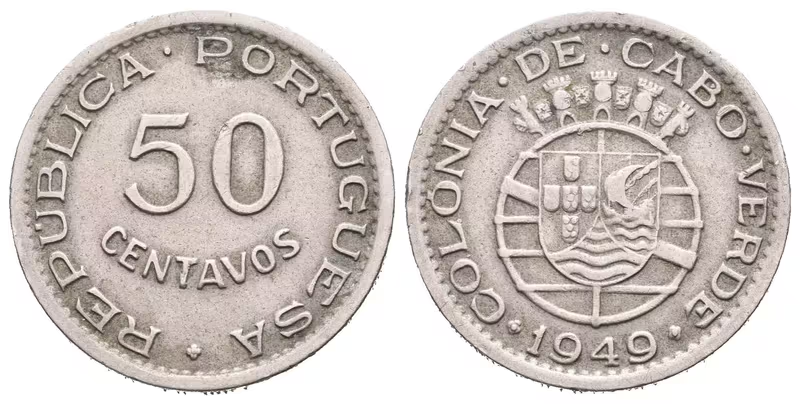
Skladem 1 ks - Code: SPORTKA-F1949
Kapverdské ostrovy, 50 Centavo 1949
Portugalské Kapverdské ostrovy, republika (1910 - 1975) 50 Centavos 1949, KM.6, patina, drobné rysky
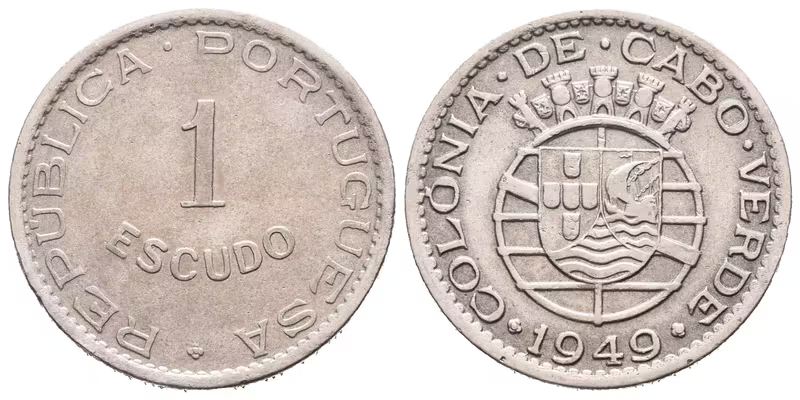
Skladem 2 ks - Code: SPORTKA-E1949
Kapverdské ostrovy, 1 Escudo 1949
Portugalské Kapverdské ostrovy, republika (1910 - 1975) 1 Escudo 1949, KM.82, pěkná zachovalost, patina, drobné rysky
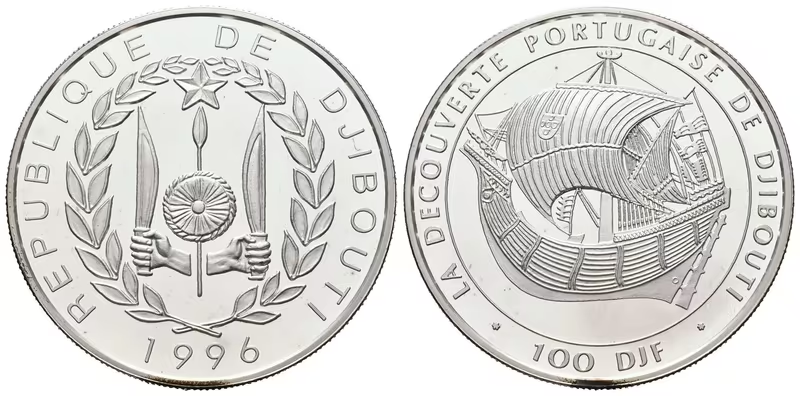
Skladem 1 ks - Code: SDJI-D1996
Džibutsko, 100 Franků 1996 - Portugalská karavela Nao, námořní objev Džibutska
Džibutská republika (1977-dosud) 100 Franků 1996 - Portugalská karavela Nao, námořní objev Džibutska, KM# 33 Ag (.925), 38,6 mm (31,47 g), v kapsli. Stav mince odpovídá fotografii. Jedná se o druhotný prodej. (Možná oxidace, atd.. ! - VIZ FOTOGRAFIE !)
Skladem 1 ks