Proof
Proof is a premium method of striking coins distinguished by the highest quality of finish, typically with a polished mirror field and a contrasting matt relief. It is not a particular "type of coin" defined by metal or denomination, but a production technology and resulting appearance intended chiefly for collector issues.
The technique of proof striking arose from the need to produce coins with an exceptionally clean and representative appearance. Already in earlier periods of minting, particularly careful strikings appeared, for example for control purposes, as royal gifts or as pattern pieces. The actual "proof" in today's sense, however, is linked to the development of modern minting technology, when dies and procedures began to be deliberately adjusted so that the coin had a maximally smooth field, sharp details and uniform quality across the whole issue.
In the 19th century proof strikings became a regular part of the production of certain significant mints, particularly where there was a demand for presentation sets of coins. These sets served not only as a showcase of the mint's mastery, but also as a collector's article for the wider public. Coin collecting gradually changed from a purely specialist hobby into a more accessible field, and proof strikings became a symbol of the "highest" quality that could officially be acquired.
In the 20th century the importance of proof finish grew further. Mints began to use proof primarily for commemorative and anniversary issues, where it was expected that the coin would not serve in circulation but would be kept in a case or capsule. Proof gradually became a standard term of numismatics: it denotes a technology that places emphasis on the perfection of the surface and on the visual contrast between the mirror field and the matt relief. At the same time other premium finishes spread, standing between ordinary striking and proof (for example various types of "brilliant uncirculated" or satin finishes), so that mints could offer more price and quality tiers.
History
Today proof finish is associated mainly with the collector market. Mints use it as the top variant of a given issue, often with a lower mintage and with emphasis on presentation. What may once have served as a pattern piece or representative set has thus in modern times become a separate and highly valued category of strikings, in which not only the motif and the metal but also the perfection of the surface and the absence of production flaws are assessed.
Proof coins are produced significantly more carefully than ordinary circulation strikings. The basis is the preparation of the dies: polishing of the field surfaces, deliberate matting of the relief and inspection of details, so that the result is the typical contrast. The preparation of the planchets (metal discs) is also important — they must be clean, without scratches, and they are often treated before striking so that the surface is as smooth as possible. The striking itself is usually carried out under higher pressure and often with a repeated blow, so that the details are sharp and the relief is "full".
The result is a coin with a mirror field and a matt relief, looking three-dimensional and highly contrasting. With proof coins, however, even minor blemishes are easily revealed: fingerprints, hairline scratches or microscopic abrasions can be markedly visible on the mirror field. For this reason proof coins are usually packaged directly at the mint in capsules and cases, and handling without protection is considered inappropriate. In descriptions, proof is given as a quality of striking, not as a circulation grade — a proof coin may be new and have not circulated, yet its surface may nonetheless have been damaged by improper handling.
How proof is produced and how it is recognised
In practice one may also encounter terms that resemble proof but are not identical: for example "prooflike" denotes coins with a markedly shiny field which, however, did not arise through classical proof technology. The distinction is important particularly with more expensive collector issues, where a difference in finish may mean a significant difference in price.
In our auction and shop
- Code: MCZ107-PROOFBack in stock−7 %
200 Kč 2016 - Bitva u Hradce Králové, PROOF
Česká republika (1993 - ) 200 Koruna 2016 - 150. výročí bitvy u Hradce Králové, autor Roman Shamilyan, Aurea C207, etue, certifikát, PROOF Ag 0,925, 31 mm (13 g), raženo 5 275 ks (běžná kvalita), 10 000 ks (proof)
Skladem 1 ks - Code: MC195-PROOF2
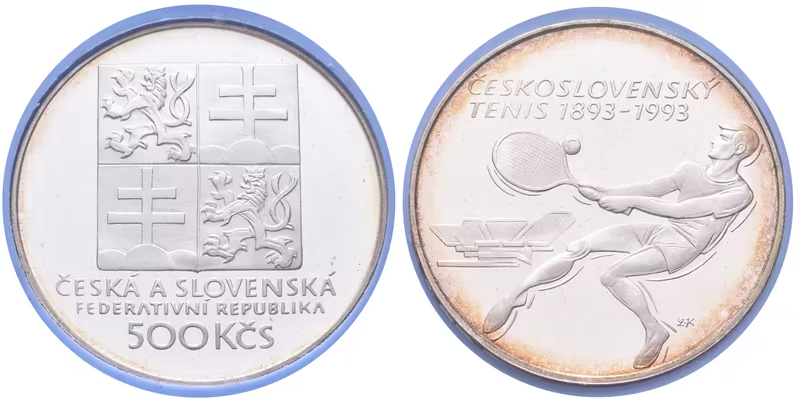
500 Kčs 1993 - Československý tenis PROOF
Československo (1953 - 1993) 500 Koruna 1993 - 100. výročí založení prvního tenisového klubu, autor Ladislav Kozák, Aurea 195, PROOF Ag 0,900, 40 mm (24 g), raženo 29 884 ks (běžná kvalita), 1 162 ks (proof) původní plastová kapsle, patina v ploše - viz…
Skladem 1 ks - Code: MC195-PROOF
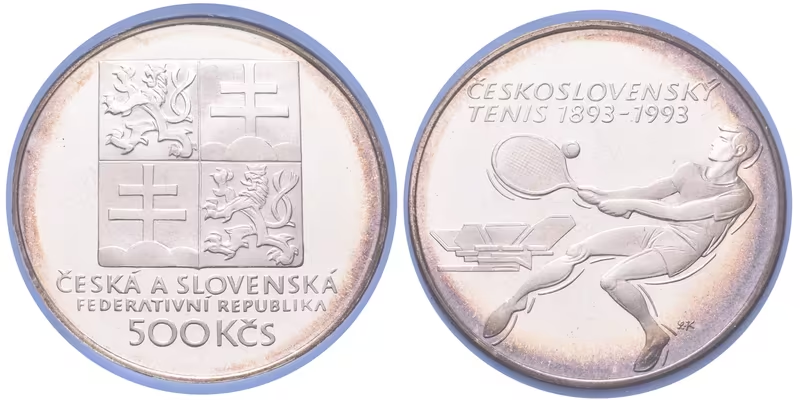
500 Kčs 1993 - Československý tenis PROOF
Československo (1953 - 1993) 500 Koruna 1993 - 100. výročí založení prvního tenisového klubu, autor Ladislav Kozák, Aurea 195, PROOF Ag 0,900, 40 mm (24 g), raženo 29 884 ks (běžná kvalita), 1 162 ks (proof) původní plastová kapsle, patina v ploše - viz…
Skladem 1 ks - Code: MC192-PROOF4
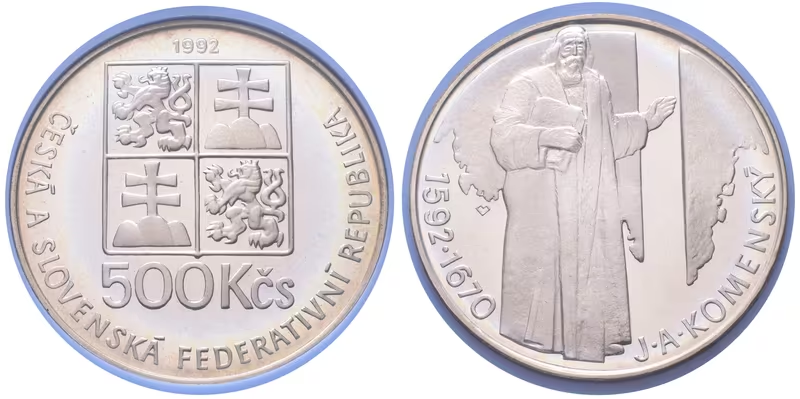
500 Kčs 1992 - Jan Ámos Komenský PROOF
Československo (1953 - 1993) 500 Koruna 1992 - 500. výročí narození Jana Ámose Komenského, autor Michal Vitanovský, Aurea 192, PROOF Ag 0,700, 40 mm (24 g), raženo 41 656 ks (běžná kvalita), 3 347 ks (proof) původní plastová kapsle, patina v ploše - viz…
Skladem 1 ks