Reverse proof
Reverse proof is a special quality of strike for collector coins in which the contrast between the fields and the relief is reversed compared with the classic proof: the design is mirror-bright and the background has a matte, subtly velvety appearance. It is used mainly for limited issues.
Reverse proof belongs to the group of modern techniques that build on the traditional proof strike intended for collectors. The classic proof emerged as a way to produce representative coins with exceptionally sharp detail and pronounced contrast: typically with a mirror-bright background and matte relief. In the past, proofs were also used as "specimen" pieces for quality control and the presentation of mint output; gradually, however, proof became primarily a collector standard. With the development of the collector market in the 20th century, mints refined the surface treatment of dies and planchets and began offering more surface variants of the same coin.
It was in this environment that the idea of reversed contrast took hold. Reverse proof does not represent a new denomination or a separate monetary unit, but rather a deliberate variant of surface finish. The purpose was to offer collectors a different visual effect while preserving the top-tier workmanship typical of proof. By reversing the contrast - that is, by making the relief bright and the background matte - the design is emphasised in a different way: the gloss is concentrated on the most important elements and the background appears calmer, which aids the legibility of the details. This effect works particularly well on coins with rich relief, fine engraving, and larger smooth fields, where the difference between gloss and matte is readily apparent.
The spread of reverse proof is also linked to the fact that modern mints have begun to treat concepts of strike quality as a "product". Alongside circulation coins and ordinary commemorative issues, a broad segment of collector strikes has emerged, where not only the motif but also the surface, packaging, and limited mintage play a role. Reverse proof therefore often appears on anniversary sets, jubilee coins, and special editions. In some cases it is used as one of several variants within a single series, in order to distinguish individual years or to create an "exceptional" piece for a particular anniversary.
History
Technologically, reverse proof is made possible by more advanced control of the surfaces of dies and planchets. Where previously the boundary between gloss and matte was rather a by-product of manual polishing and sandblasting, today the surfaces are prepared deliberately and reproducibly. Mints can thus produce strikes with a very stable appearance across an entire series. At the same time, it should be noted that reverse proof is sensitive to handling: the polished relief easily picks up fine hairline scratches, and the matte background may, conversely, "accept" pressure marks if the coin is not handled correctly. For this reason, reverse proofs are usually distributed in capsules and with an emphasis on protective packaging.
In numismatics, reverse proof has become established as a fixed term for a collector quality, not as a designation of a particular country or period. Its meaning is therefore primarily aesthetic and technological: it describes how the contrast of surfaces was achieved, and thus the character of the resulting coin. In practice, reverse proof has become one of the most sought-after effects of modern coin production, because it combines a high level of workmanship with a distinctive, immediately recognisable difference from the classic proof.
The basic feature of reverse proof is the reversed handling of surfaces. On a standard proof, the background is usually mirror-like and the relief matte; on a reverse proof it is the opposite: the relief is mirror-bright and the background has a matte, subtly structured finish. This structure may appear "velvety" or finely grainy, depending on how the die surface was prepared. The result is often very photogenic, but at the same time demanding in terms of lighting - the contrast comes out best under oblique light.
Appearance, technology and how to recognise a reverse proof
Technologically, reverse proof usually requires carefully prepared planchets and multi-strike production, similar to a proof. The difference lies primarily in the surface treatment of the dies: the parts that are to create the matte background are deliberately structured, while the parts for the polished relief are buffed to a mirror finish. The cleanliness of the process is also important, because any impurity or minor defect shows up more markedly on such contrasting surfaces than on an ordinary strike.
Reverse proof is best recognised by changing the angle of view. The polished relief "catches" reflections and behaves like a smooth metallic surface, while the background remains visually calm and diffuses the light. In catalogue descriptions, reverse proof is usually listed as a separate quality of strike and often has a different mintage than the standard proof or ordinary strike. As regards care, the coin should not be touched with the fingers: the polished areas are sensitive to hairlines and the matte fields can pick up fingerprints, which then disturb the overall effect.
In our auction and shop
- Code: ZD-3014DIV
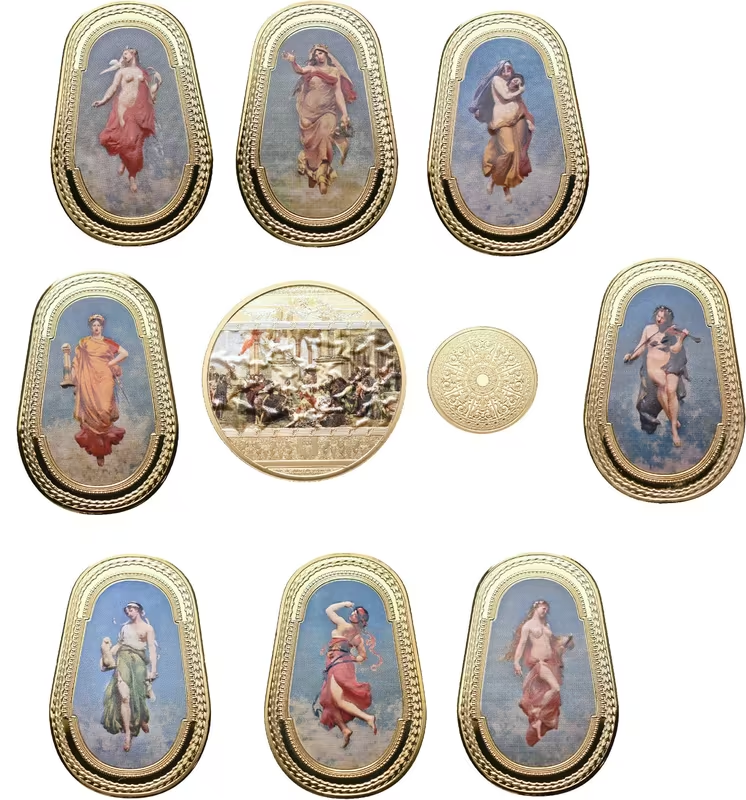
Soubor medailí Národní divadlo
Česká republika (1993 - ) Soubor medailí b.l. - Opona Národního divadla Au 0,585, 18 mm (2 g), PROOF Zlacené a kolorované Cu-Ni 33 mm (15,5 g), PROOF 8x Zlacené a kolorované Cu 26x40 mm (16,7 g), PROOF ke každé medaili je certifikát, vše uloženo v…
Skladem 1 ks - Code: ZD-3014MUCHA
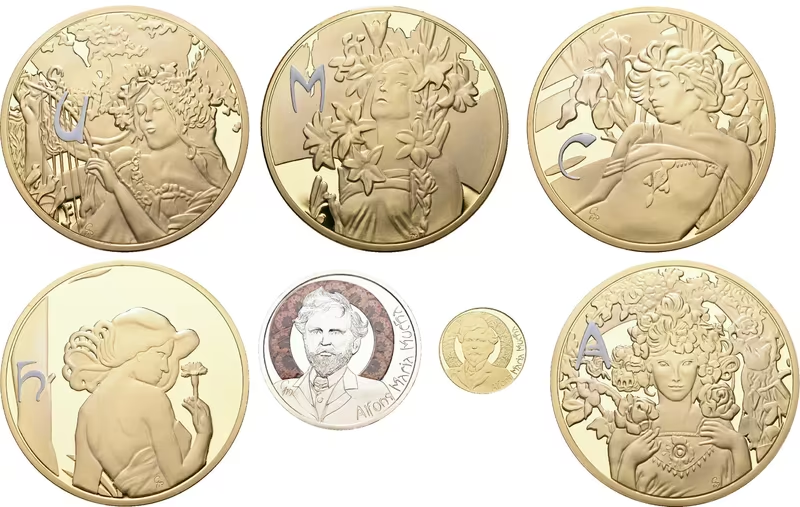
Soubor medailí Alfons Mucha
Česká republika (1993 - ) Soubor medailí b.l. - Ikonická díla secesního mistra Alfonse Muchy Au 0,999, 18 mm (1,2 g), PROOF Cu-Ni 33 mm (15 g), PROOF 5x Pozlacené Cu 50 mm (49,4 g), PROOF ke každé medaili je certifikát, vše uloženo v kartonovém albu,…
Skladem 1 ks - Code: ZSTOG-2007
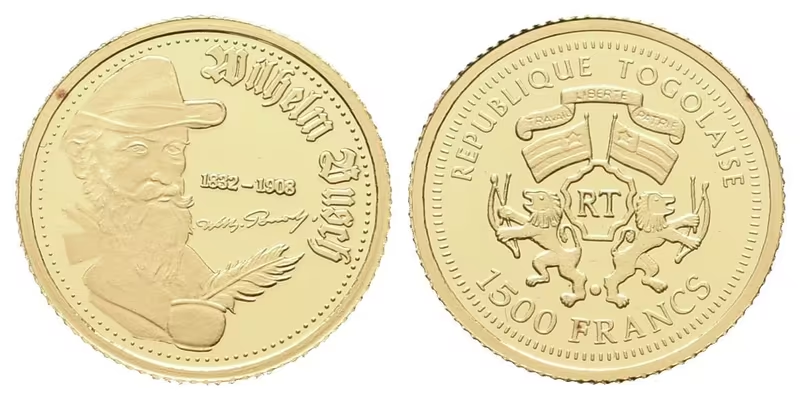
Togo, 1500 Francs 2007 - Wilhelm Busch
Togo 1500 Franků 2007 - Wilhelm Busch Au 0,999, 13,92 mm (1,00 g), PROOF, certifikát Z cyklu Nejmenší zlaté mince světa
Skladem 1 ks - Code: ZSPAL-2010
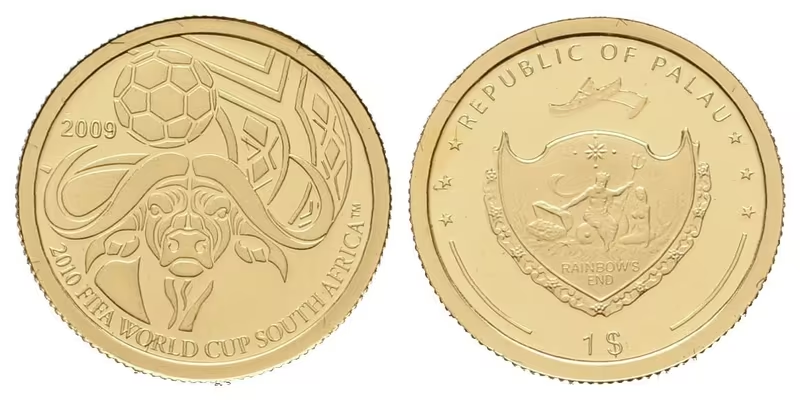
Palau, 1 Dollar 2009 - Mistrovství světa ve fotbale 2010
Palau 1 Dolar 2009 - Mistrovství světa ve fotbale Au 0,999, 13,92 mm (1,00 g), PROOF, certifikát Z cyklu Nejmenší zlaté mince světa
Skladem 1 ks