Kingdom of Scotland
The Kingdom of Scotland was a northern British state existing from 843 to 1707, which arose from the unification of the Pictish and Scottish tribes under the rule of Kenneth MacAlpin and developed into an independent kingdom defending its freedom against English expansion. The Kingdom of Scotland is significant in numismatics for its distinctive coins fea…
The Kingdom of Scotland was formed in 843 by the unification of the Pictish tribes of northern Scotland with the Dalriadan Scots of the Argyll region under the rule of Kenneth I MacAlpin. Kenneth used dynastic claims and military force to take over the Pictish kingdom and founded the MacAlpin dynasty, which ruled Scotland for several centuries. This unification laid the foundations of Scottish national identity and independence, which endured into modern times.
The early Scottish kings gradually extended their dominion southwards at the expense of the Anglo-Saxon kingdom of Northumbria. Malcolm III Canmore (1058–1093) led numerous raids into northern England and married St Margaret, sister of the Anglo-Saxon prince Edgar. Through this marriage the Scottish royal court became Anglicised and adopted western European Christian traditions, without losing its Scottish distinctiveness.
The 12th and 13th centuries brought the feudalisation of Scotland under the Davidian dynasty. David I (1124–1153) introduced the feudal system, invited Norman nobles and founded royal burghs (towns). The Alexanders continued to build a centralised monarchy on the English and French model. Scotland became a fully fledged European kingdom with a developed administration, legal system and church organisation.
A great crisis came in 1286 with the death of Alexander III without a male heir. The succession crisis led to the intervention of the English king Edward I, who proclaimed himself overlord of Scotland. William Wallace and later Robert Bruce led the Scottish struggle for liberation, which culminated in the victory at Bannockburn in 1314. Robert I Bruce became the hero of Scottish independence, and his victory secured Scotland's freedom for another four centuries.
History
The Stuart dynasty (1371–1707) ruled Scotland throughout the late Middle Ages and the early modern period. Robert II founded the dynasty that linked Scotland with continental Europe through the "Auld Alliance" with France against the common English enemy. James IV and James V fostered Renaissance culture and art, but their successor Mary Queen of Scots became entangled in conspiracies that cost her both throne and life.
A fundamental change came in 1603, when James VI of Scotland also became James I of England and united the two crowns in a personal union. Scotland nevertheless retained its own parliament, church, legal system and administration. Cromwell's republic temporarily annexed Scotland, but the restoration of the Stuarts in 1660 restored the country's autonomy.
The last century of Scottish independence was marked by religious and political conflicts. Scottish Presbyterians resisted English Anglicanism, the Darién colonists failed in Panama, and economic problems weakened the country. The Act of Union of 1707 marked the end of the independent Kingdom of Scotland and the formation of the Kingdom of Great Britain.
Scottish culture and tradition, however, survived political union. The Jacobite risings of the 18th century sought to restore independence but were unsuccessful. The Scottish Enlightenment in Edinburgh produced figures of world stature such as David Hume and Adam Smith. Modern Scotland retains a strong national identity, and from 1999 has had its own parliament with broad autonomy.
Scottish royal coinage
Scottish coinage began relatively late in comparison with other European kingdoms. The first Scottish coins were struck by David I around 1136 in his burghs on the Anglo-Saxon model. These early coins were silver pennies with the king's name and simple symbols. Quality was initially uneven but gradually improved with the arrival of experienced craftsmen from England and the Continent.
Under the reigns of Alexander III and Robert Bruce a distinctive Scottish coinage system developed with typical motifs. The coins featured the Scottish lion, the royal sword, lilies and the cross. Most famous are the silver groats of Robert I bearing the inscription "ROBERTUS DEI GRA REX SCOTORUM" (Robert by the Grace of God King of Scots), which symbolised Scottish independence and sovereignty after the victory over England.
The Stuart period brought an expansion of denominations and an improvement in coin quality. James III introduced gold coins – the unicorn and the lion – which competed with English and European gold coins. Mary Queen of Scots struck beautiful portrait coins with her own likeness, which were among the finest Renaissance coins of their time. Scottish coins of this era often showed French influences thanks to the "Auld Alliance".
After the personal union with England in 1603, Scotland struck its own versions of English coins combining English and Scottish symbols. These "Anglo-Scottish" coins bore English motifs on one side and Scottish symbols such as the thistle or the Scottish lion on the other. After the Union of 1707 independent Scottish coinage ceased and unified British coins were introduced.
In our auction and shop
- Code: SVEL90-S2010STO
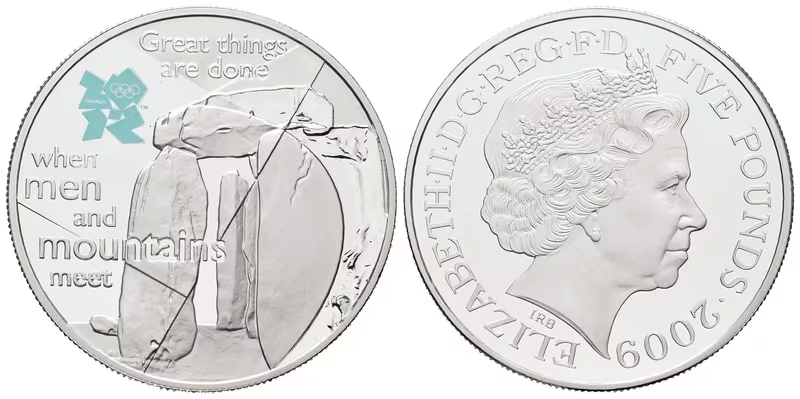
Velká Británie, 5 liber 2009 OH Londýn - Stonehenge
Velká Británie, Elizabeth II. (1952 - 2024) 5 britských liber 2010 - Stonehenge Ag 0,925, 38,61 mm (28,28 g), certifikát, PROOF Velká Británie, neboli Spojené království Velké Británie a Severního Irska (ang. United Kingdom of Great Britain and Northern…